

A homeowner picks up their phone, types “builder near me” into Google, and three profiles appear in the Map Pack. They tap the first one that looks credible, read a handful of reviews, and make a call. The builder they ring isn’t necessarily the best in the area, they’re just the one who showed up. Local SEO for builders determines which profiles appear in that moment, and many users rarely click past those three Map Pack results. That single moment, repeated frequently across towns and cities throughout the UK, is exactly the moment local search optimisation is built to capture.
At This Video Works, we’ve worked through this process for Property Consultants, Surveyors, Builders, Construction Firms and Ground Works specialists, across the West Midlands and the Cotswolds: towns where these firms weren’t previously ranking, where their work was strong but their online visibility was weak. Fixing that came down to a set of repeatable steps, and none of them required a computer science degree. This article covers six of those steps as a practical checklist you can start working through today.
Why most builders are invisible online even when their work is excellent
Google’s local Map Pack shows three results above the standard organic listings. Many homeowners rarely look further than those three. If your business isn’t in that cluster for the search being made, you simply don’t exist in that transaction, regardless of how strong your portfolio is or how many successful projects sit behind you.
Google determines which businesses appear using three factors: relevance, distance, and prominence, the framework the search industry consistently uses to explain local ranking. Relevance is shaped by how completely and accurately your profile describes what you do. Distance is fixed by your location. Prominence is built over time through reviews, directory listings, and signals from your website. Once you understand these three levers, you stop treating your Google listing as a one-time setup task and start treating it as a live business asset.
The deeper issue is that many excellent builders rely almost entirely on word-of-mouth. That works well during busy periods, but it leaves the pipeline exposed when referrals dry up. Strong local search visibility, what some in the industry call construction SEO, fills that gap consistently, generating enquiries from homeowners who are actively looking for exactly what you offer, rather than waiting for a past client to mention your name.
Local SEO for builders: Google Business Profile best practice
Your primary category is the single strongest relevance signal in your Google Business Profile. Local SEO practitioners widely recognise it as the most influential field for Map Pack ranking. For builders, that means choosing the most specific category that matches your core trade. “Home Builder,” “Renovation Company,” or “General Contractor” will serve you far better than a broad label like “Contractor”, though it’s worth checking Google’s current category list for your market to confirm the exact label available to you. Secondary categories should be added only for services you genuinely provide.
Once your category is right, the next priority is your services list. Each real building service you offer should be listed individually so Google can match your profile to specific high-intent searches. A homeowner searching for “loft conversion specialist near me” and a homeowner searching for “heritage renovation builder” are two different people making two different searches. Your services list is what connects both of them to you.
Photos matter more than most builders realise. Finished project shots, before-and-after sequences, and team images all contribute to both engagement and trust. Businesses with photos consistently receive more direction requests and calls, you can see the difference in your own GBP insights within a few weeks of uploading regularly. For a builder, your photo library is your portfolio, and it should be updated after every project rather than set once and forgotten.
Weekly posts covering project updates, seasonal services, or local news signal to Google that the business is current and relevant, all else equal, a more active profile tends to outperform a dormant one. The Q&A section is often completely ignored by builders, or filled in by strangers. Pre-populate it with the questions you actually get asked during enquiry calls; as a best practice observed across the industry, it tends to improve conversion as well as visibility.
Local citations and trade directories that actually move the needle
A citation is any online mention of your business name, address, and phone number. When those details appear consistently across authoritative directories, Google gains confidence that your business is real, legitimate, and locally established. For UK builders, the tier-one general directories to prioritise are Yell, Thomson Local, Bing Places, and Apple Business Connect alongside your Google Business Profile.
Trade platforms carry additional weight that generic directories don’t. Checkatrade, TrustATrader, Rated People, and MyBuilder all carry topical relevance specifically for trades and construction, this is local citations for tradesmen working at its most effective. A listing on Checkatrade tells Google that your business genuinely operates in the building sector, not just that a website says so. These platforms also generate their own direct traffic, which means you get a ranking signal and a separate stream of enquiries from a single profile.
NAP consistency is the detail that ties all of this together. Your business name, address, and phone number must match exactly across every directory and platform you appear on. Even small discrepancies, an abbreviated street name, a phone number that changed three years ago, weaken every citation you’ve built. Audit existing listings and correct any inconsistencies before creating new ones.
Reviews: the ranking signal most builders are sitting on
The highest-converting review request combines a face-to-face ask at job sign-off with an SMS or WhatsApp message containing a direct Google review link, sent within 30 to 60 minutes of that conversation. This approach works because it catches the client when the completed work is still vivid and the ask feels personal rather than automated. The message should mention the specific job by name, and the link should take them directly to the review form in one tap.
The numbers behind this are worth knowing. According to Checkatrade’s own data, a single review can lift conversion rate by 26.9%, and businesses with 11 to 20 reviews can double their conversion rate compared to those with none. Businesses with a rating of 4.0 or above receive roughly 12 times more clicks than those below that threshold. These aren’t marginal gains; they represent a substantial commercial difference driven by a simple recurring habit.
Responding to reviews is equally important. Each response should acknowledge the specific job rather than using a generic template. A well-written response to a positive review reinforces trust and gives Google locally relevant text to read. For the rare negative review, a calm, factual response that offers to resolve the issue demonstrates professionalism to every future reader who sees it, which is ultimately more valuable than the review itself.
Service-area pages that drive local SEO for builders
If you work across multiple towns, a single homepage cannot rank for searches in each of them. Service-area pages solve this: each page targets one primary combination of service plus location, such as “loft conversions in Stratford-upon-Avon” or “house extensions in Cheltenham.” The H1, URL, title tag, and opening paragraph should all reflect that combination clearly and naturally.
The pages that rank are the ones that contain genuine local proof. Actual job photos from that postcode, references to local planning restrictions or conservation area considerations, and testimonials from named clients in that town all separate a strong service-area page from a templated one. Google identifies and effectively ignores pages where only the town name has been swapped in. Aim for 800 to 1,500 words of substantive, unique content on each page, though the right length will vary depending on how competitive that area is and how much local evidence you can include.
Schema markup is the technical layer that supports all of this. Use HomeAndConstructionBusiness schema on your homepage with accurate NAP details, your service areas listed under areaServed, and links to your social profiles. On each service page, add a Service schema block that names the service, describes it, lists the area it covers, and references the main business entity via the provider field. This helps Google connect individual pages to your business profile and understand what you offer where.
Measuring results and knowing when to bring in specialist support
Local search results take time to build, and the right way to track them is over 90-day periods rather than week to week. The three metrics that matter most are Google Business Profile insights (profile views, direction requests, and call clicks), Google Search Console data showing impressions and clicks for local queries, and website enquiry form submissions broken down by landing page. These three together give you a clear picture of whether the work is translating into real business.
For builders running a full site programme, maintaining consistent local SEO alongside the day job is a genuine challenge. Between new photos after every project, weekly profile posts, review requests at job completion, and citation updates when details change, the maintenance adds up quickly. Some builders build this into their routine and manage it well once the foundations are in place. Others find it more efficient to work with a specialist who already understands the construction sector.
That’s where some builders find it worth bringing in outside support, someone who already understands the difference between a snagging list and a specification, and doesn’t need educating on how the trade works. The team at This Video Works, handles Google Business Profile management, review strategy, citation building, and service-area pages as part of an integrated marketing programme built specifically for SEO for trades and construction companies. Start treating your online presence like a well-finished job
The checklist comes down to six repeatable actions: a complete, category-specific Google Business Profile; consistent citations across UK directories and trade platforms; a regular review request process after every job; well-structured service-area pages with genuine local proof; accurate schema markup connecting your pages to your business entity; and monthly tracking to confirm what’s working and where to focus next.
Local SEO for builders in the UK isn’t a technical mystery. It’s a set of tasks that compound over time, each one building on the last. The builders who appear consistently in the Map Pack aren’t necessarily the most skilled in their area. They’re the ones who applied the same care to their online presence that they apply to every job they take on.
If you want to improve local SEO for builders, start with your Google Business Profile today. Get the category right, fill out your services, and upload a few project photos. Then ask your next satisfied client for a review before you leave the site. The process is simpler than it looks, and the results are more durable than any single referral.
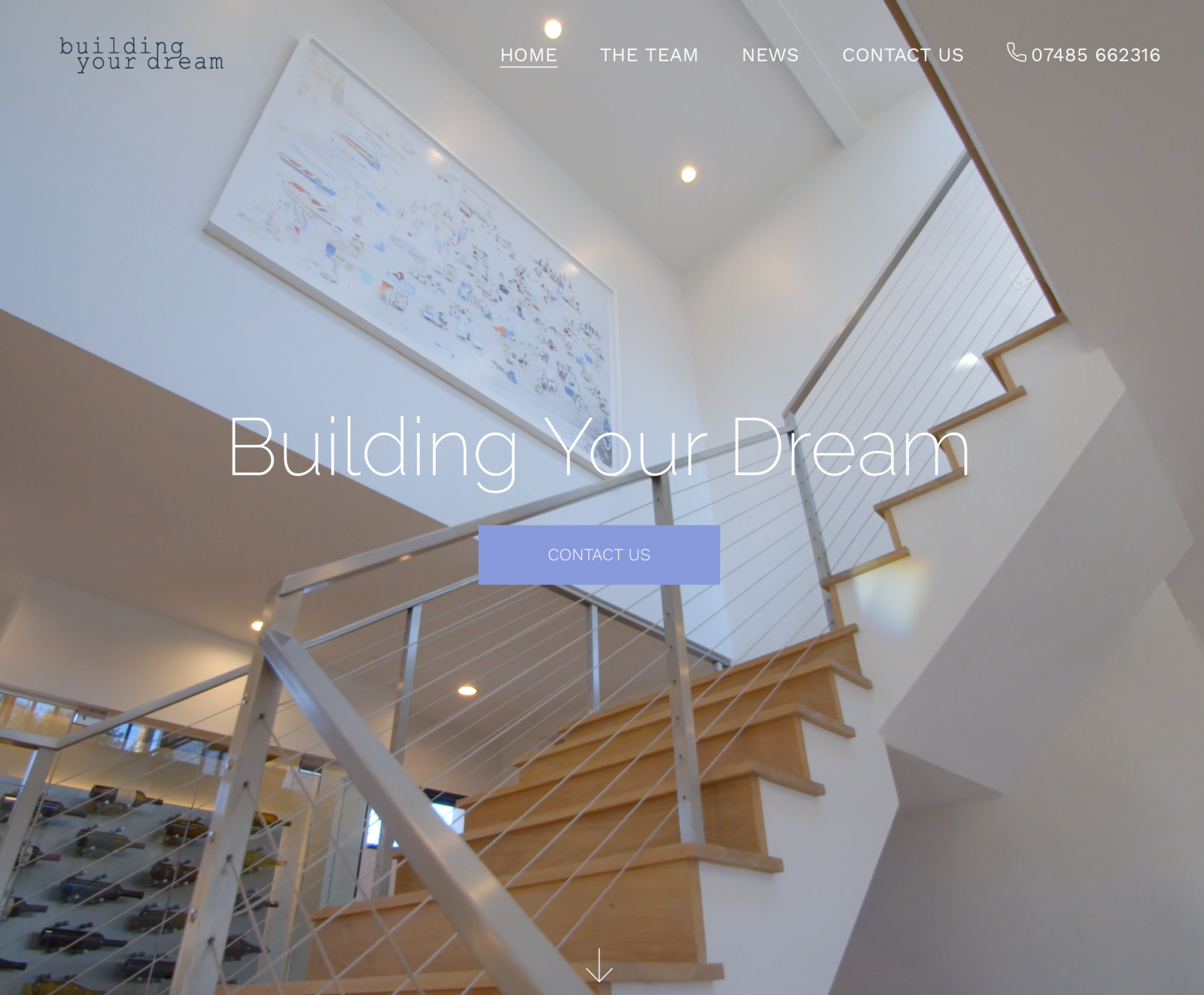
Our Building Your Dream demo site was created to show exactly how easily a sector-specific marketing site can be built and how it can use video to deliver additional impact.