
Search results look different in 2026. Google AI Overviews now summarise answers at the top of the page for a significant share of queries. Perplexity cites specific sources by name, and ChatGPT and similar large language models can recommend businesses directly in response to questions like “who should I use for X in London?” For most small UK businesses, this is invisible territory, not because they lack quality or expertise, but because AI systems cannot read their content in the way they need to.
The gap is largely technical and structural, which means it is fixable. This article covers the affordable AI SEO tools, the foundational requirements, and a practical 30-day plan to help your business start appearing where AI systems are looking. No technical degree required.
How AI search is changing the way customers find businesses
The shift from ten blue links to AI-generated answers has happened faster than most small business owners realise. Around 47% of UK desktop searches now trigger an AI Overview; across all device types and query categories, the figure averages around 33%. The businesses being cited in those overviews are capturing customer trust before anyone scrolls down to the organic results.
The businesses missing from those answers are simply invisible to the systems generating the summaries. Most UK SME websites lack the modern structured signals and schema markup that AI systems require. Those systems need content that directly answers the specific questions people are asking. Most UK SME websites have no schema at all explaining what they do and where they are, with UK law firms according to research we’ve read, using it least of all. Our own research a couple of years back into companies adopting SSL certificates to prove a site was safe, from a sample of over 3000 businesses, showed small legal firms the least likely to comply of businesses in any sector. Accountants didn’t score well either.
Unfortunately, in the UK only 11% of businesses use schema effectively, if at all and these tend to be major businesses. Not too surprisingly, we are supposedly the least prepared country in the developed world to adjust to the reality of AI based search.
But where there is a significant gap in actual and potential usage, it represents a genuine competitive opportunity for businesses willing to act now, the chances are high that your competitors are simply not prepared.
What AI systems need before they will recommend your business
The businesses appearing in AI Overviews share two consistent characteristics. First, their content directly and specifically answers the kinds of questions real customers type into search. Not “we offer excellent accounting services across London” but “what does a small business audit cost and how long does it take?” AI search tools surface content that matches user queries with precision. Broad, generic content is filtered out. Pages built around specific customer questions, priced services, process explanations, and common concerns perform significantly better in AI citations.
Second, those businesses have structured data in place. Schema markup is the technical code that tells AI systems and search engines exactly what your content is, who you are, and why you should be trusted. Without it, AI has to guess. With it, your business information, reviews, services, and content become immediately readable and citable. Research indicates that pages with FAQPage schema are cited roughly 4 to 5 times more often in AI Overviews. Organisation and LocalBusiness schema anchor your identity in Google’s Knowledge Graph. Article schema signals authorship and freshness. Despite this, schema markup adoption among UK small businesses remains low, whilst over 72% of top-ranking pages globally use it. That gap is your advantage if you close it first.
For businesses who want this handled end-to-end, This Video Works offer an integrated approach to AI-powered SEO for small businesses. As a UK-based content and AI-optimised digital marketing specialist, This Video Works begins every project with pre-production query research to identify exactly what target customers are searching for across Google, AI assistants, and social search. Schema markup is then applied across written content, video, and business pages, so that AI systems can read and recommend it without friction, covering the technical and content work that many generalist agencies leave untouched.
AI SEO tools for small businesses: what is worth using at every budget level
Before you spend anything, three free tools give you a working foundation. Google Search Console shows which queries are driving impressions and clicks to your site and reveals the gaps your content is not covering. Google Analytics 4 tracks what users do once they arrive. Ahrefs Webmaster Tools, free for verified site owners, adds keyword and backlink data on top of that. These three alone give you the baseline you need before investing in anything paid.
When you are ready to spend, entry-level options for AI keyword research and content optimisation are genuinely affordable. Ubersuggest and Mangools (KWFinder) both sit in the region of $29 per month (approximately £23, £25 at current rates) and give most small businesses enough data to work with. For AI content optimisation benchmarked against live search data, Surfer SEO (from around $89 per month) is a strong mid-tier choice. ChatGPT Pro at around $20 per month earns its place for drafting content briefs, generating query lists, and refining copy before publication. None of these require technical expertise to use effectively. Pricing is subject to change, so check each provider’s website for current plans.
For businesses reliant on local customers, two additional tools are worth considering for local AI SEO. BrightLocal and Localo both offer Google Business Profile monitoring, citation management, and local keyword tracking. These are particularly useful for understanding how your business appears in geo-specific AI answers, and for maintaining consistent business information across the directories that AI systems draw from when forming local recommendations. Feature availability varies by plan, so review each tool’s current offering before committing.
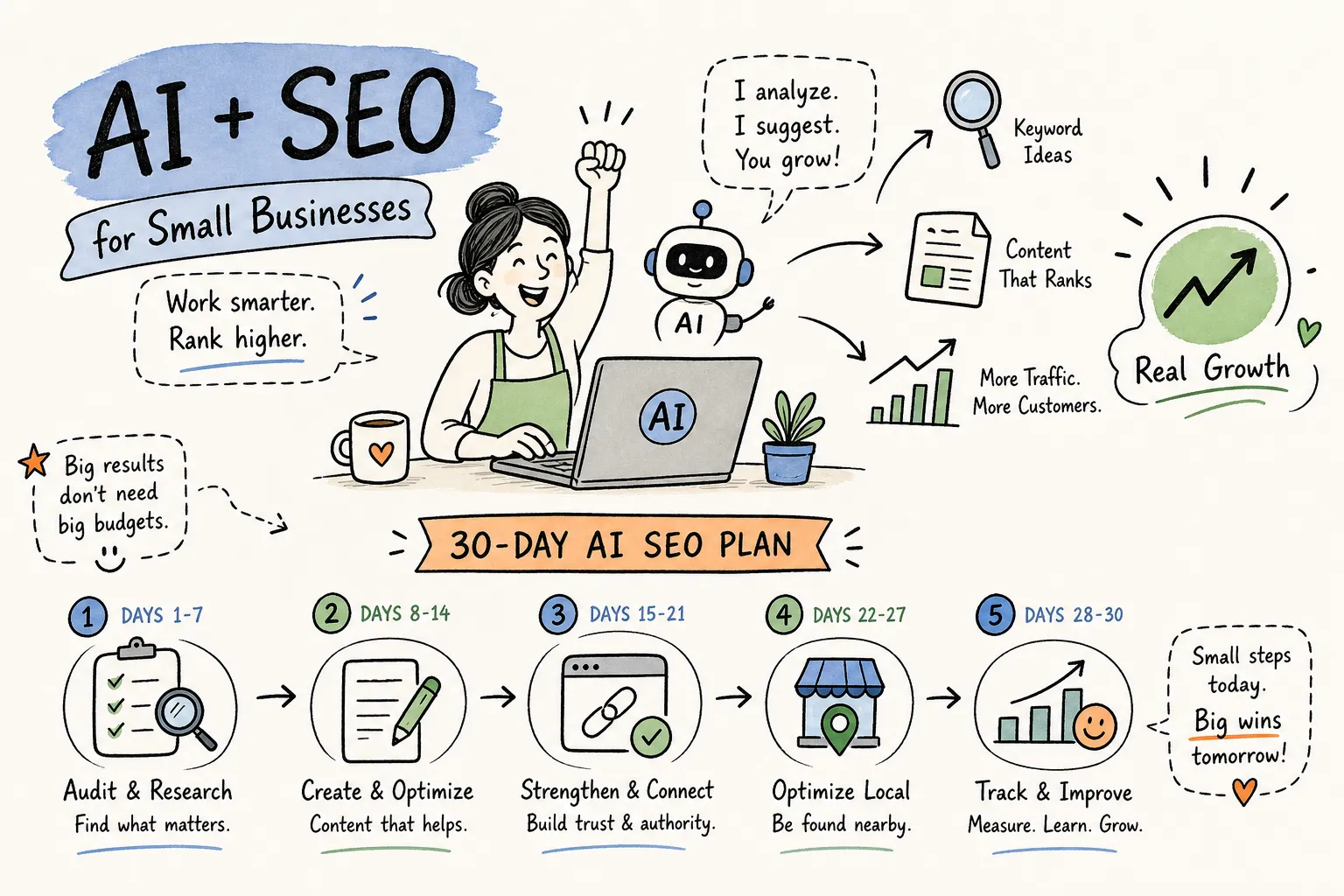
AI SEO for small business: your 30-day plan to start appearing in AI search results
Week 1: query research and content audit (days 1 to 7)
Set up or verify your access to Google Search Console, GA4, and one paid keyword tool. Use ChatGPT or your keyword tool to generate 50 to 100 query variations based on your core service and your typical customer type. These should be phrased the way a customer would type them, not the way a marketer would write a headline. Validate each query against real search data to confirm demand. By the end of the week, identify three to five specific questions your current content does not answer, and flag them as your priority content gaps. This query-first approach is the engine of effective SEO automation for SMBs.
Weeks 2 and 3: content creation and schema setup (days 8 to 21)
Write or commission content that directly and specifically answers each priority query. Each piece should read like a thorough, authoritative answer to a single customer question, not a general overview of a topic area. Think: “How much does commercial property conveyancing cost in Manchester?” rather than “Our conveyancing services are comprehensive and affordable.” In parallel, audit or implement your schema markup. At minimum, ensure your site carries LocalBusiness or Organisation schema, and that key content pages carry the relevant type markup such as FAQPage or Article. If schema coding sits outside your skill set, this is worth outsourcing. The return on a one-off implementation is substantial and long-lasting.
Week 4: publish, monitor, and refine (days 22 to 30)
Publish your optimised content and begin monitoring performance through Search Console. At this stage, you are looking for early signals rather than dramatic results: new query impressions appearing in Search Console, any initial appearances in AI Overviews, and shifts in click-through rate on the pages you have updated. Document what is showing early movement and use that to refine your query list for the next cycle. The 30-day plan is not a one-and-done process; it is the template for an ongoing content and optimisation rhythm. Your second cycle can prioritise whichever query clusters showed the earliest traction.
What realistic results look like and how to protect your site
AI SEO for small business does not produce overnight results, but it does produce measurable ones. At 30 days, expect to see new query impressions appearing in Search Console as Google begins indexing your optimised content. At 60 days, look for traffic movement on the pages you have worked on. Some sites begin to see AI Overview appearances within around three months once schema markup and query-matched content are in place, though timelines vary and are not guaranteed, most businesses see meaningful gains over three to six months, with larger authority gains taking longer. Documented case studies of this kind of implementation have produced organic traffic improvements of 50% to 120% within three to six months when query research and structured data are applied together.
On AI-generated content: Google’s guidance is clear. Content must be created for users, not to game ranking algorithms. AI-assisted content is not penalised by default, but low-quality, generic, or factually unreliable content is. Every piece of AI-drafted content must be reviewed and verified by a human before publication. Use AI tools to research, draft, and refine, but keep human judgement at the centre of what gets published. This protects your site from algorithmic penalties and, more importantly, it protects your reputation with the customers you are trying to reach. A cited answer in a Google AI Overview carries real credibility; a poorly researched one that turns out to be wrong carries real reputational risk.
Start now, not later
AI SEO for small business is not about chasing every new platform or investing in expensive software suites. It is about understanding how AI search systems decide what to recommend, and then making your business visible in that decision process. Two things drive this above everything else: content that answers specific customer questions with precision, and structured data that tells AI systems exactly who you are and why you should be trusted.
The AI SEO tools to get started are affordable. The 30-day plan is manageable for a business owner or small marketing team working without a dedicated technical department. For those who want the query research, content production, and schema markup handled end-to-end by a specialist, This Video Works offers exactly that, an integrated AI SEO service built for UK SMEs who need the technical and content work handled by a specialist rather than juggled in-house. The businesses appearing in AI citations right now are not necessarily the biggest or the most established. They are the ones that started early.