
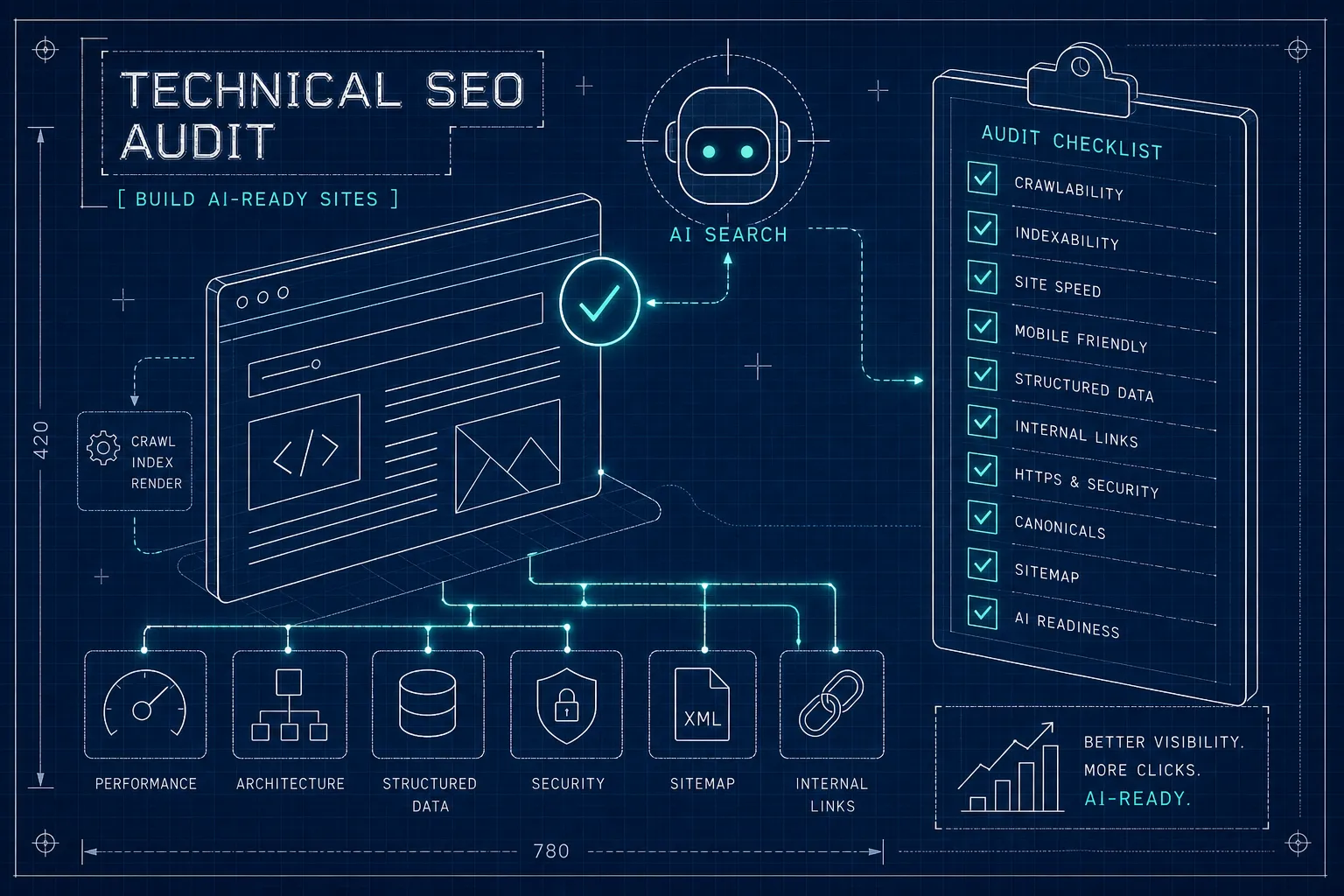
Technical SEO for AI search demands more than good on-page copy, it requires a robust technical foundation that most sites simply don’t have yet. Good on-page SEO used to be enough: write a well-structured page, earn some decent backlinks, and Google would reward you with rankings. That era hasn’t completely ended, but the rules have shifted in a way that catches most site owners off guard. AI search systems, including Google AI Overviews, ChatGPT Search, and Perplexity, don’t simply crawl pages and rank them. They parse content, cross-reference claims against knowledge bases, and make a deliberate decision about whether to cite you as a source. That distinction changes everything about how your site needs to be built and maintained.
Some UK providers are already treating this as a combined technical and content challenge, though adoption remains limited. This Video Works is one example: the studio applies schema markup to video transcripts and business details as well as written pages, so AI systems can read and cite video-led content in the same way they process written copy. That kind of integrated approach is rare, but it reflects how AI retrieval actually works, and it’s covered in the schema section below.
This article is a prioritised audit checklist for generative search optimisation, not a theoretical overview. Work through each section and you’ll finish knowing exactly what to fix, what to measure, and which tools to use to track progress.
Why AI search has changed the rules for technical SEO
From keyword signals to entity and context understanding
Traditional search engines rewarded keyword density and backlink volume. AI systems evaluate something fundamentally different: whether your content answers a specific query with enough clarity and authority to stake a citation on. AI doesn’t rank pages; it selects sources. That distinction matters because the selection criteria go well beyond what appeared in the old Google Quality Rater guidelines.
The data backs this up. Brand mentions and domain authority show the highest statistical correlation with AI citation frequency, at 0.664 and 0.326 respectively (figures drawn from large-scale GEO correlation studies published in 2024, 2025). Technical factors enable inclusion, but entity signals drive how frequently you’re cited. Your technical work opens the door; your brand and content authority determine how often you walk through it.
What AI crawlers prioritise that traditional bots didn’t
AI crawlers behave differently from the Googlebot most SEOs have optimised for. They deprioritise JavaScript-heavy pages, are less tolerant of deep crawl hierarchies, and abandon pages over 1MB at a measurably higher rate (pages above that threshold are abandoned 18% more often, based on AI crawl behaviour analysis). Traditional crawlers were relatively patient with rendering delays; AI crawlers are not. The sections that follow address each of these specific behaviours with practical fixes.
Technical SEO for AI search: crawlability and rendering checklist
Why JavaScript-heavy sites lose out
If your core content is hidden behind heavy client-side JavaScript frameworks, AI systems may fail to see, index, or cite it at all. Large language models encounter notable challenges interpreting dynamically rendered content, which means your beautifully designed React or Vue site may be functionally invisible to the systems you most want to reach. Client-side vs server-side rendering is the fix: it ensures crawlers receive fully formed HTML on first contact, with no JavaScript execution required.
The performance data above reflects this pattern. AI crawl analysis consistently shows that JavaScript-heavy sites face higher barriers for AI citation than their SSR equivalents, this is the highest-priority item on your audit list if you’re running a content-heavy business site on a JavaScript framework without SSR.
The indexability prerequisite you can’t skip
A page must be indexed by Google to appear in Google AI Mode. This has been confirmed explicitly, and it has a straightforward implication: any page blocked by a noindex tag or excluded via robots.txt is ineligible for AI citation regardless of how good the content is. Verify your most important pages in Google Search Console and confirm they appear as indexed.
XML sitemaps and canonical tags play supporting roles that are easy to overlook. The lastmod tag in your sitemap signals content freshness to AI crawlers, which prioritise recent material. Canonical tags prevent authority fragmentation in AI embedding graphs: if multiple URLs serve similar content without a canonical signal, the AI’s confidence in citing any of them decreases. Neither factor is as urgent as rendering, but both belong on your checklist.
Schema markup for AI: your direct line to generative systems
Which schema types correlate with AI citations
Pages cited in Google AI Mode frequently implement Organisation, Article, and BreadcrumbList schema. Content with proper schema markup has a 2.5x higher chance of appearing in AI-generated answers compared to unstructured content, and FAQPage schema alone shows a 67% citation rate on relevant question-format queries. These aren’t marginal gains; they’re the difference between being in the pool of potential sources and being invisible to the selection process.
Each schema type serves a distinct purpose. Article schema signals expertise and freshness through the author and datePublished fields, both of which AI systems use to evaluate credibility. FAQPage enables direct answer extraction: AI treats these pages as pre-extracted answers, which is exactly why the citation rate is so high. HowTo allows AI to lift step-by-step instructions cleanly, even though the traditional HowTo rich result was deprecated from standard search in 2023.
One critical rule applies across all types: schema must match the visible on-page text exactly. Mismatched or buried schema is treated as unreliable and deprioritised accordingly. All schema should be implemented in JSON-LD, which Google explicitly recommends for AI parseability. For a practical guide to structured approaches, see structured data for AI search.
Entity alignment and knowledge graph grounding
AI systems cross-reference structured claims against knowledge bases including Wikipedia, Wikidata, and the Google Knowledge Graph. When your schema explicitly identifies entities and their relationships, the AI’s retrieval confidence increases. Your Organisation schema, for instance, should link to verified external references where possible; this anchors your brand to known facts rather than leaving the AI to infer your identity from context.
Video content represents a significant, underused opportunity here. Applying schema markup to video transcripts and business details, not just written pages, allows AI systems to read and cite video-led content in exactly the same way they process written copy. Podcasts, Reports and Web Design, making sure AI can cite your content integrates this approach as part of its standard content and technical pipeline. The majority of businesses and video production companies overlook this entirely; implementing it before your sector catches up is a practical competitive advantage in UK markets, particularly as AI search visibility becomes a primary acquisition channel. For smaller organisations looking for a focused plan, consider AI SEO for small businesses to align resources and timelines.
How to structure content for semantic and vector retrieval
Chunking, clarity, and answer-ready formatting
AI retrieval systems break content into chunks of roughly 300 tokens and embed each chunk independently, a process central to vector search and embeddings optimisation (see how a vector index works and 5 critical best practices). A page that reads as one long, undifferentiated block performs poorly because individual chunks lose context and the AI can’t reliably extract a clean, citable answer. Each section of a page should answer a distinct question, start with a clear topic sentence, and avoid burying the core answer in supporting detail. Concise summaries at the top of sections also improve embedding quality.
This is a structural discipline more than a writing one. You’re not rewriting your content; you’re reorganising how ideas are sequenced so that each section is self-sufficient. A section that can be lifted out of the page and still make complete sense on its own is a section that AI systems can cite with confidence.
Headings hierarchy and how AI reads your pages
AI parsers rely on structural signals that many site owners treat as optional. A logical H1, H2, H3 hierarchy, consistent internal linking, and clean HTML that reflects the actual content order all contribute to the confidence with which AI systems cite a page. Poor heading structure creates ambiguity in entity mapping: if the AI can’t determine what a section is about from the heading alone, it reduces the probability of citing that content.
Here’s a quick self-audit you can run right now: open the page source and read only the headings in order. Do they tell a coherent story without the body copy? If the answer is no, the AI is likely struggling with the same ambiguity you’re experiencing as a reader.
Site performance as a citation filter: Core Web Vitals and speed
The thresholds that matter for AI visibility
Performance metrics function as a filter, not a ranking signal in the traditional sense. Sites with CLS at or below 0.1 appear in AI summaries 29.8% more often than sites with poor layout stability. Sites with LCP at or below 2.5 seconds are approximately 50% more likely to appear in AI results. A TTFB below 200ms correlates with a 22% increase in citation density in some dataset analyses, though evidence across studies is mixed and TTFB is not itself a Core Web Vital, treat it as a supporting indicator rather than a primary target. The mechanism behind these figures is partly direct (fast pages are easier to crawl and parse) and partly indirect: strong Core Web Vitals support organic rankings, and roughly 97% of AI Overview sources come from the top 20 organic results.
Speed thresholds AI crawlers use to deprioritise pages
Pages over 1MB are abandoned by AI crawlers 18% more often than lighter pages. AI Overviews actively filter slow, script-heavy sites from citations, making speed a foundational requirement rather than an optional improvement. The current interactivity standard is INP (Interaction to Next Paint), the successor to Time to Interactive. Competitive sites are now targeting sub-150ms INP; the official “good” threshold is sub-200ms.
The practical implication is straightforward: run a Core Web Vitals audit before any other optimisation work. Use Google’s PageSpeed Insights or the Core Web Vitals report in Search Console to identify your current position against each threshold. The goal isn’t perfection; it’s avoiding the “poor” category (LCP above 4.0 seconds, CLS above 0.25, INP above 500ms) where AI citation rates drop significantly.
Monitoring your AI search visibility and citation readiness
GEO auditing tools built for this era
Standard rank trackers don’t measure what you actually need to know. Generative Engine Optimisation (GEO) tools, sometimes called answer engine optimisation (AEO) tools, are a distinct category designed specifically for this problem. OtterlyAI is a strong starting point for a technical audit: it tests server access against specific AI user agents (GPTBot, ClaudeBot, PerplexityBot), checks robots.txt for inadvertent blocks, and surfaces on-page factors correlated with citation frequency. For a UK business that suspects it’s being blocked without knowing why, this is the first tool to run.
Scrunch AI provides a real-time feed of AI bot crawl activity, showing exactly when GPTBot or PerplexityBot visited a page and correlating those visits with changes in citation status. AthenaHQ delivers share-of-voice metrics and source domain analysis, which is more useful once your technical issues are resolved and you’re tracking competitive visibility. Semrush’s AI Visibility Toolkit covers citation monitoring and sentiment analysis across platforms. Each tool serves a different stage of the audit and monitoring cycle.
What to track and how to measure progress
Four core metrics are worth monitoring consistently:
- Citation presence rate, how often your domain appears as a source in AI responses
- Crawler visit frequency, broken down by bot type (GPTBot, ClaudeBot, PerplexityBot)
- Technical blocker count, tracked over time to confirm fixes have held
- Schema validation status, reviewed regularly in Google Search Console
A monthly review cycle is the minimum; real-time alerts for citation drops are worth enabling from day one.
If you’re not ready to invest in dedicated GEO tools yet, Cloudflare’s AI crawler analytics can be added to many sites with no additional cost (availability depends on your Cloudflare plan). It visualises exactly where AI bots encounter errors on your site, which makes it a practical first step that delivers immediate diagnostic value before you commit to a paid platform.
Run the audit this week, not next quarter
The checklist runs in order of priority for a reason: fix rendering and indexability first, then implement and validate schema markup for AI, then structure content for chunked retrieval, then address Core Web Vitals, then set up monitoring. Each layer builds on the previous one. Skipping the foundation makes every layer above it less effective, regardless of how well-executed it is.
The core message is worth stating plainly. Technical SEO for AI-driven search is not a replacement for strong content. But without the technical foundation, even excellent content will fail to enter the pool of pages AI systems consider for citation. You can write the most authoritative, well-researched page in your sector and still be invisible if your rendering is wrong, your schema is missing, or your site is blocking the wrong bots.
Run the audit this week. Fix the highest-impact issues first, starting with crawlability and schema. Revisit your monitoring tools in 30 days and measure the change. If you want support with the schema implementation, the content structure, or the video content that underpins all of it, This Video Works offers the full technical and content pipeline as an integrated service. The gap between businesses that have addressed this and those that haven’t is widening; the earlier you act, the lower the competitive cost of the work.