
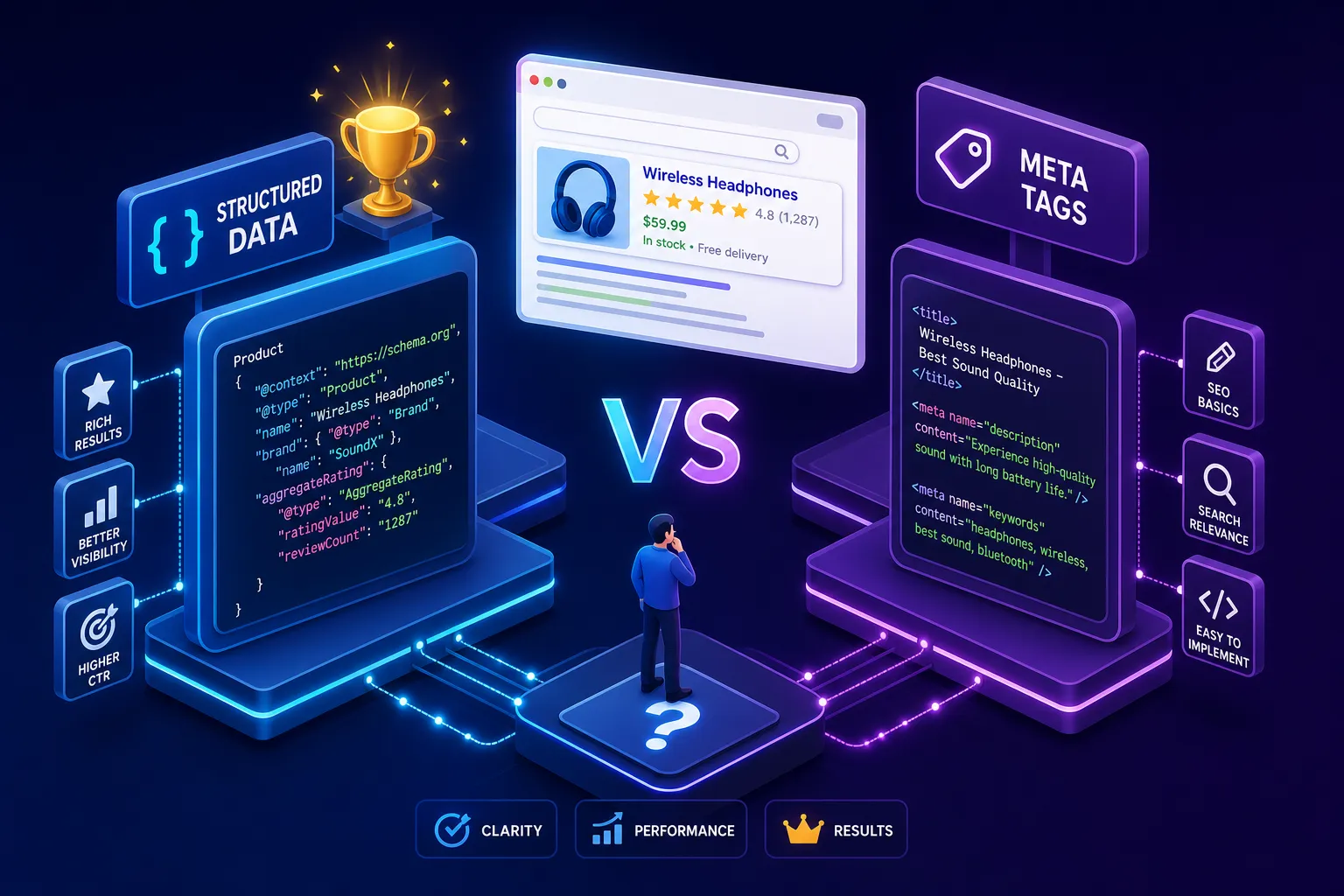
Anecdotally, many businesses assume that filling in their meta title and description counts as “doing SEO.” It doesn’t. In 2026, the gap between that assumption and what actually earns rich result eligibility and AI citation likelihood has never been wider. The structured data vs meta tags debate isn’t purely academic. These two tools serve fundamentally different functions, and only one of them significantly increases your chances of appearing in AI-generated search results, rich snippets, and the kind of prominent SERP real estate that genuinely moves the needle. By the end of this article, you’ll know exactly what each tool does, when to use which, and how to combine them so your site is visible both to human searchers and the AI systems that are increasingly doing the searching on their behalf.
The confusion is understandable. Both meta tags and structured data live in the technical layer of your pages, neither is visible to your visitors, and both influence how search engines interact with your content. But treating them as interchangeable is a mistake that can cost businesses measurable traffic.
What meta tags actually do (and where they stop)
Meta tags are HTML elements that sit inside the section of a webpage. They tell search engines how to display your page in standard results and whether to crawl and index it at all. They’re the foundation of basic search visibility, and getting them wrong undermines everything built on top of them.
The three meta tags that genuinely matter for SEO
Your title tag is the clickable headline in search results. Keep it under 60 characters, place your primary keyword first, and make it unique for every page. Your meta description sits beneath that headline: 150 to 160 characters, written to earn the click, and with a clear reason for the reader to choose your result over the nine others on the page. The robots tag controls whether a page gets indexed and whether the links on it get followed. These three elements shape what your standard blue-link result looks like in Google, nothing more.
A weak implementation looks like this: a title tag that’s just the business name, a meta description copied from the first paragraph of the page, and no thought given to the searcher’s intent. A strong one targets a specific query, promises a specific outcome, and treats every character as valuable real estate.
Canonical tags and duplicate content
The canonical tag is a meta-layer instruction rather than a direct ranking signal. It tells search engines which URL is the “master” version of a page when multiple URLs serve near-identical content. For ecommerce sites with product variants (different sizes, colours, configurations), this is essential: without canonical tags, ranking signals get split across dozens of near-duplicate URLs and diluted to the point of uselessness.
What meta tags cannot do
Here’s the hard ceiling: meta tags cannot trigger rich results. They cannot produce star ratings, recipe cards, event panels, FAQ dropdowns, video carousels, job posting features, or breadcrumb trails in search results. A well-crafted meta description improves the click-through rate on a standard result; it cannot transform that result into a rich one. Critically, structured data is what materially increases the likelihood of your content being cited by Google’s AI Overviews, Bing Copilot, or Perplexity, meta tags alone do not provide the machine-readable signals those systems rely on. That requires something else entirely.
What structured data is and why JSON-LD became the standard
Schema markup is machine-readable code that explicitly tells search engines and AI systems what a page contains, not just how it looks. Where a meta tag describes a page in broad strokes, structured data labels every component: the author, the publication date, the price, the rating, the event location, the video duration. It speaks the language that search engines and AI tools actually read natively.
Schema.org vocabulary: the shared language of search engines
Schema.org was created jointly in 2011 by Google, Bing, Yahoo, and Yandex. It defines the “types” (Article, Product, LocalBusiness, VideoObject, Event) and the “properties” within each type (name, price, datePublished, aggregateRating). When you implement schema markup using this vocabulary, you’re not writing for humans; you’re writing for machines. The analogy holds: meta tags describe a building from the outside; structured data labels every room inside.
Structured data vs meta tags: which format to use for implementation
JSON-LD embeds as a separate block in the page head, completely independent of your visible HTML. Microdata and RDFa weave directly into the HTML markup itself. Google officially recommends JSON-LD, and the practical case for it is clear: it’s easier to write, easier to maintain, and less prone to error. It also won’t break if your HTML structure changes. JSON-LD is Google’s recommended option and typically the most straightforward to implement, though microdata and RDFa remain supported formats if your setup requires them.
Here is a minimal JSON-LD example for an Article page:
{
“@context”: “https://schema.org”,
“@type”: “Article”,
“headline”: “Structured data vs meta tags: what matters more in 2026”,
“author”: { “@type”: “Organization”, “name”: “This Video Works” },
“datePublished”: “2026-07-14”,
“description”: “A practical guide to understanding what structured data and meta tags each do, and how to use both correctly.”
}
And the practical case for it is clear: it’s easier to write, easier to maintain, and less prone to error. It also won’t break if your HTML structure changes. JSON-LD is Google’s recommended option and typically the most straightforward to implement, though microdata and RDFa remain supported formats if your setup requires them.
And a minimal Product block for an ecommerce page:
{

  "@context": "https://schema.org",

  "@type": "Product",

  "name": "Example Product Name",

  "sku": "12345",

  "offers": {
    "@type": "Offer",
    "priceCurrency": "GBP",
    "price": "49.99",
    "availability": "https://schema.org/InStock"

  },

  "aggregateRating": {
    "@type": "AggregateRating",
    "ratingValue": "4.5",
    "reviewCount": "38"

  }

}
What structured data actually enables
Rich results of every meaningful kind require structured data: recipe cards, event listings, job postings, review stars, video panels, breadcrumbs, Top Stories carousels, and product snippets with pricing and availability. The click-through rate data is not marginal. According to Google’s published case studies, Rotten Tomatoes saw a 25% higher click-through rate after implementing structured data for rich results, and Nestlé saw an 82% higher CTR. Pages with proper schema markup can see substantial increases in impressions and organic traffic, because they occupy more visual space in search results than standard blue links ever could.
Where they overlap and where they diverge completely
Both tools are necessary, but they operate in distinct lanes. Knowing exactly where structured data vs meta tags each apply, and where they work in tandem, is what separates a solid technical SEO foundation from a fragmented one.
The overlap: keyword alignment across both
Your title tag, meta description, H1 heading, and the name and description fields inside your JSON-LD should all reference the same primary keyword. This isn’t redundancy; it’s reinforcement. Search engines use consistency across these signals to confirm relevance and intent. If your structured data describes one thing and your title tag implies another, you create a conflict that weakens both signals simultaneously.
Where only structured data applies
Rich results, AI citations, and semantic entity recognition fall entirely outside what meta tags can achieve, regardless of how well-written they are. The rich result types that require structured data include Events, Job Postings, Recipes, Articles in Top Stories, Video carousels, Breadcrumbs, Local Business panels, Product snippets, and Review stars. Note that FAQ rich results are now restricted to authoritative government and health sites following recent changes to Google’s guidance, so don’t invest implementation time in FAQPage schema if you’re a commercial business targeting standard rich results.
An ecommerce product page as a practical example
A product page done correctly uses both tools in tandem, each doing a distinct job. The title tag is unique, keyword-first, and under 60 characters. The meta description includes a call to action plus a shipping offer, running to around 155 characters. A canonical tag points to the master variant URL to consolidate ranking signals. Then JSON-LD ProductaggregateRating so that the result in search can show star ratings, price, and stock status as a rich snippet. The meta tags handle the click; the structured data handles the rich result. Neither can do the other’s job.
Why schema markup is the stronger signal for AI-driven search in 2026
AI search tools prioritise structured, machine-readable signals when identifying trustworthy, citable sources. A page with clean JSON-LD is far easier for an AI system to interpret and recommend than a page with only standard meta tags, which is why the structured data vs meta tags distinction matters so much in the current search landscape.
How AI systems read and cite content
Google’s AI Overviews, Bing Copilot, and Perplexity all extract and summarise content from across the web. According to analysis of AI citation patterns, pages with proper schema, particularly Article, VideoObject, and LocalBusiness types, are significantly more likely to be cited in AI Overviews than equivalent pages without it, with some estimates indicating uplifts in the region of 35 to 40%.
FAQPage markup that aligns question-and-answer pairs with real user queries can be high-leverage where it remains eligible following Google’s restrictions, because it gives AI systems extractable answer spans that are easy to incorporate directly into a generated response. Structured data helps AI tools disambiguate entities, connect content to the Knowledge Graph, and attribute sources correctly.
The competitive gap most UK businesses haven’t noticed yet
At This Video Works, we implement schema markup on every piece of content we produce, both video and written, as standard practice. Our implementation data consistently shows that schema markup is widely adopted in the US but appears significantly underutilised across the UK market. That gap represents a real window right now. Businesses applying structured data to their content are appearing in AI overviews and citations that competitors relying on meta tags alone are far less likely to achieve. Structured data significantly increases the chance of being cited by an AI assistant; meta tags alone do not provide that signal.
Structured data and indirect ranking effects
To be clear about what schema markup doesn’t do: Google does not treat it as a direct ranking factor. Both John Mueller and Danny Sullivan have confirmed this on record. However, the indirect path is genuine and logical. Richer, more prominent search results generate higher click-through rates. Higher CTR sends positive engagement signals to Google. Over time, those signals contribute to where a page positions. The mechanism isn’t a shortcut; it’s a chain from better presentation to better user behaviour to better results.
Structured data vs meta tags: how to implement both correctly from the start
Getting the implementation right matters as much as understanding why it matters. Errors in either layer create problems that undermine the whole system.
Getting your meta tags right first
Before touching schema, audit your meta foundation. Every page needs a unique title tag with the primary keyword first and a character count under 60. Every meta description should reflect the actual page content, include a reason to click, and land between 150 and 160 characters. Your robots directives need to be correct on every page, and canonical tags must be set on any page with variant or duplicate URLs. These are table stakes. Getting them wrong doesn’t just limit your reach; it actively undermines everything layered on top.
Building a basic JSON-LD block
Start with the schema type most relevant to your page. A business homepage takes Organization or LocalBusiness . A blog post takes Article. A product page takes Product with aggregateRating . Write the JSON-LD inside a </code> block in the page head. One rule is non-negotiable: every field in your schema must match exactly what's visible on the page. If your schema says "InStock" but the page shows "Out of Stock," Google can issue a manual action.
Content Parity Isn’t Optional
Validating before you publish
Use three tools in sequence. JSONLint catches syntax errors, the most common of which are trailing commas, missing commas, and unescaped quotes, which together account for a significant proportion of all JSON-LD errors and cause the entire schema block to be ignored if left unfixed.
The Schema Markup Validator at schema.org checks your implementation against the full vocabulary.
Google's Rich Results Test previews whether your page is eligible for rich features and what they'll look like.
After publishing, use URL Inspection in Google Search Console to confirm the markup has been fetched and parsed correctly. Validate monthly, and always re-check after CMS updates.
The practical verdict: use both, but know which one does the heavy lifting
The structured data vs meta tags question doesn't have a winner so much as a division of labour. Meta tags are still essential. Without them, your basic indexing and click-through rate on standard results suffer, and no amount of schema markup compensates for a broken title tag or a missing canonical. Get that foundation solid first.
But in 2026, schema markup is where the meaningful visibility gains are happening: rich results, AI citations, and the kind of search presence that puts your business in front of people before they've even finished typing a query. The adoption gap observed directly in our client work makes this particularly urgent for British businesses. The window where implementing schema markup ahead of your competitors delivers a material advantage is open right now. If you want to discuss how This Video Works integrates structured data into video and written content as a complete package, start that conversation here.