
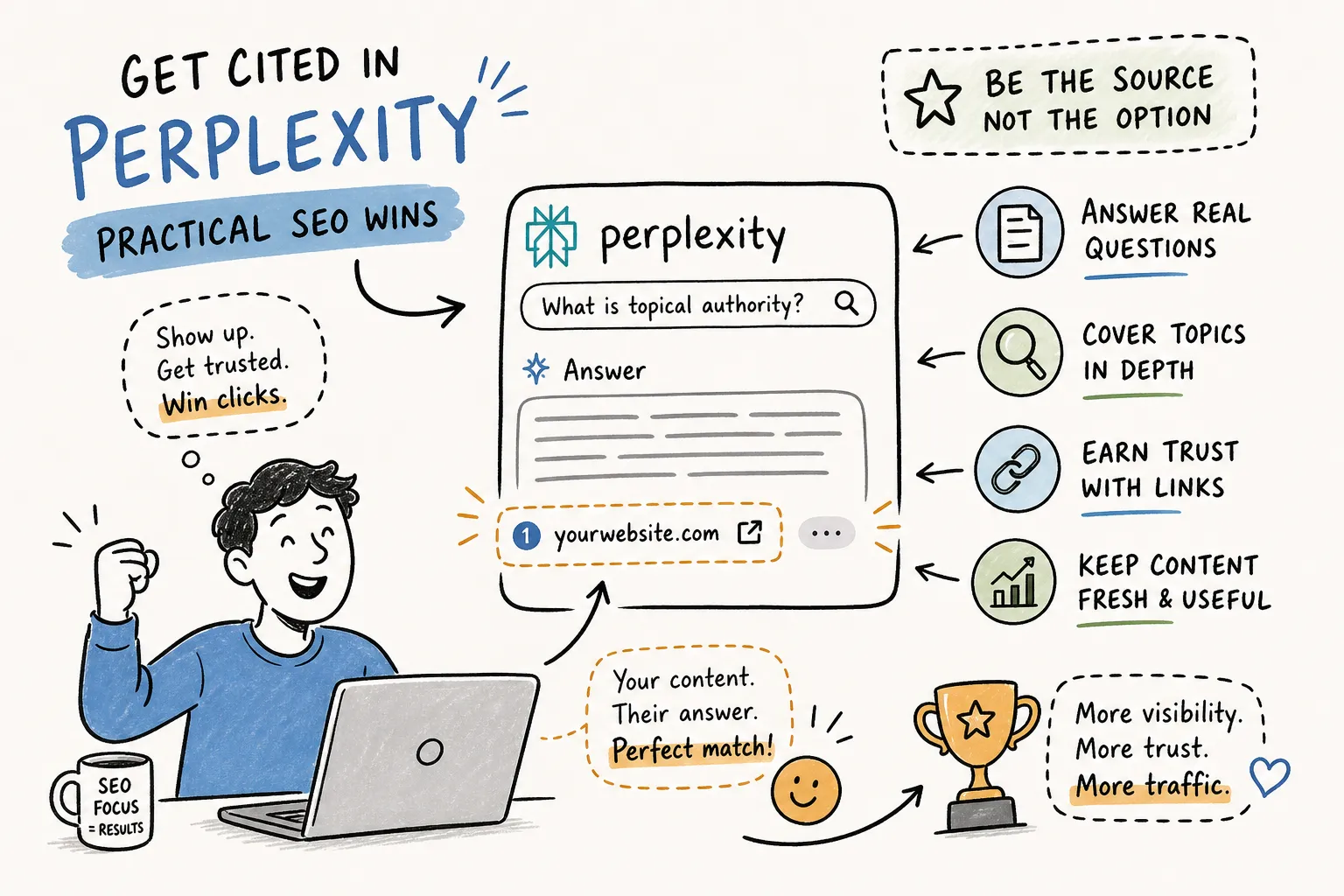
If your pages aren’t appearing in Perplexity citations, the problem is rarely poor content quality. Perplexity evaluates roughly ten pages per query and cites just three to four, a 30, 40% citation rate at best, and most pages that get pulled into the evaluation never make it through. The decisive factor is nearly always structure: whether the content is organised in the way AI systems extract and verify information during context assembly.
Here’s the tension worth naming early: traditional SEO habits actively work against you here. Long introductions and broad topic coverage are among the signals that cause pages to fail Perplexity’s extraction filter. UK businesses across professional services, technology, and financial advice are now working with specialist content and production partners to get their written and video content cited in AI responses. For many, learning how to appear in Perplexity citations has become as strategically important as ranking on page one of Google, and the optimisation logic is different enough to warrant its own approach.
This article walks you through a prioritised sequence covering on-page structure, schema markup, entity consistency, content freshness, and citation tracking, so you can apply changes in the right order and test whether they’re working.
How Perplexity actually decides which sources get cited
The ten-page funnel: retrieval versus citation
The process works in stages. Hybrid retrieval using BM25 and semantic embeddings pulls roughly ten candidate pages per query. Three reranking layers then filter those pages on relevance, recency, entity clarity, authority, and source diversity. The final LLM synthesis stage assembles the answer and assigns inline citations only to what it can quote accurately without distortion.
That last point matters more than most people realise. Citation is assigned during context assembly, not retrofitted afterwards. If your page isn’t structured to be extracted cleanly at that moment, it won’t be cited even if it was retrieved. Getting into the funnel and getting cited are two entirely separate outcomes.
The three signals that carry the most weight
Answer position carries an estimated 20% weighting. Pages where the core answer appears within the first 100, 150 words are strongly over-represented in cited sources, because Perplexity’s NLP extracts from the opening section of a page rather than buried conclusions.
Structural extractability carries a similar weighting. Clean heading hierarchies, tables, and FAQ sections that allow a self-contained passage to be lifted cleanly all improve citation probability.
Freshness accounts for approximately 15% of the weighting. Pages updated within the past 18 months, containing meaningful new content rather than cosmetic edits, consistently outperform stale equivalents.
How to appear in Perplexity citations: content structure
The BLUF rule and why long introductions hurt you
90% of top-cited sources answer the core question within the first 100 words. Perplexity’s extraction model reads from the top of the page, so a long scene-setting introduction before the actual answer signals the opposite of what the system is looking for. Pages with extended preamble are frequently deprioritised in the reranking stages even when the content further down is strong.
The practical fix is structural, not a full rewrite. Audit your existing pages and move the direct answer to the opening. Supporting detail, context, and caveats follow afterwards. This single change produces measurable results faster than any technical optimisation.
Heading structure that mirrors real search queries
Question-matching headings, framed the way users actually search, make pages significantly easier to retrieve and extract as answers. Headings like “What is the difference between X and Y?” or “When should you use X?” signal to the reranker that a specific, extractable answer follows. A clean H1-to-H2-to-H3 hierarchy with no skipped levels produced a 65% lift in citation likelihood in controlled tests, outperforming schema-only changes, which produced no measurable effect in isolation.
Audit your heading structure before touching anything else. If your headings skip levels, use marketing language rather than answering real questions, or don’t reflect what your audience is actually searching for, fix that first. It’s the single largest lever available to you.
Schema markup and entity consistency: the technical layer most UK businesses overlook
Which schema types Perplexity responds to most
Schema-rich pages are consistently over-represented in Perplexity citation sets. The most predictive schema.org types are FAQPage, which shows a 41% citation rate against a 24% control group rate and cuts time-to-first-citation by roughly six hours; Article and BlogPosting for guides and editorial content; HowTo for step-by-step instructions; Organization for entity anchoring; and LocalBusiness for location-specific pages.
The critical distinction from the data: schema-only changes without content updates produced no measurable citation lift. Schema works as a confidence signal layered on top of substantive content, not as a substitute for it. If your content isn’t structured to answer questions clearly, adding JSON-LD won’t compensate.
Entity consistency and why scattered signals cost you citations
Perplexity maps brands and entities to knowledge graph nodes, cross-referencing structured data, third-party mentions, and semantic signals to confirm identity. Inconsistent business names, addresses, or descriptors across your website and third-party directories actively penalise your confidence score in the entity-matching layer. A brand that appears as “Smith & Co” on its website, “Smith and Co Ltd” on Companies House, and “Smith & Company” in directory listings gives the system conflicting signals and fails the entity clarity gate.
Audit your entity signals across your site, Google Business Profile, and key directories. Every name, descriptor, and location reference should match precisely. Getting this right before publication is significantly easier than retrofitting it afterwards. At This Video Works, pre-production query research and schema coding are applied directly to video transcripts and written content before anything goes live, so every asset is structured and marked up in the language AI systems natively read.
Content freshness and topical depth: the ongoing citation engine
Why meaningful updates outperform new content volume
Pages updated within 14 days, with new data, revised conclusions, or added sections, were cited 2.3 times more often than pages untouched for 60 or more days, while typo fixes and cosmetic edits produced zero measurable effect. The content has to contain genuinely new information for the freshness signal to register.
Content stamped “updated two hours ago” earned 38% more citations than identical content with a dateline from the previous month. Your update schedule directly affects your citation rate. A 2026 analysis of citation patterns across competitive niches found that pages not refreshed at least every 13 weeks were three times more likely to lose their AI citations, making quarterly updates the absolute minimum for competitive topics and monthly updates the standard for fast-moving industries.
Building topical authority that AI systems recognise
Topical authority in the context of AI citation means owning a subject area with depth and consistency across multiple interconnected pieces of content, not just publishing one comprehensive post. Perplexity’s source diversity filter avoids citing the same domain repeatedly within a single answer, but within a topic area, demonstrating consistent expertise increases the probability that your domain passes the authority gate when a relevant query fires.
Identify two or three core subjects your business genuinely owns, then ensure your content systematically covers real audience queries within those subjects at depth. A domain with 50 or more interconnected articles on a core topic cluster shows a significantly higher citation likelihood than one with a single long-form piece, regardless of that piece’s individual quality.
How to track and test whether your pages are being cited
Running test queries and recording what you find
Perplexity doesn’t provide a citation dashboard. The practical method is to run targeted queries that match your content directly, then check whether your domain appears in the numbered source list at the top of the response. Record results with a screenshot and date, so you have a baseline to compare against after making changes.
Test with a range of query types: direct questions your content answers, comparative queries in your subject area, and entity-specific queries pairing your business name with a topic. This reveals which content types are getting through the funnel and which are being retrieved but not cited. Clicking the inline numbered brackets or opening the Sources tab confirms the exact URLs being cited, so you can track at page level rather than domain level.
Optimise to appear in Perplexity citations: a prioritised sequence
Run through this sequence in order, starting with your highest-traffic pages:
- Fix the heading hierarchy so levels aren’t skipped and headings mirror real user questions.
- Move the core answer to the first 100, 150 words of the page.
- Add or correct schema markup using the appropriate schema.org types for your content.
- Audit entity consistency across the page and off-site mentions, including directories and your Google Business Profile.
- Update the page with new data, a revised section, or a meaningful addition.
- Retest with the same queries after 48, 72 hours.
Perplexity indexes changes quickly, often within 24, 48 hours for already-indexed pages. You don’t need to wait weeks to see whether an edit has made a difference, which makes this an unusually direct feedback loop compared to traditional SEO.
What to do next
The hierarchy of what the data actually shows is worth restating clearly. Structural clarity, heading logic and answer position, produces the largest single lift. Meaningful freshness updates follow. Schema markup reinforces and confirms what the content already signals. Entity consistency runs underneath all of it as a foundational layer that either supports or undermines every other signal.
The businesses appearing in Perplexity citations aren’t the ones with the most content. They’re the ones whose content is structured to be extracted, verified, and quoted cleanly by an AI system operating on a tight source budget of three to four slots per answer. That’s a structural and technical challenge as much as a content one, and it’s exactly why getting cited by Perplexity AI requires a different discipline from conventional search optimisation.
Pick one high-priority page, run the six-step sequence above, and test it against a real query within 48 hours. That’s the most direct way to find out where your content currently stands. If you want your video and written content built to appear in Perplexity citations from the ground up, including pre-production query research and schema coding applied before anything goes live, that integrated approach is what This Video Works is built to deliver.