
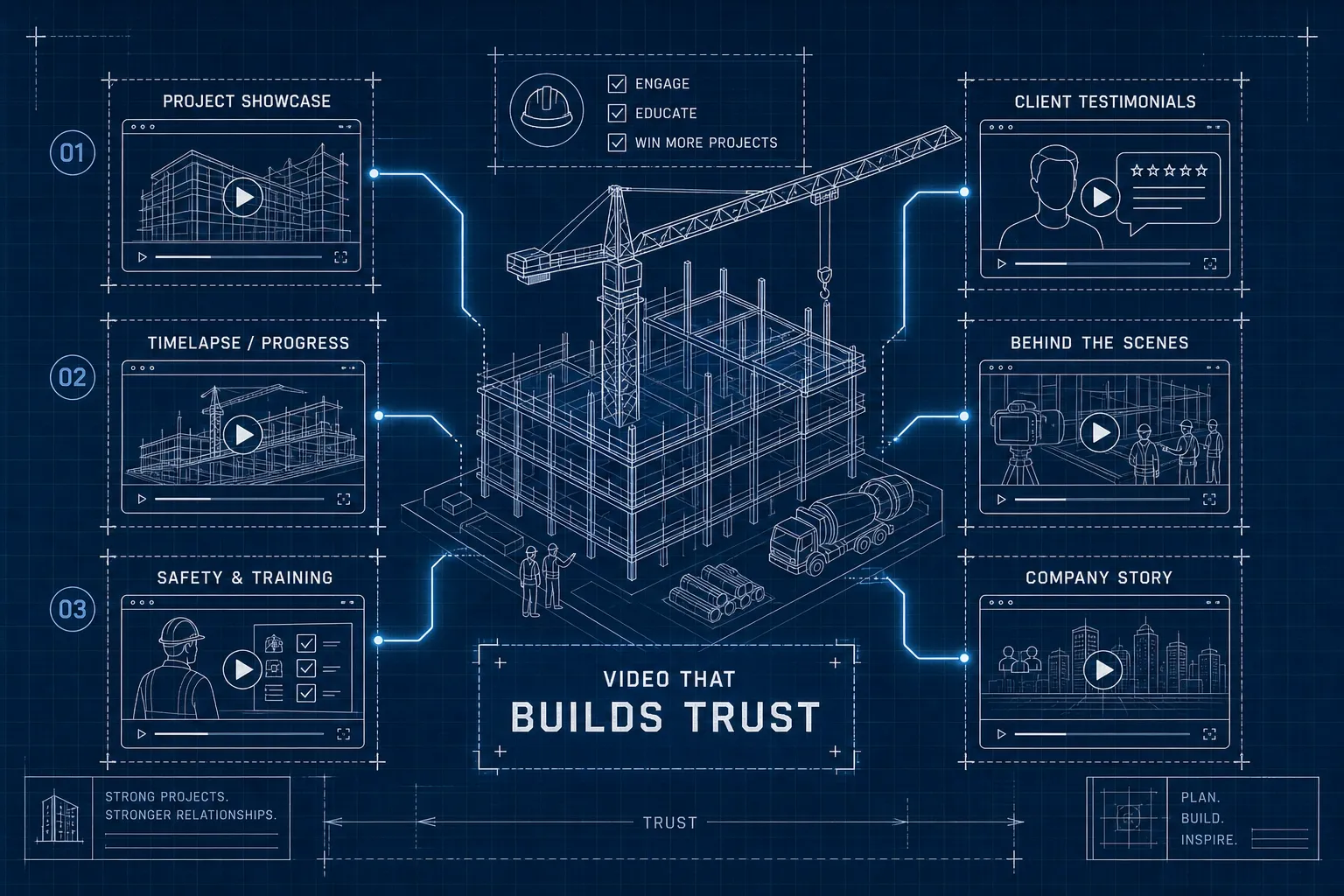
If you’ve been asking yourself what kind of videos a construction company should make, you’re not alone, and the answer matters more than most firms realise. Most construction businesses still win work the way they always have: a satisfied client mentions your name to a neighbour, a developer passes on your number to an architect, and the phone rings. Word of mouth built the industry, and it still carries enormous weight. The problem is that the buyer has changed. Before they call anyone, they search. They watch. They form an opinion about your business based entirely on what they find online, and if what they find is a sparse website with three photos from 2019, they move on.
Video is the format that closes that gap. It carries the warmth, credibility, and proof of your best referral conversation, but it works at scale, around the clock, for an audience that has never heard your name before. This is precisely why This Video Works built Building Your Dream: a sector-specific demo construction site designed to show small building businesses what video-led marketing actually looks like before they commit to a campaign. It is a live proof of concept, not a brochure.
By the end of this article, you will know which video formats are worth your budget, where to post them, what they cost to produce in the UK, and how to get started with a simple 30/60/90-day plan that generates genuine enquiries rather than just views.
What kind of videos should a construction company make, and why format matters
Not all construction videos do the same job. The most useful way to think about format selection is through the buyer journey: awareness, consideration, and decision. A prospective client who has never heard of your firm needs something different from someone who is comparing three shortlisted contractors before a final call. Choosing the right format for the right stage is what turns a camera roll into a pipeline tool. There is no shortage of construction video ideas, the challenge is knowing which ones to prioritise first.
Time-lapse and drone footage: capturing attention at scale
Time-lapse is consistently the highest-engagement format for construction businesses. It condenses weeks of genuine progress into a short, visually satisfying clip that people stop scrolling for, share, and watch more than once. Drone footage adds a quality that no static photograph can replicate: scale, context, and a sense of ambition that communicates capability before a single word is read.
Both formats live at the awareness stage, they are built for people who have not yet heard of your firm but will stop and pay attention when something genuinely impressive fills their screen. These are the construction video ideas to reach for when you want to establish visibility quickly and make an immediate impression.
Project walkthroughs and before-and-after reveals: showing the finished work
Where time-lapse creates excitement, a polished walkthrough or before-and-after reveal answers the real buying question: can they actually deliver? These formats sit at the consideration stage and work particularly well for residential renovation, heritage restoration, and commercial refurbishment projects, where the transformation story matters as much as the specification. A buyer who watches a three-minute walkthrough of a completed project that mirrors their own brief has already done a significant portion of their due diligence, making them a far warmer lead than someone who has only read a brochure.
A full case study video: the most efficient mid-budget format
A well-constructed case study video typically brings together time-lapse progress footage, a polished walkthrough of the finished result, and a short client testimonial into a single four-to-six-minute piece. It covers the entire buyer journey in one asset and can be cut into shorter clips for social platforms. For firms with a mid-tier video budget, this is an efficient use of production spend: one shoot day, multiple formats, content for every stage of the pipeline.
Client testimonials: the format that converts the most cautious buyers
Testimonial videos are the top-performing format for direct lead generation in construction. Industry case studies report meaningful uplifts, in the range of 12, 25%, for firms that integrate client testimonials and project videos into their websites and outreach. These are not abstract marketing statistics. They reflect what happens when a prospective client sees someone who looked exactly like them, describing a project that looked exactly like theirs, and saying they would hire the same firm again without hesitation.
What makes a strong construction testimonial video
The best construction testimonials follow a simple structure: introduce the client and their problem, show the project in progress, and close with a specific outcome. Aim for somewhere between 75 and 90 seconds for website and proposal placement, this aligns with research guidance on video retention for professional audiences. Avoid scripted answers entirely. A real client speaking naturally about a genuine concern they had before signing carries far more weight than polished corporate language, and buyers can tell the difference immediately.
Using testimonials in tenders and proposals
Video testimonials are not just for websites. Embedding a short clip in a tender submission or proposal document has been shown to improve shortlisting outcomes. Some agency case studies report proposal acceptance rates rising substantially when video is included, though results vary by sector and audience. For a B2B construction firm chasing framework contracts or commercial refurbishment work, this is a meaningful and underused competitive advantage. Most competitors are still submitting text-only documents.
Team introductions and process explainers: the trust layer most firms skip
Buyers choosing a building contractor are not just selecting a service; they are choosing people who will work on their property or commercial premises for months. Team introduction videos reduce the anxiety of that decision before the first site visit. A short, honest “meet the team” clip showing the people behind the project creates familiarity that a LinkedIn bio or a brochure photo simply cannot match. It also signals confidence: firms that show their faces are firms that stand behind their work.
Why process explainers answer questions before they are asked
A process explainer that walks a prospective client through your typical project lifecycle, from initial site survey and specification through to snagging and digital handover, does two things at once. It demonstrates expertise, and it pre-empts the questions that usually slow down a conversion. Construction firms that produce this kind of content often report shorter sales cycles, because by the time a prospect calls, they already understand the process, the timeline, and what to expect. That makes the first conversation far easier.
Safety and training videos for construction: an overlooked internal asset
Beyond client-facing content, safety and training videos for construction serve a different but equally important purpose. Short, clearly filmed clips covering site inductions, PPE requirements, or task-specific procedures help standardise practice across teams and provide documented evidence of compliance. They also reduce the burden on site managers who would otherwise repeat the same briefings repeatedly. If you are thinking through your full range of construction video ideas, internal training content is worth adding to the list, it has a direct operational benefit and a measurable impact on consistency and risk management.
Keeping these videos practical and personal
Team and explainer videos do not need to be expensive. A well-lit, clearly audible conversation filmed on a completed project or in a yard is more credible than an over-produced corporate interview. The goal is authenticity rather than high production value. A site manager explaining what happens at first fix, on camera, in plain language, is more persuasive than a polished voiceover reading from a brochure.
Platform specs, UK production costs, and legal essentials
Knowing which video to make is only half the decision. Where it is posted and what it costs to produce determines whether a video campaign is sustainable or a one-off experiment that gets forgotten after the first upload.
Where to post construction videos
YouTube and LinkedIn are the priority platforms for B2B and longer-form construction content. On YouTube, aim for two to five minutes in 16:9 with closed captions and a clear call to action in the first 20 seconds. On LinkedIn, 30 to 90 seconds in a 1:1 or 4:5 format with burned-in captions performs best, as most users watch without sound. Instagram Reels and TikTok suit short, punchy clips in 9:16 at under 60 seconds, and are ideal for time-lapse content and project progress updates aimed at a broader awareness audience.
Realistic UK costs for each video type
Site walkthroughs typically range from £1,000 to £3,000 for a polished result, though simpler freelance options can sit lower. Time-lapse with multiple site visits generally runs from £1,500 to £4,000. Client testimonials, which require careful scheduling, interviewing, and editing, sit between £2,000 and £8,000 depending on complexity. Drone inserts can be added for £500 to £1,500 as a standalone shoot. These are not figures to be alarmed by; they are figures to be planned for. A testimonial video that meaningfully improves your tender acceptance rate, as shown in a number of agency case studies, can repay its production cost relatively quickly.
Drone regulations, site permissions, and insurance
Commercial drone filming on UK construction sites carries specific legal requirements that cannot be ignored. You need CAA compliance under the correct operational category. Many active construction site operations require Specific Category authorisation, though some routine flights may qualify under PDRA01 depending on the criteria, it is worth consulting current CAA guidance or a qualified operator to confirm which route applies to your shoot. You also need landowner permission for take-off and landing, a risk assessment, a method statement, site controller permission, and a safety induction. Many clients and site owners commonly require public liability cover of at least £5 million, though this is not a universal legal minimum for all operations. Engaging a production company with genuine construction site experience removes most of this administrative burden and ensures your shoot is insured and compliant from day one.
What kind of videos should a construction company make first? A 30/60/90-day plan
The most common reason construction firms do nothing with video is that the choice feels overwhelming. A simpler approach: commit to three formats across three months and build from there. This is not a content strategy for a media company; it is a pipeline tool for a building contractor.
Month one: Commission a time-lapse setup on a project currently on site and a basic walkthrough at completion. These two pieces give you content for YouTube, LinkedIn, and your website. More importantly, they establish the habit of capturing work as it happens, the foundation everything else builds on.
Month two: Film a client testimonial on a recently completed project. Keep it under 90 seconds and let the client speak naturally. This is the format most likely to convert a cautious buyer who is comparing you against two or three other firms.
Month three: Record a team introduction or a process explainer. This is the trust layer that sits beneath everything else and makes the earlier content more credible.
By the 90-day mark, you have five pieces of content across multiple formats covering every stage of the buyer journey. Based on the kind of outcomes reported in sector case studies, this approach gives you a solid foundation from which to build the next quarter, and a consistent presence where your buyers are already looking.
Ready to start? Here is where This Video Works come in
Not every construction firm has the same goals, budget, or content maturity. A residential renovator working on heritage properties in the Cotswolds has different video priorities from a commercial fit-out contractor pitching for public sector contracts. Choosing formats without a clear strategy risks spending money on content that lands in the wrong place for the wrong audience.
This Video Works built Building Your Dream to address exactly this problem for firms like yours. The demo site illustrates what sector-specific video marketing can look like for a building contractor: the formats, the tone, the platform approach, and the content types that support conversion. The agency works specifically within construction, which means an understanding of construction language, sales cycles, and the trust barriers that buyers bring to every decision.
Working with a specialist means starting with a strategy session rather than a shopping list. This Video Works helps contractors identify which two or three video formats will have the greatest impact given their project type, target client, and available budget, then plans production around the work schedule rather than around a studio calendar. If you are still weighing up what kind of videos your construction company should make and want guidance grounded in the realities of the sector, get in touch with the team and let the work speak for itself.