
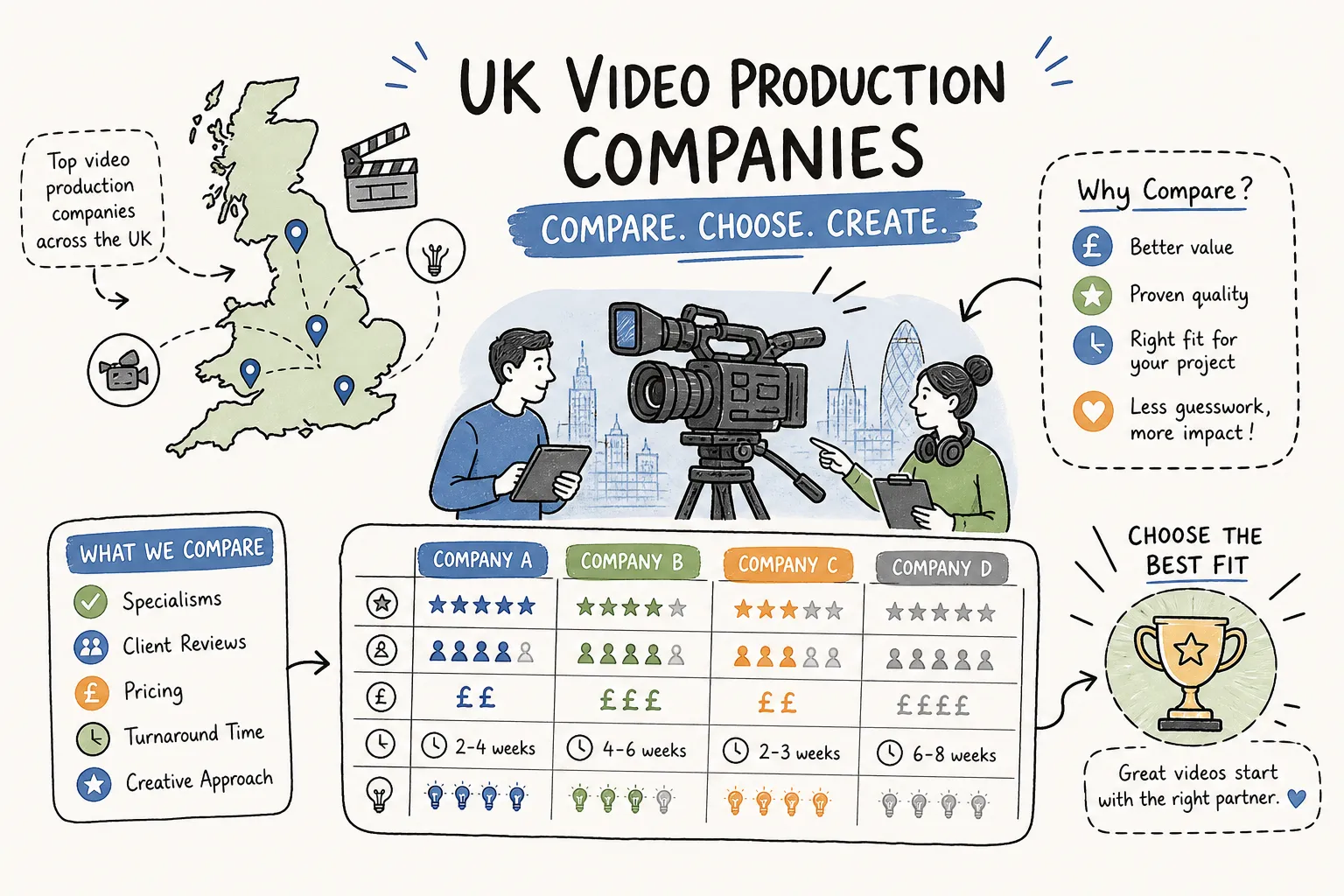
Getting quotes from UK video production companies is a strange experience. The numbers vary wildly, the showreels all look polished, and many quotes fail to itemise what you’re actually paying for. You’re left trying to compare a £2,500 freelancer with a £15,000 agency quote, using nothing but gut instinct and a few impressive client logos. This video production company UK comparison guide gives you a better method.
By the end of it, you’ll know how to read a quote properly, understand what production styles actually mean for your results, and put together a shortlist of three to five suppliers who genuinely fit your project and budget. The biggest differentiator between providers isn’t price or camera kit; it’s what they do once the filming is done. Some providers think beyond the shoot, building in SEO, structured content, and AI visibility as part of their standard process. Most don’t. That distinction matters more than almost anything else when you’re buying content that needs to do a commercial job.
Freelance videographer vs. full-service production company
Most business owners don’t realise these are two fundamentally different propositions until they’ve already hired the wrong one. The difference isn’t just about team size; it’s about scope, process, and what you get at the end of it.
What a solo videographer typically covers
A freelance videographer generally covers filming and basic editing. Pre-production is minimal: you brief them, they turn up, they shoot, they cut. Day rates typically run from £350 to £800, with most freelance projects landing between £1,000 and £3,500 in total. For simple social content, event coverage, or a tight budget, that’s a perfectly reasonable option. What you won’t get is strategic input, a backup crew if something goes wrong, or much capacity to scale across multiple locations or shoot days.
Where a full-service company adds real value
A production company brings a producer-led process: dedicated editors, structured pre-production, creative direction, and the infrastructure to handle more complex briefs. SME-level corporate work from a full-service company typically sits between £5,000 and 15,000 for a brand or company overview video. That higher price covers the team, the workflow, and the consistency, not just extra crew on set.
Which tier suits your project type
The honest answer: use a freelancer for social clips, lean budgets, and straightforward event coverage. Use a production company for brand films, professional services content, or anything that needs to perform commercially over a long period. The decision should be based on scope, not just what you can afford this month.
UK video production company comparison: freelancer vs. agency at a glance
| Factor | Freelance videographer | Full-service production company | Integrated agency |
|---|---|---|---|
| Typical cost | £1,000, £3,500 | £5,000, £25,000+ | £8,000, £30,000+ |
| Pre-production | Minimal | Structured | Research-led |
| Creative direction | Limited | Yes | Yes, with content strategy |
| SEO / AI optimisation | Rarely | Occasionally | Standard |
| Content repurposing | Not typically | Sometimes | Built into process |
| Best for | Social clips, events | Brand films, corporate content | Long-term content assets |
Video production company UK comparison: realistic costs in 2026
Pricing is the most confusing part of comparing agencies. The ranges are wide, the quotes rarely explain themselves, and the extras are almost never mentioned upfront.
Realistic price bands by video type
For talking-head or testimonial videos, expect to pay between £3,000 and £6,000. That typically covers a single-location shoot, one to two rounds of editing, and a clean final cut. Brand films with multiple locations, motion graphics, and voiceover work sit between £8,000 and £25,000, depending on shoot days and post-production complexity. High-production adverts with drone work, broadcast-quality standards, or complex visual effects start at £20,000 and can reach £60,000 or more. The sweet spot for most UK SMEs is the £5,000 to £15,000 range: professional, full-service corporate video that does a real marketing job without campaign-level budgets.
How to compare video production pricing UK: the London premium and regional differences
London-based agencies start corporate video around £3,500 and brand films between £8,000 and £15,000, with premium production rising from there. Regional production companies across England, Scotland, and Wales regularly deliver comparable quality at 15 to 30 per cent lower rates. Geography is worth factoring into your shortlist; there’s no reason to pay a London premium if your project doesn’t require it.
Hidden costs most quotes leave out
The extras that inflate final invoices are predictable once you know to ask about them: additional revision rounds beyond the standard two, music licensing, raw footage ownership, social cutdowns, and file archiving. Some agencies charge separately for captions, subtitles as .srt files, and aspect ratio variations for different platforms. Knowing this before you sign prevents the awkward scope-creep conversations that happen after the shoot, when you have less leverage.
Production styles that separate good agencies from great ones
Showreel quality is the obvious comparison point. It shouldn’t be. What matters more is how a company films, because that determines whether you come across well on screen and whether the content does a real commercial job.
Script-led vs. interview-led filming
Scripted approaches require the person on camera to deliver pre-written lines with confidence and precision. For professional presenters, that’s fine. For most business owners, it produces stilted, slightly anxious delivery that audiences read as performative. Interview-led or prompt-led filming is fundamentally different: the subject answers questions in their own words, which creates a natural tone that audiences consistently find more credible and trustworthy. In practice, unscripted interview formats consistently outperform scripted videos in engagement and completion rates. The content feels real, because it is.
Why your on-screen performance affects results more than production value
Even technically polished video fails if the person on screen looks uncomfortable. The best UK production companies build their on-set process around drawing out genuine responses from non-actors, using conversational, question-led methods that take the pressure off memorisation and delivery. This is where trust-building content is made, not in post-production. Before committing to any agency, ask directly how they direct clients on camera. If they can’t give you a clear answer, that’s a warning sign.
The rare combination: authentic filming and strategic post-production depth
Many agencies focus on either production craft or strategic post-production, and fewer combine both. Fewer still think about how a finished video will perform in search, how it should be structured for AI-driven platforms, or how footage can be repurposed across formats over time. That gap is where enquiries are won or lost, and it’s where the real difference between a video that generates enquiries and one that just sits on a landing page tends to appear.
What most UK agencies skip: SEO integration and AI visibility
This is the part of the video production company comparison most buyers never think to ask about. It’s also the part that has the biggest impact on long-term return from your video investment.
Why most video companies stop at delivery
The standard agency model ends when the final MP4 is sent across. You get your files, perhaps a few social cuts, and the project is closed. But a video without an optimised transcript, without structured data applied to the page it lives on, and without any consideration of how AI systems read and recommend content, is significantly harder for Google, Bing, or AI assistants to surface. Most UK production companies don’t address this; it falls outside their background and their standard process.
Schema markup, AI overviews, and what structured content actually does
Schema markup is code applied to your content that tells search engines and AI systems precisely what a video is about, who produced it, and what questions it answers. It’s the difference between content that AI can read and cite, and content that it simply ignores. Schema markup is widely adopted in the US but, according to industry data, only around 18 per cent of UK business websites use it consistently, which means early adopters here have a meaningful competitive edge right now. When evaluating any video production agency UK, ask directly whether schema is included as standard or treated as an optional extra.
How to spot a provider that thinks beyond the edit
Three practical signals that a production company has a strategic mindset: they ask about your target audience’s search behaviour before scripting; they discuss content repurposing as part of the original scope; and they mention structured data or AI search visibility without being prompted. If none of those come up in an initial conversation, the agency is solving a filming problem, not a marketing one.
How to read video production company reviews UK
When researching the best video production companies in 2026 across the UK, review platforms and case studies can be useful, but only if you know what to look for. A polished testimonial about “great communication and beautiful footage” tells you very little about commercial outcomes. Look instead for reviews that mention specific deliverables, content performance, or what happened after the shoot. Did the video generate leads? Did the agency handle rights and licensing cleanly? Did they deliver on time and within scope? Those details tell you far more than a five-star rating attached to a vague compliment.
When reviewing top video production agencies UK-wide, pay particular attention to case studies featuring clients in your sector. Production style and strategic depth vary considerably across industries; an agency brilliant at documentary-style brand storytelling may not be the right fit for professional services content that needs to rank in search.
Key questions to ask before you sign anything
The right questions reveal a company’s process, professionalism, and genuine commitment to your results. These aren’t abstract due diligence points; they’re the things that separate a smooth project from a difficult one.
Questions about process, timelines, and revisions
Find out what the pre-production process includes, how many revision rounds are in the quote, and what specifically counts as a revision. Ask who your main point of contact will be from brief through to delivery, and what a realistic timeline looks like from shoot to final files. Standard UK corporate video turnarounds run four to eight weeks. Companies that can’t answer these questions clearly tend to be difficult to manage mid-project, when decisions need to be made quickly.
Questions about rights, ownership, and licensing
Confirm whether you own the final video and raw footage outright, and whether copyright is assigned in writing. Check that music, graphics, and any on-screen talent are fully licensed for your intended use, including paid advertising. UK copyright law requires a signed written assignment; verbal agreements do not transfer ownership. Many businesses get caught out on exactly this point, discovering later that they don’t own what they paid to have made.
Questions about post-delivery support and content longevity
Ask what formats and aspect ratios are included in the deliverable package. Find out whether the content is structured for search or AI visibility, or whether that falls outside the agency’s scope. Ask whether footage can be repurposed into social clips, localised versions, or additional cuts later. These questions tell you whether the agency thinks of video as a one-time deliverable or a long-term content asset. The answer matters, because content lifespan is where most of the commercial value actually lives.
Building your supplier shortlist: a practical framework
You now have the knowledge. Here’s how to apply it to your specific situation.
Match your budget to the right production tier
Under £5,000, look at credible freelancers or lean production companies with a focused specialism. Between £5,000 and £15,000, this is full-service corporate video territory, where most UK SMEs should be focused. Above £15,000, you’re into brand film and campaign work, where creative direction and strategic alignment matter most. The cheapest quote almost never represents the best value once content lifespan and commercial performance are factored in.
Match your content goals to a production style
If the goal is trust-building with potential clients, particularly in professional services, prioritise interview-led production companies with demonstrable experience putting non-actors at ease. If the goal is search and AI visibility, shortlist agencies that mention schema markup, pre-production query research, and AI-optimised content without needing to be prompted. If the goal is volume, social content at scale, look for companies with clear repurposing workflows built into their packages from the start.
Red flags that tell you to keep looking
Remove a company from your shortlist if they cannot explain their pre-production process in plain terms, if their quote does not address content rights explicitly, or if they have no answer when you ask how the video will perform in search. These are not niche concerns. They are basic indicators of whether a production company is thinking about your results or just their own deliverables.
The real differentiator in this video production company UK comparison
Comparing UK video production companies is less about price and showreels than most people assume. Process, production style, and what happens to your content after delivery matter far more to the actual return on your investment.
Few providers combine authentic, interview-led filming with technical SEO and AI-optimised content strategy. Most agencies stop at the edit. This Video Works is built around filling exactly that gap, bringing together on-camera performance, pre-production query research, and content structured for AI visibility from day one, rather than as an afterthought. If you want to see what that integrated approach looks like in practice, explore what This Video Works offers.
The gap between a video that sits on your website and one that actively generates enquiries is process. And now you know what questions to ask.
Frequently asked questions: video production company UK comparison
What is the average cost of a corporate video in the UK in 2026?
Most UK SMEs spend between £5,000 and £15,000 for professional, full-service corporate video. Freelance projects typically run £1,000 to £3,500, while brand films and campaign content can reach £25,000 or more depending on complexity.
How do I compare video production companies in the UK?
Look beyond showreels. Ask about pre-production process, on-set direction methods, content rights, revision rounds, and whether SEO or AI visibility is included. Use the questions in this guide before signing anything.
What is schema markup and why does it matter for video?
Schema markup is structured code that tells search engines and AI systems what your video is about. Without it, your content is significantly harder to surface in search results or AI-generated answers. Only a minority of UK video production agencies include it as standard.
Should I hire a freelancer or a production company?
Use a freelancer for social content, events, and tight budgets. Use a production company when the video needs to perform commercially, building trust with prospects, ranking in search, or representing your brand over a long period.
What are the best video production companies in the UK in 2026?
The best fit depends on your sector, budget, and content goals. The markers of a strong provider are the same regardless of name: a clear pre-production process, interview-led filming, transparent pricing, full content rights, and post-production support that includes SEO and AI optimisation.