
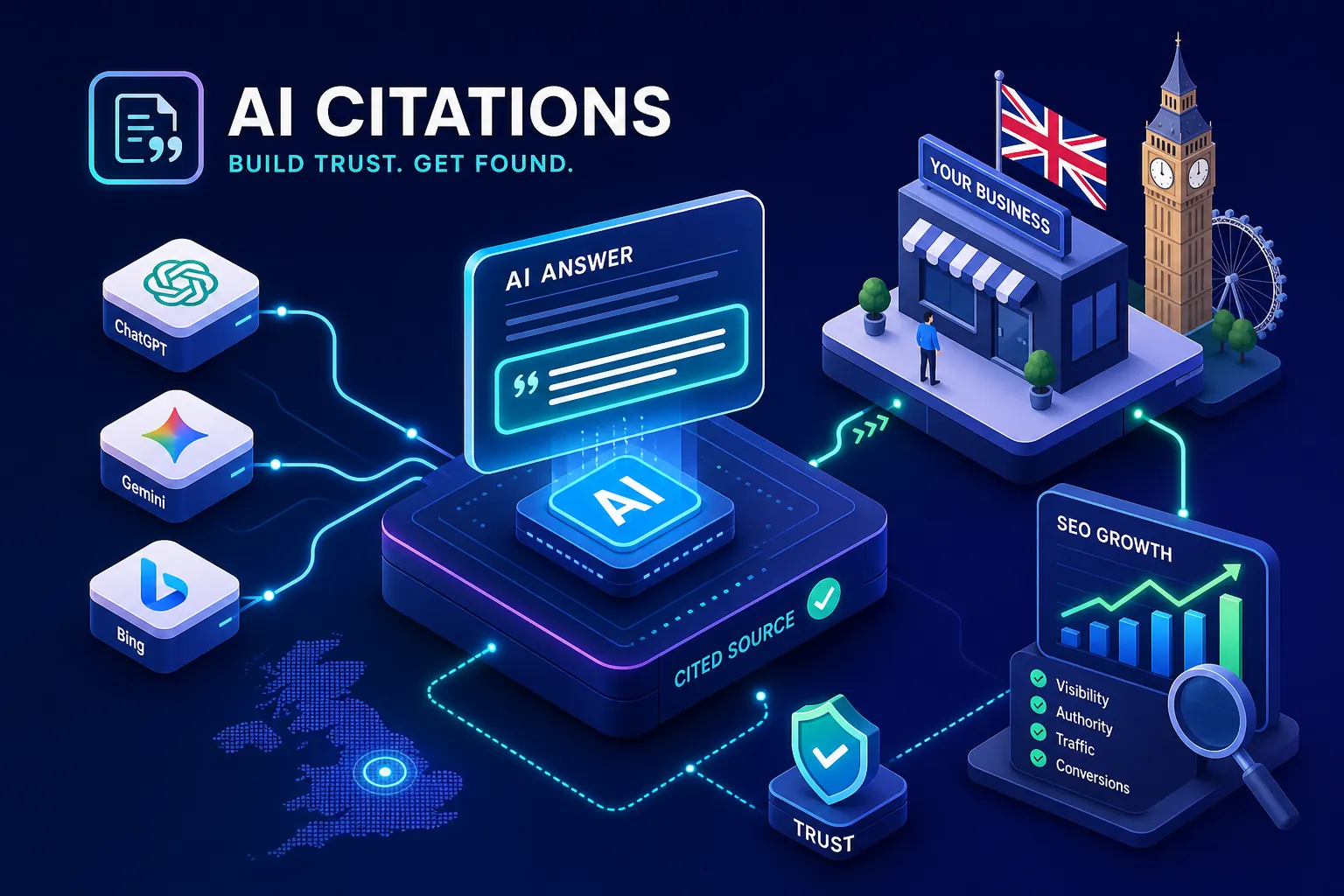
Someone in your target market types a question into ChatGPT or Perplexity right now. An answer comes back, complete and confident, with three or four source links underneath. One of those links belongs to a competitor you’ve barely heard of. Yours doesn’t appear at all. That’s not a ranking problem in the traditional sense. That’s a citation problem, and it’s a different challenge entirely.
AI citation SEO UK is the discipline of earning source mentions inside AI-generated answers, not just positions in the ten blue links. When Google’s AI Overviews, Perplexity, or ChatGPT generate a response to a customer’s query, they pull from a shortlist of trusted, extractable sources. Getting onto that shortlist requires a specific combination of content formatting, technical markup, and authority signals that many UK business websites currently lack some or all of these elements.
Schema markup, the structured code that makes content machine-readable, is more widely adopted on US business websites, though adoption patterns vary considerably by market and sector; many sites, including UK ones, lack the specific schema types most useful for AI citation. That’s an opportunity worth acting on. This article covers the four core citation signals, the content formatting that makes pages citation-ready, which schema types matter most, why video transcripts belong in the strategy, and a concrete seven-step checklist you can act on this week.
AI citation SEO UK: what it actually means for your business
Traditional SEO gets a page into search results. AI citation SEO gets that page quoted as a source inside a generated answer. These are not the same outcome, and conflating them leads to a lot of wasted effort. A page can sit comfortably on page one of Google and still never appear as a citation in an AI Overview, because ranking and citation rely on overlapping but distinct signals.
The process AI systems use works as a three-stage pipeline. A retrieval step finds candidate pages relevant to the query. A passage-selection step identifies usable snippets within those pages. Then a trust-ranking step decides which sources actually get cited in the final answer. A page that clears the first stage but fails the second, because the answer is buried in dense paragraphs or cluttered HTML, never makes it into the response the user reads.
For UK businesses, the starting position is genuinely behind. Schema markup is common on US business websites; it’s the exception rather than the rule here. Most UK sites have the right words on their pages but present them in formats AI systems can’t easily parse or quote. The gap appears to be closing; early adopters have a genuine opportunity to gain advantage before adoption rises more broadly.
How AI systems decide which sources to cite
Based on observed citation behaviour across platforms, four signals play a decisive role in whether a page earns a citation across ChatGPT, Perplexity, and Google AI Overviews.
Relevance and authority
Relevance comes first: the page must semantically match the query, with the title, URL, and on-page wording aligned to the specific sub-question being answered. A broadly relevant page that doesn’t directly address the precise question won’t clear the retrieval stage. Authority determines whether the page is trusted enough to cite. Domain trust, referring domains, brand recognition, and corroboration from other trusted sources all contribute. A well-structured answer on a domain with no external validation is far less likely to be cited than the same answer on a site with genuine third-party credibility behind it.
Extractability and freshness
Extractability is where many good pages fail. The model needs to quote or paraphrase cleanly, and cluttered HTML, buried answers, or walls of unbroken text all reduce the chance of a passage being selected. Freshness matters particularly for time-sensitive queries: pricing, regulation, and market data strongly favour pages with visible update dates and current information. Google AI Overviews lean more heavily on classic search-quality signals, while Perplexity and ChatGPT tend to place more weight on extractability and cross-source corroboration. In practice, optimising for all four signals covers the common ground across platforms without requiring a separate strategy for each.
Content formatting that makes pages citation-ready
The single most effective structural change you can make is to lead every page or section with a direct, standalone answer in the first one to two sentences. Before evidence, before context, before caveats, the answer appears first. This is how AI systems are designed to generate responses, and pages that mirror that structure are far easier to extract from. If the answer to the page’s primary question is buried in paragraph four, most AI systems won’t wait for it.
Self-contained sections and FAQ structure
Each section should be understandable in isolation, without references to “as mentioned above” or “as we covered earlier.” An AI system pulling a passage from your page has no interest in the surrounding context. If the passage doesn’t make sense on its own, it doesn’t get cited. Keep paragraphs to two to four sentences, use descriptive H2 and H3 headings phrased as questions where editorially justified, and commit to one idea per paragraph.
FAQ sections map directly to how AI answer engines work: one question, one focused answer, clearly separated. Adding a well-structured FAQ block to service pages and guides gives AI systems a ready-made source of extractable content. Named entities strengthen citeability further. For UK professional services pages, referencing HMRC, the FCA, Companies House, or the ICO where relevant signals primary-source credibility that vague generalisations never achieve. Display visible publish and update dates, too, freshness tends to matter as a citation signal, and hiding it removes a trust marker that AI systems are inclined to look for.
Schema markup: the technical layer most UK sites are missing
Schema markup is structured code, written in JSON-LD format, that tells AI systems and search engines not just what your page says but what it means: who the author is, what type of content this is, which organisation it belongs to, and how the question-and-answer structure maps to the visible text. Without it, AI systems have to infer all of this from context. JSON-LD helps search engines and crawlers understand page elements, author, date, question-and-answer structure, more reliably and with far less ambiguity.
Four schema types deliver the most direct influence on citation rates. Organisation schema is foundational and belongs on the homepage or global template. It establishes entity identity: name, logo, contact points, and sameAs links to authoritative profiles including your Google Business Profile and LinkedIn page. This tells an AI system who is speaking before it evaluates what is being said. Article or BlogPosting schema adds authorship, publish date, and publisher attribution to editorial content, the credibility layer that signals real expertise rather than anonymous filler.
FAQPage schema is the most directly extractable format for AI answer engines and should be added to any service page or guide where Q&A sections are genuinely visible to users. HowTo schema is strong for procedural queries: step-by-step guides, compliance walkthroughs, and onboarding flows all benefit from it. The practical rule across all four types is to mark up only what users can actually see on the page. Schema that doesn’t reflect visible content may cause the page to be ignored by structured-data processors or, in more serious cases, violate Google’s structured data guidance, in either case, it’s more damaging than no schema at all.
Adoption remains low across many UK sites, which represents an advantage for those who move first. At This Video Works, JSON-LD schema markup is applied across the full content pipeline, video transcripts, written articles, and business identity data, in a single integrated process rather than bolted on afterwards. In many organisations, the video production and technical SEO functions operate separately, which creates gaps between what gets produced and what becomes citable. Bridging both disciplines means every piece of content is immediately readable by AI systems, not just by search crawlers. For UK businesses that don’t want to co-ordinate a video team and a technical SEO agency separately, that integrated pipeline removes the gap between production and visibility.
Why video transcripts belong in your citation strategy
A well-filmed business video typically contains direct, specific answers to the questions your customers are actually asking. Without a transcript, that content is completely invisible to AI systems, it can’t be retrieved, parsed, or cited. The video might be excellent. From an AI citation perspective, it doesn’t exist.
A structured transcript, published as HTML text on the same page as the video and marked up with VideoObject schema, changes that entirely. The spoken content becomes machine-readable, and AI systems can extract passages from it the same way they would from a written article. Transcripts also generate natural FAQ and HowTo content without requiring you to write it from scratch. The questions a client asks during an interview-style filming session become the Q&A structure that drives citation.
The UK businesses most likely to earn consistent AI citations are those producing all three layers simultaneously: authoritative written content, structured data markup, and video content with transcribed and schema-tagged transcripts. A video without a transcript is uncitable. A written article without schema is harder to extract. Schema without authoritative content signals nothing. Producing video and written content together, with schema applied to both from the start, is the most efficient path to AI visibility for UK SMEs.
Practical AI citation SEO UK actions: monitoring and your 7-step checklist
Before you can improve your citation rate, you need to measure it. Several tools now run prompt libraries across the major AI surfaces and record which domains appear as sources. OtterlyAI tracks citations across ChatGPT, Perplexity, Google Gemini, and AI Overviews at a starting price of around $29 per month, making it a practical entry point for most UK SMEs. Peec AI goes deeper, with URL-level citation tracking that distinguishes between a page being used as background context and being directly cited as a source. Profound and LLMrefs offer broader analytics for businesses ready to invest more in monitoring. For those covering AEO (answer engine optimisation) more broadly, tools that track Claude and other emerging AI surfaces are worth adding to your monitoring stack as your programme matures.
For most UK SMEs starting out, the most practical approach costs nothing. Build a list of 10 to 15 questions your customers genuinely ask, run them monthly across ChatGPT and Perplexity, and record whether your domain appears in the citations. This manual baseline tells you where you stand and gives you a benchmark to measure improvement against once the technical work is in place.
The following seven steps are a sequential action plan, not a loose set of suggestions. Work through them in order, because each one builds on the last.
- Add Organisation schema to your homepage with
sameAslinks to your Google Business Profile, LinkedIn page, and any authoritative directories relevant to your industry. - Add Article or BlogPosting schema to every written content page, including author name, publish date, and publisher. If you don’t have named authorship on your content pages, add it before adding the schema.
- Add FAQPage schema to service pages and guides where you answer customer questions visibly on the page. Only add it where the Q&A is genuinely present and useful to a real visitor.
- Rewrite the opening paragraph of your most important pages to lead with a direct answer to the page’s primary question, before any supporting evidence or background context.
- Publish structured transcripts for any video content on your site, as HTML text on the same page as the video, marked up with VideoObject schema including title, description, duration, and upload date.
- Reference primary UK sources such as HMRC, the FCA, the ICO, and Companies House wherever relevant to your content. These named entities add authority signals that vague generalisations never provide.
- Set up monthly citation monitoringusing OtterlyAI, LLMrefs, or a manual prompt-tracking spreadsheet. Record whether your site appears, which URL is cited, and whether the citation is accurate.
AI citation SEO UK is not a future consideration, it’s the mechanism already deciding which brands get recommended inside the answers your customers are reading right now. The gap between businesses applying this discipline and those ignoring it widens every month. Schema, structured content, and video transcripts are the engine that keeps producing results once the foundation is in place. The checklist above is where that foundation starts.