
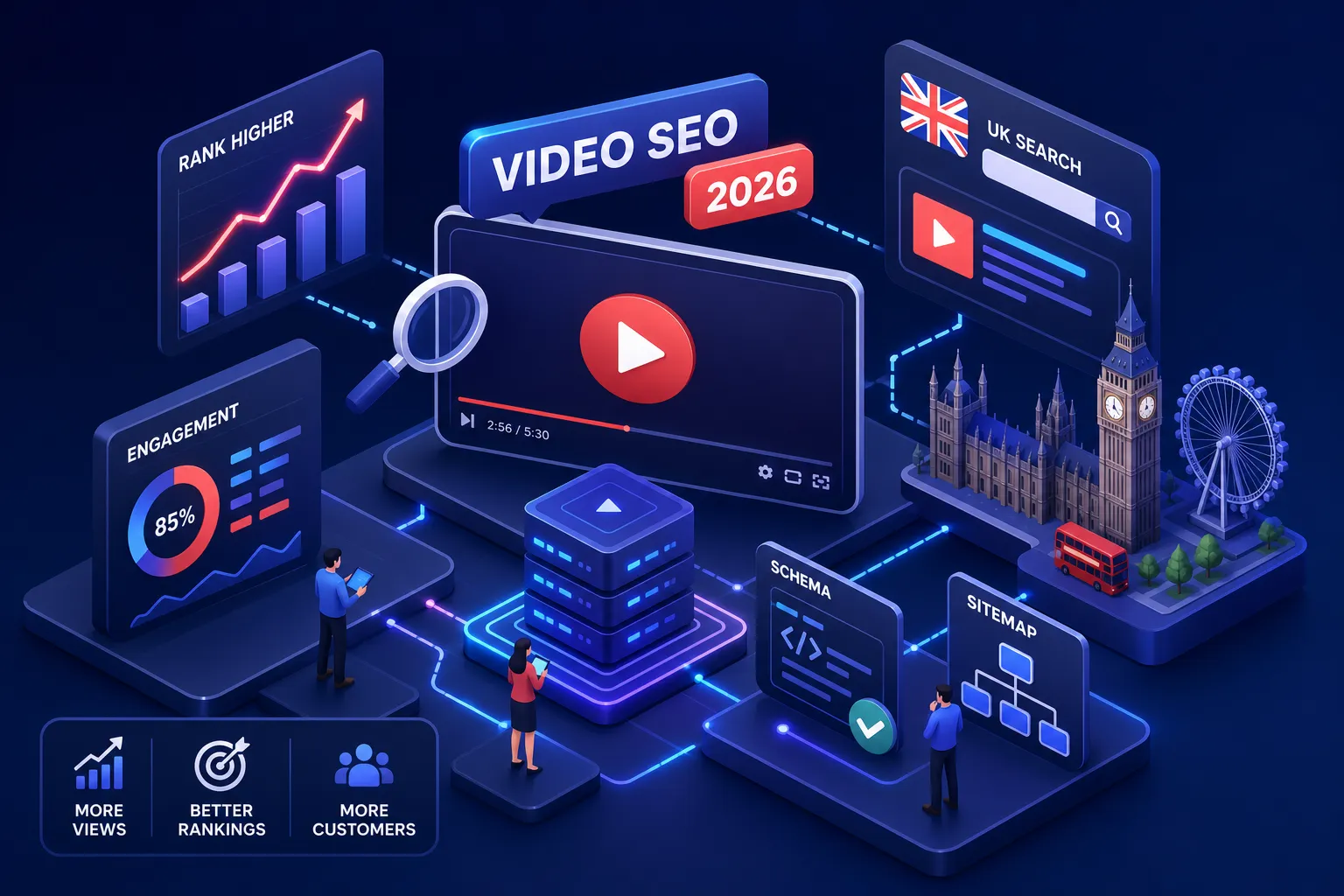
Video SEO in the UK has changed faster over the past 18 months than most businesses have had time to notice. Google AI Overviews now pull video clips and quotes directly into answers. Bing Copilot surfaces video cards in its integrated results, particularly across Microsoft 365 and Edge. Some AI answer engines, including Perplexity, cite video content alongside written sources. Tags, meanwhile, carry far less weight than they once did, transcripts, schema, and metadata structure are the signals that actually move the needle now.
What these systems care about is whether your video content is structured, readable, and answerable. The technical levers, VideoObject schema markup, properly formatted metadata, and full transcripts, are the primary drivers of video search performance in 2026. Many UK businesses are still underusing all three. That gap represents a real competitive opportunity for those who move on it now.
By the end of this article, you will know the core tactics that drive video rankings across Google, YouTube, and AI search in 2026; realistic benchmarks to measure against; what video SEO typically costs in the UK; and a practical checklist to audit your current assets or vet a new provider. A small number of specialist UK providers, This Video Works among them, have built schema and technical SEO directly into their video production process from the outset. Most agencies still treat it as an afterthought, if they touch it at all.
What changed in video search in 2026, and why it matters now
Google AI Overviews rely primarily on transcripts, schema, and on-page context rather than raw visual engagement signals. The mechanism is structured data: AI systems extract quotable passages, match them to specific queries, and assess whether a video genuinely answers the user’s question. A video without a transcript or schema is significantly less likely to be cited by AI Overviews or to appear in rich results, regardless of view count or channel authority.
This creates a distinction that many UK businesses are missing. Ranking on YouTube is a platform algorithm problem: watch time, click-through rate, and audience retention drive those results. Ranking in Google’s video carousel or appearing in an AI Overview is a crawlability and structured data problem. These are different disciplines. Optimising only for YouTube whilst ignoring Google video search leaves a real traffic channel completely unaddressed.
Bing now accounts for a growing share of UK search through Microsoft 365 and Edge integrations, particularly in professional and enterprise environments. Bing Copilot surfaces video content in a similar way to Google AI Overviews, reading structured data and transcript content rather than inferring intent from engagement metrics alone. Cross-engine optimisation is no longer a nice-to-have for B2B businesses; it is a straightforward competitive lever.
Why transcripts are now your most powerful video SEO UK asset
Titles and descriptions give a topic signal. Transcripts provide the full semantic map. AI engines use transcripts to extract quotable passages, match specific queries at a granular level, and determine whether a video genuinely addresses the user’s question. A description can tell Google your video is about “pension advice for small business owners”; a transcript can tell Google the exact moment you explain the difference between a SIPP and a workplace pension, and surface that timestamp in an AI Overview answer.
Best transcript format for indexability
The format of the transcript matters as much as its existence. An auto-generated caption file is useful, but a properly structured transcript, published as indexable text on the video landing page, is significantly more valuable. It gives Google body copy to crawl, index, and rank independently of the video itself.
Chapter markers and timestamp SEO
Chapter markers that break the transcript into labelled sections take this further. They allow search engines to surface the exact timestamp that answers a query, rather than pointing to the full video and leaving the user to find the relevant part themselves. Google’s own case study data supports the impact: ABP Network saw an 841% increase in video clicks and a 353% increase in impressions after implementing video best practices, with transcript and caption provision as a core component. (Source: Google Search Central case study, ABP Network.) That is not a marginal improvement, it is a fundamental change in what the content can do in search.
Schema markup: the technical layer most UK video agencies skip
VideoObject schema is structured code that tells Google, Bing, and AI systems exactly what a video contains: who made it, when it was published, how long it runs, what the thumbnail is, and where the content lives. Without it, search engines have to infer this information, which means slower indexing, less accurate placement, and no eligibility for video rich results.
The required fields are name, description, thumbnailUrl, uploadDate, and either contentUrl or embedUrl. Recommended additions include duration, publisher, and inLanguage. All fields must match the actual page content to pass validation, you can check your implementation using Google’s Rich Results Test at search.google.com/test/rich-results.
Schema markup is widely implemented across US markets. In the UK, it remains significantly underutilised, which creates a clear competitive window for businesses that act now. Many UK video production companies stop at filming and editing. A significant number of SEO agencies focus on written content and rarely touch video schema. The result is a gap that very few providers currently fill.
This Video Works closes this gap by applying VideoObject schema to every video asset as part of the production and publication process, alongside transcript alignment and metadata structuring. This integrated approach is what gets small UK businesses into AI Overviews rather than leaving them invisible beneath competitors who moved earlier. If you are briefing a video SEO provider and they cannot tell you exactly which schema fields they implement and how they validate them, that is a clear signal to keep looking.
The ranking signals that still drive video performance
Watch time and retention sit at the top of the ranking factor hierarchy, followed by click-through rate driven by title and thumbnail, then transcript and caption relevance, with tags a distant fourth. YouTube’s algorithm has shifted toward viewer satisfaction as measured by post-watch behaviour: return visits, shares, likes, and survey responses matter more than raw watch time as a standalone figure. The practical implication is that a video with strong retention but modest view counts will outperform a viral video that people abandon after 30 seconds.
The benchmarks to target for UK business video are specific. A good CTR sits between 2% and 5% for business content. Strong average view duration for a video under five minutes is 60% to 70% completion. Anything under 40% retention signals either a content mismatch or an audience targeting problem, and it will suppress distribution regardless of how well the metadata is optimised. For organic YouTube B2B content specifically, a CTR of 4% to 7% is solid; anything above that is strong performance.
Custom thumbnails outperform auto-generated frames consistently. Titles should reflect the exact search query the viewer would have typed, not the internal name of the video or the creative shorthand your team uses. These two elements control whether the video receives enough initial traffic to generate the engagement data that drives everything downstream. A technically excellent video with a weak thumbnail and a vague title will underperform a simpler video that nails both.
Agency vs in-house: what video SEO costs and what to measure
UK video SEO agencies operate across a broad pricing range. Based on current directory listings, most fall in the £75 to £150 per hour equivalent, with project minimums typically starting around £1,000 for smaller audits and optimisation sprints. Comprehensive monthly retainers or multi-video campaigns move into £5,000 territory, with enterprise-level programmes pushing beyond £10,000. Standard deliverables at agency level include channel audits, keyword and metadata optimisation, thumbnail testing, caption provision, and analytics reporting. Schema markup and transcript structuring are less commonly included, worth checking explicitly before you commit.
The deciding factor on agency versus in-house is almost always schema implementation. Many in-house content teams lack the specialist schema skills required to write and validate structured data, align it with page content, and maintain it as video assets evolve. For most UK SMEs, the most cost-effective approach is a hybrid model: keep content strategy and metadata work in-house, and bring in a specialist for schema implementation and technical audit.
Set your measurement framework before any work starts. Awareness KPIs are impressions, view rate, and reach. Engagement KPIs are average view duration and completion rate. Action KPIs are click-through to site, conversions, and leads. Results from well-executed video SEO can often become measurable within 60 to 90 days of proper schema and transcript implementation, though timelines vary by market and competition. One UK case study (One Vision Health / Veincentre) recorded a 58% uplift in organic traffic and a 55% improvement in contact form conversions following a structured video campaign, which gives you a useful upper benchmark to aim for.
A practical checklist to audit or brief any video SEO provider
Before hiring an agency or briefing an in-house team, run each video through this audit. The gaps you find tell you exactly what to prioritise, and the questions at the end will separate technically capable providers from those that simply optimise titles and stop there.
- Filename: descriptive and consistent, with no spaces or special characters
- Metadata: title, description, and tags accurately reflect the search query being targeted, not the internal project name
- Chapters: timecoded markers present with descriptive labels aligned to content breaks
- Captions: synchronised, accurate, published in the correct language for the target audience
- Schema: VideoObject structured data implemented and validated on the landing page, with all required fields matching the page content
- Landing page: on-page copy, headings, and internal links reinforce the video topic; transcript published as indexable text
- Distribution plan: platforms, publish dates, and social cutdowns defined before publication, not after
Three questions worth putting to any prospective provider: Do you implement VideoObject schema as standard on every video landing page? Do you publish transcripts as indexable page text rather than only as a closed-caption file? How do you report on AI Overview visibility and citation, not just YouTube impressions?
If a provider cannot answer all three clearly and specifically, you are looking at a traditional video marketing service, not a video SEO service. The distinction matters in 2026 more than it ever has.
Where to focus next
Video SEO for UK businesses in 2026 is a technical discipline as much as a creative one. The technical layer, transcripts, schema, properly structured metadata, is now a baseline requirement for businesses that want AI-driven visibility. Creative quality matters, but without it, even strong video content struggles to be found by the systems that now dominate how people discover information.
If you are assessing whether to hire a provider or handle this in-house, the schema and transcript layer is the most useful place to start your evaluation. It is where many agencies fall short, and it is where the competitive gap is currently widest in the UK market. Agree on benchmarks before any work starts, and measure against both platform analytics and Google Search Console video data, those two sources together give you a complete picture of what is working.
For UK businesses that want production and technical SEO handled in a single pipeline rather than patched together from two separate suppliers, This Video Works offers an integrated route worth exploring. Start by running the checklist above against your most recent video. What you find will show you precisely where to focus first.