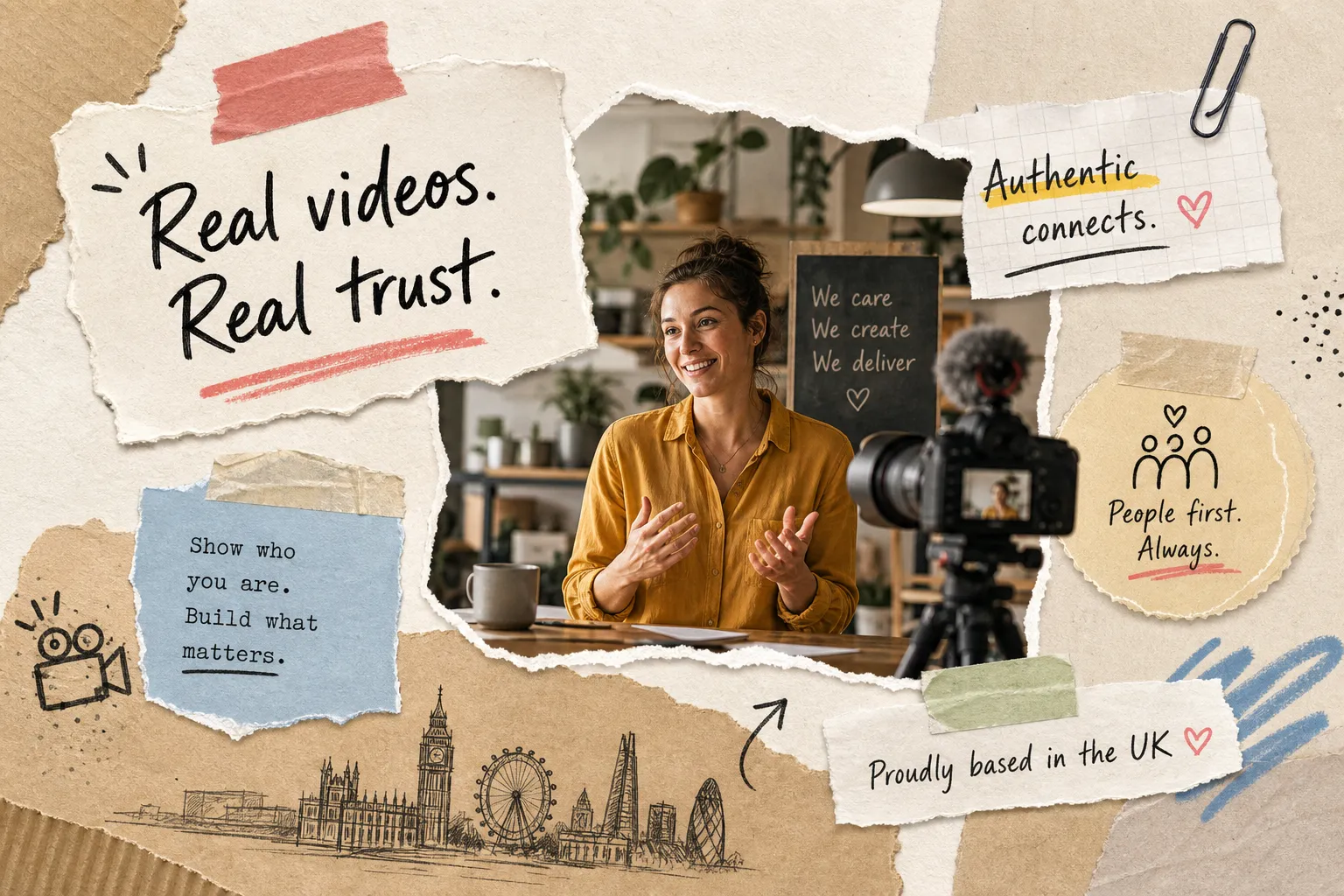
Authentic business video UK: if you have sat through a corporate video that left you cold, you already understand the problem. The production was expensive, the lighting was perfect, and yet something about it felt rehearsed and oddly unconvincing. That gap between polish and persuasion is the central problem with most business video in the UK right now, and it is why authentic business video in the UK often outperforms its glossy counterpart in engagement, enquiry quality, and measurable commercial outcomes. This article covers everything you need to plan, commission, or self-produce video that actually works: which formats to choose, how to appear natural on camera, what UK production costs look like in 2026, platform specs that matter, and a briefing template you can use with any agency.
The performance gap is well-documented. Authentic, conversation-led video drives stronger engagement, longer watch time, and better-quality enquiries than branded advertising. On LinkedIn, the difference is striking: according to video benchmark data from the platform and independent analysis, organic talking-head video averages roughly 5.5% to 6.5% engagement, while polished sponsored video ads typically sit at around 1.6% to 1.8%, a three-to-four times multiple in engagement rate. Production costs for organic talking-head content are also substantially lower than polished branded ads, though the gap varies by project scope. Understanding why that happens is the first step to doing something about it.
Why polished corporate videos quietly destroy trust
The credibility gap in scripted, over-produced content
Modern viewers, particularly UK B2B buyers, are trained to filter out promotional messaging. Logo-heavy intros, marketing-speak delivered to a teleprompter, and the unmistakable cadence of someone reciting an approved script all register as inauthentic almost immediately. The production quality becomes irrelevant when the delivery feels manufactured, because the viewer’s instinct is to discount anything that has clearly been shaped by a PR or compliance team rather than spoken from genuine experience.
What UK viewers actually respond to
What viewers respond to instead are the psychological signals of real conversation: natural eye contact, varied speech rhythm, the occasional pause or self-correction, and evidence that the person on screen actually knows what they are talking about. These cues trigger trust in a way that scripted delivery simply cannot replicate. In professional services, SME sales, and any high-consideration purchase, trust is the primary currency, and video is one of the most efficient ways to build it quickly at scale.
The commercial cost of looking too polished
The performance gap shows up in real numbers. One UK bakery campaign using authentic vertical video reported a 42% uplift in footfall, a 320% increase in local search impressions, a 90% increase in directions clicks, and an estimated £11,400 in additional sales against under £2,600 in production costs. Behind-the-scenes and testimonial content consistently outperforms branded corporate advertising in engagement, watch time, and enquiry quality. Whilst a single case study cannot be treated as universal, the direction of travel across practitioner data points the same way: authentic formats tend to outperform over-produced ones for trust-based objectives.
Authentic business video UK: formats that work
Behind-the-scenes and talking-head videos for awareness and trust
Behind-the-scenes content works because it removes the promotional frame entirely. When viewers see how a business actually operates, who works there, and what the process looks like in practice, they are making their own judgements rather than receiving a curated message. Talking-head video achieves something different but complementary: it places the founder, expert, or team member directly in front of the viewer as a human being rather than a brand. Both formats perform especially well for employer branding, thought leadership, and early-stage awareness.
Testimonials and case study walkthroughs for conversion
Customer-led video is more persuasive than anything a brand says about itself, particularly in B2B and professional services where social proof is critical. The structure that makes testimonials genuinely convincing rather than generic is straightforward: problem, solution, result, recommendation. A client describing a specific challenge they had, why they chose you, what changed, and what they would tell someone else considering the same decision is worth more than any amount of brand-approved copy. Case study video fits naturally into longer sales cycles, giving prospects the evidence they need to commit.
Choosing the right format for your goal
The decision is more straightforward than most people make it. If you need to build trust quickly, behind-the-scenes content or a testimonial is your starting point, both give viewers unfiltered evidence rather than a rehearsed pitch. If you want to establish founder or expert authority, a talking-head series is the most direct route: consistent, topic-led clips that demonstrate genuine knowledge. If you are trying to close deals in a competitive market, a well-structured case study with specific, verifiable outcomes will do more work than almost any other content type.
How to appear natural on camera without memorising a line
Why teleprompters and scripts produce the opposite of authenticity
Word-for-word scripted delivery produces a recognisable and instantly readable look: the unnatural pacing of someone reading rather than talking, the visible cognitive effort of recall, and a flatness that viewers register even when they cannot name it. Research into perceived authenticity consistently identifies scripted delivery as a trust-reducer. The result is that a technically competent teleprompter performance can make a genuinely credible expert appear less trustworthy than an unedited phone video of the same person answering a question spontaneously. Conversation-led filming, guided by questions and talking points rather than memorised lines, bypasses the problem entirely.
The prompt-led approach used by This Video Works
At This Video Works, we use a conversational, prompt-led filming methodology designed specifically to draw out genuine, trust-building responses from people who have never been in front of a camera professionally. The approach works because it is a real conversation, not a performance. Solicitors who arrived expecting to freeze have left with clear, articulate explanations of their expertise, and the footage to prove it. SME directors who said “I’ll be terrible on camera” have delivered quotable content that their sales teams now use in prospect meetings. The method is not about making people look polished. It is about making them look real, which turns out to be considerably more effective.
Practical techniques for anyone filming themselves or their team
If you are self-producing content, the single most useful shift is moving from scripts to talking points. Write down three to five key ideas rather than a word-for-word text, and answer easy questions first to warm up before addressing the main topic. Look at the lens as though you are speaking to a specific person, not a camera. Keep answers short and natural rather than trying to deliver a complete, perfectly structured monologue. Every retake is free, so use them without hesitation.
What authentic business video actually costs in the UK in 2026
Short-form social video vs a full corporate production
The UK market in 2026 breaks down into two broad tiers. Short-form social video sits between £150 and £500 for a basic edited clip, £500 to £1,200 for agency-produced social content, and £800 to £2,500 for a more developed package with multiple cuts and aspect ratios. Polished corporate video typically runs from £3,000 to £10,000 for a standard production, and £5,000 to £15,000 for a professional branded project with crew, motion graphics, and colour grading. The difference is driven by crew size, shoot days, scripting work, and the complexity of post-production. These are indicative ranges; actual costs vary depending on brief complexity, location, and supplier.
Where to spend and where to save
The practical advantage of authentic business video production UK-wide is that it is genuinely less expensive to produce than heavily scripted corporate work. Fewer takes, simpler editing, and minimal pre-production scripting all reduce cost. Where it is worth investing is in audio quality, a clean and relevant location, and a skilled interviewer or director who can guide the subject into natural, usable answers. Practitioner experience consistently puts sound quality and interview quality ahead of lighting rigs and motion graphics in terms of impact on perceived authenticity and usability. Authenticity and affordability, in this case, tend to point in the same direction.
Platform specs and timing that matter for UK audiences in 2026
LinkedIn and YouTube: where professional credibility lives
For LinkedIn, the strongest-performing format for the feed is 4:5 portrait at around 1080×1350, with 1:1 square as a reliable fallback. These are best-practice recommendations based on current platform guidance rather than enforced rules. Ideal length for organic video is 30 to 90 seconds. Captions are essential because a significant proportion of LinkedIn video is watched without sound. Your first frame needs to earn the watch before the viewer scrolls past. YouTube rewards a different approach: Shorts at 9:16 for 15 to 60 seconds, long-form at 16:9 for 6 to 12 minutes with a search-led structure. Both platforms tend to reward substantive, credibility-building content.
Instagram Reels and TikTok: where discovery and reach happen fast
Both platforms use 9:16 at 1080×1920. The sweet spot for retention on Reels is 9 to 30 seconds, with 15 to 30 seconds delivering roughly 45% to 60% average view-through. TikTok rewards an informal, native feel with trend awareness and an immediate hook, trend-led formats can drive strong discovery, whilst substantive and authentic content tends to perform better for retention and conversion. Authentic behind-the-scenes content and founder video performs particularly well on both because the algorithm responds to genuine engagement signals rather than production values.
The one rule that applies across every platform
Mobile-first framing is essential for the vast majority of social placements in 2026. Frame key visuals in the centre to avoid being obscured by UI overlays. Add open captions to every video, regardless of platform. Open with a hook in the first three seconds that gives the viewer a clear reason to keep watching. These principles apply whether you are posting a LinkedIn talking-head or a TikTok behind-the-scenes clip.
How to brief a UK agency for genuinely authentic results
What to include in your agency brief
A strong brief covers the following:
- Your primary goal and the specific metric that would make this video a success
- Your target audience and what you need them to think, feel, or do after watching
- Your core message in a single sentence
- The proof points you are comfortable putting on record
- Tone direction (natural, conversational, unscripted)
- Deliverables including cut-downs and aspect ratios
- Distribution channels
- The timeline with review rounds and approvals
One instruction worth including verbatim: “Please film this as a conversation, not a memorised script.”
The conversation-led interview structure for testimonials
Brief your agency to use open questions and talking points rather than a prepared script. The structure that works for testimonial video UK projects follows a clear arc: opening context, the problem or challenge the client faced, why they chose your business, what changed as a result, specific evidence or outcomes, and a genuine recommendation. For the shoot itself, you need three layers of footage: A-roll interview at wide, medium, and close angles; B-roll of the subject working or demonstrating; and context shots including environment wides, detail inserts, action footage, and natural candid moments. A closing hero frame is worth capturing for end cards and thumbnails.
Measuring results after the shoot
The metrics that matter for authentic business video are engagement rate, watch-through percentage, the quality and volume of comments, direct enquiries attributed to the video, and changes in time on page when the video is embedded on a website. The bakery example cited earlier, with its 42% footfall increase and 320% search impression uplift, illustrates what is achievable when format, content, and distribution are well-matched, though results will vary by sector, audience, and distribution. Set a baseline before you publish and revisit the numbers at 30, 60, and 90 days.
The most effective business video right now is the most honest
Many of the businesses generating the strongest results from video in the UK in 2026 are not the ones with the biggest production budgets. They are the ones willing to put a real person on camera, speak plainly about what they do and why it matters, and distribute that content consistently on the platforms their audience actually uses. This article has outlined a practical path to get there: a format decision framework, on-camera techniques that remove the fear of scripting, realistic UK production costs, platform specs for LinkedIn, YouTube, Reels, and TikTok, and a briefing template you can hand to any agency.
Authentic video marketing in the UK is not a trend. It is a shift in how buyers evaluate credibility, and the practitioner data on engagement, watch time, and commercial outcomes points consistently in its favour. If you want faster credibility with your audience, start producing authentic business video UK-style: plain-speaking, consistently distributed, and built around real conversations rather than rehearsed scripts.
If you want help getting there, This Video Works offers the full pipeline: pre-production research, prompt-led filming, schema markup, and distribution strategy built for AI search and social platforms. Visit This Video Works to find out what a conversation-led video could do for your business.