
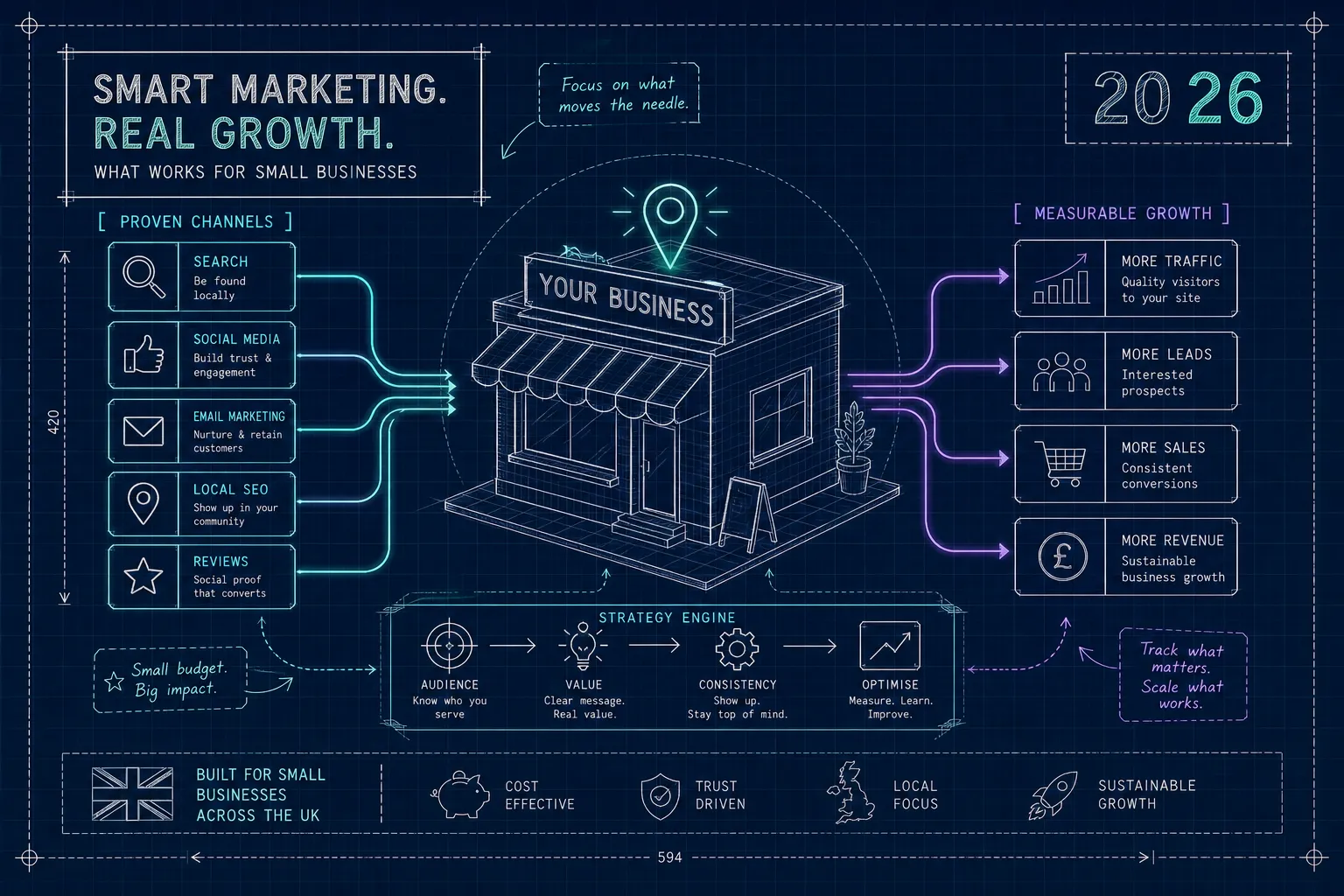
Picture a skilled plumber in Worcestershire or a heritage builder working across the Cotswolds. They do exceptional work, their existing clients love them, and yet the phone sits quietly most mornings. The problem isn’t their craft, it’s that nobody knows they exist online. If you run a local trades firm or small business in the UK, understanding small business marketing in the UK in 2026 could fundamentally change how customers find you. It doesn’t have to cost a fortune or consume your weekends, but it does need to be deliberate.
The businesses growing steadily right now aren’t spending more than everyone else. They’re spending smarter and showing up consistently in the right places. Take Building You A Home, a residential and commercial contractor operating across the West Midlands and the Cotswolds. By building a professional web presence backed by quality video content, they’ve demonstrated how even a niche trades business can stand out in a competitive market when the marketing is built with intention rather than guesswork.
By the end of this article, you’ll know which channels to prioritise, what a sensible budget looks like, and how to put together a clear 90-day small business marketing strategy for the UK market that you can act on today.
Where UK customers actually go to find local businesses
How people search before they contact a business
The buying decision happens long before a customer picks up the phone. According to BrightLocal’s Local Consumer Review Survey, 58% of UK consumers start local discovery with a traditional search engine, and Google is trusted by 66% of people when researching local businesses, with Google Maps close behind at 45%. By the time someone is ready to call or enquire, they’ve already read your reviews, scrolled your photos, and formed a firm impression of whether you’re worth contacting.
This means your online presence is already doing your selling before you’ve said a single word. A poorly completed profile, a slow website, or a blank photo gallery will cost you business you didn’t even know you were being considered for. Getting your digital foundations right is the highest-leverage thing most small businesses can do, and it costs far less than most owners assume.
Why social media is now a genuine discovery channel
Social platforms have moved well beyond brand awareness. In 2026, social media ranks as the second most common route through which UK consumers discover a new local business, sitting ahead of online review platforms. Facebook is still used weekly by 30% of consumers to look up local businesses, while TikTok reaches 31% monthly for local discovery.
The practical takeaway is straightforward: being findable on at least two or three channels is the new baseline for any SME marketing strategy in the UK, not an optional extra for ambitious businesses. Your potential customers are scrolling before they search, and if your business isn’t visible, a competitor’s is.
Small business marketing UK: channels that deliver results
Local SEO and your Google Business Profile
Your Google Business Profile is the single most impactful free action you can take today. Despite this, an estimated 44% to 56% of UK small businesses still haven’t fully verified and completed theirs. A well-optimised profile includes accurate opening hours, high-quality photos, relevant service categories, regular posts, and timely responses to reviews. Each of these signals tells Google that your business is active, legitimate, and worth surfacing to nearby searchers.
Local SEO extends beyond the profile itself. Your website’s on-page content, consistent contact details across directories, and the volume of genuine customer reviews all contribute to how prominently you appear when someone nearby types “builder near me” or “plumber Stratford-upon-Avon.” None of this requires a large ad spend. What it does require is consistency and close attention to detail maintained over time.
Social media: picking the right platform for your business type
Most UK SMEs make the same mistake: they open accounts on five platforms and post sporadically on all of them. Choosing one or two platforms and showing up consistently will deliver far better results than spreading yourself thin. Retail and hospitality businesses typically perform best on Instagram, TikTok, and Facebook, while professional services and construction trades tend to see stronger returns from LinkedIn and Google Search.
For trades businesses specifically, before-and-after project photos, short site progress updates, and genuine client testimonials are among the most effective content formats available. These work because they answer the exact question a potential customer is asking: “Can this business actually do what they say they can?” Show the work, and let the work do the persuading.
Video and demo content as a trust-building tool
For service-based businesses, where customers can’t handle a product before they commit, professional video content carries disproportionate weight in building trust. According to Wyzowl’s annual Video Marketing Report, 89% of people say video quality influences how much they trust a brand. It’s worth noting that Wyzowl are themselves a video software company, so treat the figure as directional rather than independent, but the broader principle is consistently supported: for a trades or construction business, a well-produced video is a credibility signal that separates professional operations from the competition.
Building You A Home illustrates this clearly. The demo site, created by This Video Works, a Manchester and London-based video production and marketing agency, combines quality video content with a clean, well-structured website to show precisely how a niche contractor can present itself professionally online. A well-built digital presence tells prospective clients that a business is organised, serious, and capable. For someone about to commit thousands of pounds to a renovation or commercial fit-out, that trust signal can be the difference between an enquiry and a bounce.
Content marketing compounds over time in a way that paid advertising rarely does. Regular project case studies, useful blog guides, and service-specific landing pages gradually build search authority and give your audience a reason to return and refer you to others. Merge that with quality video and you have a content engine that works around the clock.
Setting a realistic marketing budget as a UK SME
The 5, 12% rule and what it means in practice
Most UK SMEs should allocate between 5% and 12% of annual revenue to marketing. Established businesses with stable pipelines can sit comfortably at the lower end, around 7% to 10%, while growth-stage businesses or those entering new markets should lean closer to 10% to 20% to build awareness at pace.
In real terms, a business turning over £150,000 per year should feel comfortable committing between £10,500 and £18,000 to marketing over the course of a year. That budget covers website maintenance, a modest paid search campaign, regular content production, and consistent social activity. For paid search specifically, the UK average cost-per-click sits around £5.26, so any campaign budget needs to reflect realistic volume expectations from the outset.
Free and low-cost resources to stretch your spend
You don’t need to spend everything at once. Several high-quality free resources exist specifically for UK small businesses. Google Business Profile costs nothing to set up and manage. The FSB offers free social media courses and a digital marketing guide for members. Start Up Loans publishes a free marketing toolkit designed for small business owners building from scratch. Google Digital Garage and HubSpot Academy both provide free training covering SEO, email marketing, and content strategy.
Email marketing deserves particular attention because its return on investment is consistently strong. According to DMA UK research, approximately £36 is returned for every £1 spent on email marketing for retail and ecommerce businesses. For service businesses with an existing client base, a simple regular email update costs almost nothing to produce and keeps your name front of mind when a referral opportunity arises.
How to build a 90-day small business marketing plan
Weeks 1 to 4: lay the foundations before you spend anything
Before committing any budget to advertising or content, audit what you already have. Check your Google Business Profile is fully completed and verified, test your website on a mobile phone and confirm it loads quickly, and look for any existing customer reviews that haven’t been responded to. This groundwork costs nothing but ensures any subsequent spend lands on solid foundations rather than a leaking bucket.
Once you’ve completed the audit, choose one or two channels that genuinely fit your industry and audience. Then set one clear, measurable goal for your first quarter: more enquiry form submissions, more calls from local search, or a specific number of new social followers who convert into leads. One clear goal with a number attached is worth more than three vague intentions.
Weeks 5 to 12: test channels and build consistent content
With your foundations in place, begin producing content for your chosen channels. A manageable starting rhythm for most small businesses looks something like this:
- Two or three short social posts per week
- One longer blog post or project case study per month
- At least one short video per fortnight, if you have the resource
Consistency matters more than volume at this stage. Track what performs and what doesn’t, after 30 days of regular activity, you’ll have enough real data to make decisions rather than assumptions. Double down on what’s generating enquiries and cut what isn’t. By week 12, you’ll have a clear baseline of channel performance that tells you exactly where to direct next quarter’s budget.
Measuring results with a simple KPI dashboard
The three metrics every small business should start with
Start with three numbers, not fifteen. Website sessions tell you whether your marketing is reaching people at all. Leads or enquiries tell you whether those people want to engage with your business. Revenue from those leads tells you whether the whole effort is paying off. These three metrics cover acquisition, conversion, and revenue, the only marketing outcomes that genuinely matter for a small business at this stage.
Set a target for each metric at the start of your 90-day plan. Without a target, you have raw numbers but no context, and context is what turns data into decisions. If you generated 400 website sessions in month one and 600 in month two, that’s progress worth building on. If you generated 400 enquiries but converted only 3, that’s a conversion problem worth investigating without delay.
How to track by channel without expensive software
You don’t need expensive tools to run a clean, useful dashboard. GA4 handles website traffic and source attribution for free. Your CRM, email inbox, or a simple spreadsheet handles lead and enquiry counts. Your accounting system handles revenue. Used consistently, these three tools give you a complete picture of which marketing activities are generating real business.
| Section | KPI | What it tells you |
|---|---|---|
| Acquisition | Website sessions | Whether your marketing is reaching people |
| Acquisition | Traffic by channel | Which channels are sending visitors |
| Conversion | Leads or enquiries | How many prospects you’re generating |
| Conversion | Cost per lead | Efficiency of your lead generation spend |
| Revenue | New customers | How many leads become paying clients |
| Revenue | Revenue or ROAS | Whether the whole effort is paying off |
Review results monthly for most businesses, and weekly if you’re running active paid campaigns. Paid media can consume budget quickly without regular checks, and catching a poor-performing campaign early saves far more than any optimisation made after the fact.
Building your marketing system, one quarter at a time
Effective small business marketing in the UK doesn’t require a large agency contract or an eye-watering ad spend. What it requires is clarity about who your customers are, consistency on the right channels, and the discipline to measure what’s working and adjust accordingly. That combination, applied steadily, is what separates the businesses that grow year on year from those stuck chasing one-off enquiries.
This 90-day framework moves the needle on small business marketing in the UK by prioritising foundations first, then channel testing, then measurement and iteration. Each quarter builds on the last, and the cumulative effect of that systematic approach compounds in ways that any single campaign never will.
Businesses in even the most traditional sectors are proving this works. Our construction demo Building Your Dream demonstrates how a heritage construction contractor operating across the Cotswolds and West Midlands can present itself as credibly online as any large firm, by showing up professionally, producing quality content, and meeting customers where they already search. That’s not a digital marketing miracle; it’s a deliberate system applied with consistency.