
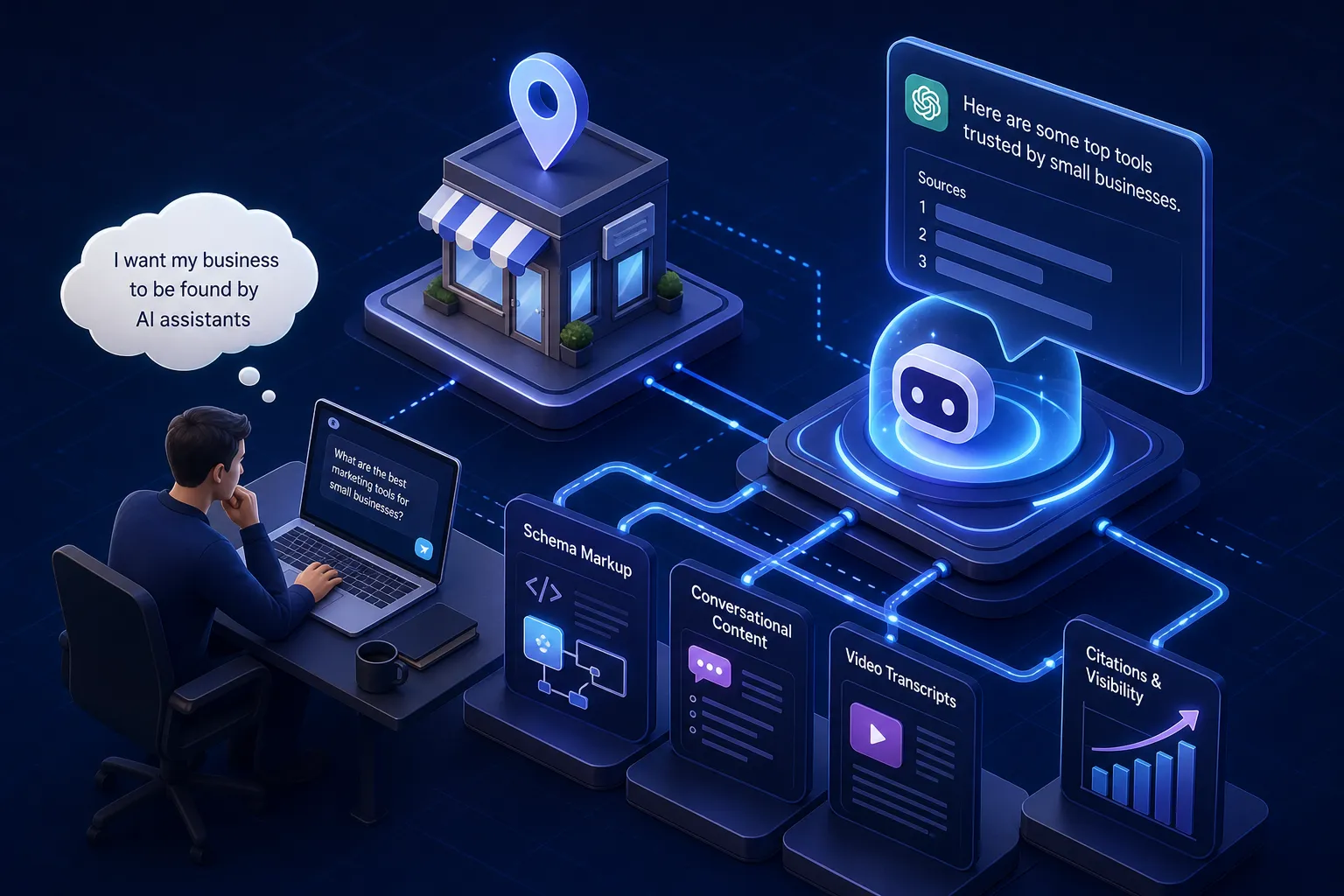
To optimise content for ChatGPT and Gemini search, UK businesses need to think about how AI assistants actually retrieve and select information, and most aren’t set up for it yet. ChatGPT, Gemini, and Perplexity don’t browse your site the way a human does. They retrieve and rank from specific signals, then synthesise an answer, and the businesses getting cited are the ones who’ve structured their content deliberately around those signals.
This isn’t about gaming algorithms or chasing the latest SEO trick. It’s about understanding how these systems actually work, then aligning your content to match. At This Video Works, we’ve been applying exactly this approach for UK SMEs: threading together video production, written content, and technical schema markup into a single AI-optimised system. What follows is the practical version of what that looks like.
How AI search systems actually find and pick content
Most people assume AI search works like a smarter version of Google. It doesn’t, and that assumption leads to content that gets ignored. Understanding the real pipeline is what separates citable content from content that never surfaces.
ChatGPT, Gemini, and Perplexity all use a retrieve-then-rank-then-generate process. Here’s how it works in sequence:
- Your query gets rewritten into one or more sub-queries.
- A live index is searched (often using Bing-oriented infrastructure).
- Candidate pages are ranked on relevance, recency, and credibility.
- Specific passages are selected and synthesised into an answer with citations.
The system doesn’t read your whole page. It reads your snippet, decides whether to open the page, and then reads it in focused chunks, though the exact behaviour does vary by product and indexing strategy.
At the first stage, your title, URL, and meta snippet determine whether the page gets opened at all. At the second stage, the AI scans for the most relevant passage, not the most comprehensive one. Sections near headings, short self-contained paragraphs, and explicit question-and-answer pairs tend to get selected. If a passage can’t stand alone without surrounding context, it’s often skipped entirely.
How to align your content to conversational search queries
LLM retrieval systems prioritise content that mirrors the way a person would ask a question. If your content is written for crawlers or for formal publishing conventions, it’s structured wrong for this environment. The fix is straightforward once you know what to look for.
The most retrievable structure puts the direct answer within the first one or two sentences of every section, before any supporting detail or caveats. This is the canonical answer block: the passage a model can extract and cite without reading anything else on the page. Think of it as writing the summary before the explanation, every time, for every section.
Headings shaped like actual queries, “what does X mean”, “how do I do Y”, “which option works best for Z”, align directly with the sub-queries AI systems issue during retrieval. These intent-specific headings act as chunking anchors, making each section retrievable as its own discrete unit. That’s exactly how passage-level selection works across both ChatGPT and Gemini.
Explicit question-and-answer sections are highly quotable. They match retrieval queries directly and are formatted in a way models find easy to extract. Keep each answer to two or three sentences. Definitions work similarly: start with “what it is” before adding nuance, so the definition itself becomes the citable passage rather than a paragraph the model has to dig through.
Apply schema markup to optimise content for ChatGPT and Gemini search
Structured data is the technical layer that tells AI and search engines what your content is, who produced it, and what question it answers. It doesn’t guarantee a citation, but without it, you’re relying entirely on a model’s ability to infer context from plain text, a gap worth closing.
The schema types that matter most for AI citation are:
- FAQPage: exposes question-and-answer pairs in machine-readable format, directly matching the way AI systems synthesise answers to user queries.
- HowTo: breaks procedural content into discrete steps, which AI systems can reuse cleanly for “how do I” queries.
- Article / BlogPosting: provides attribution signals including author, publisher, and publication date, which influence whether a source is considered citable.
- Organization and Person: establish entity identity with credentials and consistent naming, building authority beyond the individual page.
- LocalBusiness / Service: clarify what your business offers and to whom, which matters for local and service-based queries.
JSON-LD sits in the page head as a clean block of structured code, separate from your visible content. It communicates entities and relationships in the language search and AI systems natively read. At This Video Works, this is the standard we apply across video pages, written articles, and business profiles for UK SME clients, schema coded in so AI systems can identify, read, and cite the content immediately. In our experience, many UK SMEs have yet to implement this properly, which creates a real competitive window for those who act early.
Structure your text so AI passage selection works in your favour
Well-optimised schema won’t help if the body text itself can’t be cleanly extracted. Vector retrieval and passage-level selection both reward specific structural habits, and most business content falls short on this front without realising it.
Each paragraph should cover one idea. If a sentence requires the previous paragraph to make sense, the chunk is too dependent on surrounding context. AI systems retrieve passages, not pages, so every section needs to hold its meaning in isolation. Short paragraphs of two to three sentences, each focused on a single concept, give retrieval systems the cleanest possible extraction units.
Embedding models convert text into vectors and compare them against query vectors to determine relevance. Text with a focused semantic signal produces a stronger, more distinctive vector. Boilerplate, keyword stuffing, and content that covers multiple unrelated topics in the same passage all weaken that signal. The practical rule: one passage, one idea, written in the way a knowledgeable person would naturally explain it to someone who asked them directly.
Build the authority signals AI assistants look for before citing a source
Retrievability gets your content selected. Authority signals determine whether it gets cited. These are not the same thing, and most content optimisation advice conflates them, leading to pages that appear in retrieval but never make it into the final answer.
Named authors with clear credentials, visible publication dates, and last-updated timestamps all signal to AI systems that the content is attributable and current. Mark these up in your schema using Article or Person types with datePublished and dateModified properties. An anonymous, undated page is far less likely to be cited even if the content itself is accurate and well-structured.
Content that references primary sources, links to authoritative external evidence, and is itself mentioned or linked by credible third-party sites carries more weight in AI ranking. Entity consistency also matters: your business name, author names, and topical associations should appear consistently across your site, your schema, your Google Business Profile, and any external mentions.
This consistency is what builds recognisable entity authority over time, and it’s the foundation that makes every other tactic compound more effectively.
Turn video transcripts into citable AI content
Video transcripts are often underutilised as a format for AI citation. Most businesses treat a video as a standalone asset. The transcript, properly structured and marked up, is a second piece of indexable, retrievable content that can be cited independently of the video itself.
When a video is filmed in a conversational, question-and-answer format, the transcript naturally contains the kind of direct, first-person answer blocks that LLM retrieval systems favour. The language is natural, the structure is question-driven, and the passage length tends to be short and focused. With light editing to remove filler and add clear section headings, a transcript can be as effective as, or in many cases more effective than, a formal written article for conversational search queries, because it sounds like a human answering a question, which is exactly what these systems are built to find.
The transcript should be published as structured HTML text on the same page as the video, not buried in a collapsed accordion or served as a downloadable file. Use descriptive H2 and H3 headings to break it into retrievable sections. Apply VideoObject schema to the page, and link it to the Article or FAQPage schema already on the page to create a connected, machine-readable content structure.
This is the approach This Video Works uses for UK SME clients: filming in a conversational, interview-led style, then structuring and marking up the transcript so both the video and the written content work together as an AI-optimised asset. For businesses with no video presence yet, practitioners in this space often find it among the faster routes to appearing in AI overviews, because the content format and technical structure are built for citation from the outset.
Putting it all together
Getting cited by ChatGPT, Gemini, and Perplexity is not a matter of luck or domain authority alone. It comes down to whether your content is structured in a way these systems can retrieve, parse, and trust. To genuinely optimise content for ChatGPT and Gemini search, that means answer-first writing, focused passage structure, the right schema types implemented in JSON-LD, visible authority signals, and, if you use video, transcripts that are published, headed, and marked up as carefully as your written articles.
Each of these tactics works independently. Combined, they make your content genuinely LLM-friendly in a way that compounds over time. Start with the structural changes. They’re free and immediate. Then layer in schema markup, authorship signals, and transcript publishing as a second phase. Businesses that apply this approach now, while many UK competitors have yet to implement even basic semantic SEO for AI assistants, are the ones that will be embedded in AI answers when others finally catch up. If you’d like support building out that system, get in touch with the team at This Video Works to discuss how we’d approach it for your sector.