Most business owners approach a video shoot the same way: they write a script, try to memorise it, and then stand in front of a camera attempting to look natural while reciting words they’ve never actually said out loud before. The result is almost always the same. The delivery is flat, the energy is wrong, and the person on screen looks nothing like the confident professional who walks into a client meeting without a second thought. Live video prompting offers a fundamentally different solution, one that works with how people actually communicate, rather than against it.
Instead of handing a presenter a script and asking them to perform it, a producer feeds questions, cues, and conversational direction in real time during filming. The presenter responds as they would in any normal conversation, and the camera captures something genuine. This Video Works has taken this technique even further with remote live prompting: a setup where business owners record professional video from their own office, guided by a producer who isn’t in the room at all. It can often eliminate the need for a full crew, reduces performance pressure, and removes the scripted delivery that makes so many business videos feel lifeless.
This article explains what live video prompting actually is, why it so often outperforms autocue for non-media professionals, and how to make the most of it whether you’re recording in a studio or at your desk.
What live video prompting actually is (and what it isn’t)
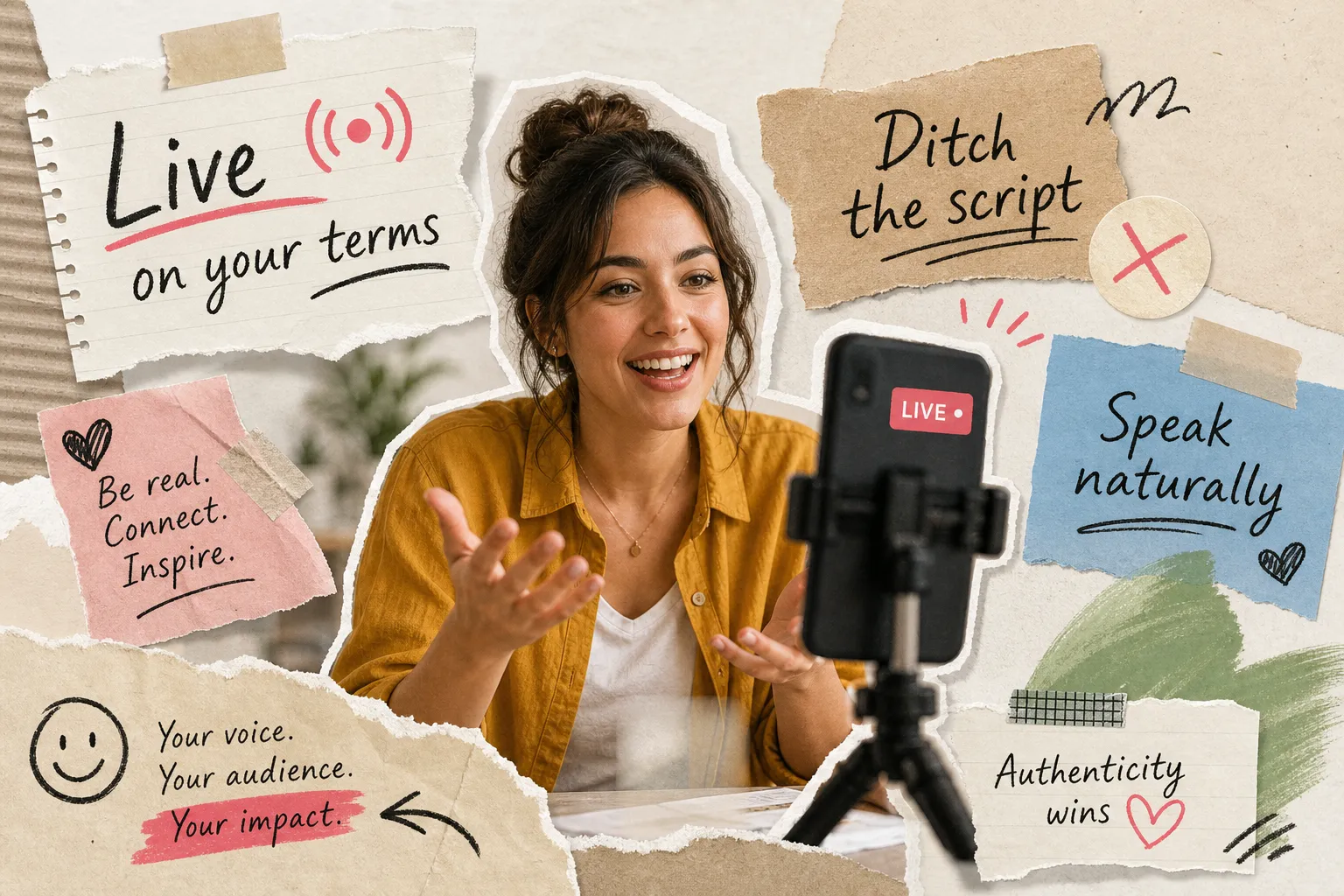
Live video prompting is a technique where a producer or director feeds questions, cues, and conversational guidance to the presenter in real time during filming. The presenter responds naturally, as if having a conversation, rather than reciting a prepared script. The result tends to look and sound like an interview or direct address, honest, engaged, and completely unrehearsed, because that is essentially what it is.
The person doing the prompting is doing active, skilled work. They listen carefully, steer the conversation toward the content goals, ask follow-up questions when an answer needs developing, adjust pace when the energy drops, redirect if the presenter goes off-topic, and signal when a great take is done. This is much closer to the work of a journalist or talent producer than anything a camera operator does. It requires strong briefing familiarity, sharp listening skills, and the ability to draw out specific answers without leading the presenter into unnatural phrasing.
It’s also worth being clear about what live video prompting is not. It is not an AI video generation tool, not an autocue system, and not a coaching session that happens before the shoot. The prompting happens live, during filming, shaping the performance in real time rather than preparing the presenter for a performance they then have to execute alone, live video prompting is a human-led, conversation-driven process.
Why the teleprompter works against most business owners
A teleprompter requires the presenter to read a pre-written script while maintaining eye contact with the lens. For trained broadcast journalists, this is a learnable skill built over years of practice. For most business owners and professionals, the trade-off is less favourable: the words may be accurate and delivery steadier, but spontaneity often suffers and the person can disappear behind the script.
The physical tells are surprisingly easy for an audience to detect, even when they can’t name them. Autocue tends to create a fixed eye position and can reduce the natural variation of gesture and emphasis that makes someone watchable. Viewers may not consciously register that someone is reading, but they often sense a lack of presence. Trust drops. The person on screen doesn’t seem to be talking to the viewer; they seem to be reciting at them.
There’s a deeper problem too. A script written for reading is rarely the way the presenter would actually explain something. It’s polished by a copywriter, approved by committee, and stripped of the specific phrases, pauses, and personality that make someone compelling to watch. By the time the script reaches the teleprompter, the authentic voice of the business owner has often been edited out entirely.
How live video prompting draws out natural, confident performances
When someone is answering a question rather than reading a script, their brain engages differently. Their voice varies naturally in pitch and pace, they pause where it makes sense, they use their own words rather than a copywriter’s phrasing, and their face reflects genuine thought. Live video prompting creates this dynamic by replacing the performance with a conversation. The camera catches authenticity instead of compliance.
Business owners, consultants, solicitors, accountants, and other professionals already know their subject deeply. They don’t need a script to tell them what to say. What they need is a structure that gives them permission to say it. A skilled prompter knows the content goals and asks questions that guide the presenter through the right territory. Expertise comes out in the presenter’s own voice rather than a version polished into blandness by committee. The result is content that actually sounds like the person who made it.
Why subject-matter experts respond well
Subject-matter experts respond particularly well to this format because they’re already fluent in their topic. The live prompting session removes the main obstacles between their knowledge and the camera: no script to memorise, no performance to execute, no audience of strangers pointing equipment at them. There’s just a conversation, and the producer shapes it into something usable in the edit. For many professionals, this is the first time video has genuinely felt straightforward.
Remote live prompting: record professional video without a crew in the room
This is where the format has moved on significantly. At This Video Works, remote live prompting means the producer connects via a reliable video call setup and runs the entire session from a completely separate location. The business owner sits in their own office or boardroom. The producer handles the conversation from their end, directing the session in real time and shaping the performance without anyone needing to travel, set up equipment in an unfamiliar space, or manage the anxiety of a full crew in the room.
Technical checklist for the presenter’s end
The technical requirements at the presenter’s end are straightforward. A decent camera, whether a good webcam or a dedicated camera with a capture card, provides the image quality needed for professional output. A clean background or a well-dressed professional environment handles the visual context. Adequate lighting, either natural light from a window or a simple ring light or panel, keeps the face even and readable. A reliable internet connection ties it all together. The producer handles everything else: session structure, question flow, real-time video prompts, and the creative direction that shapes how the final edit comes together.
This approach removes one of the biggest practical barriers for business owners outside major cities, or those who want to avoid the cost and disruption of a full location shoot. The result is professional, authentic video content that doesn’t require a studio or a day off the tools.
Who benefits most from a live-prompted video approach
The primary audience for live video prompting is exactly the group that traditional video production has consistently struggled to serve well: people who are expert in their field but not in front of a camera. Solicitors, financial advisers, consultants, healthcare professionals, and business directors all have authority and credibility. They just need a format that lets it come through naturally. Live prompting removes the performance requirement entirely, and what remains is genuine expertise delivered conversationally.
Video content that feels genuinely personal is one of the strongest trust-building tools a business has. Viewers form opinions about whether they’d want to work with someone within seconds of watching them on screen. A business owner who sounds like themselves, engaged and knowledgeable, is far more compelling than one reading polished sentences that could have been written by anyone. This matters especially for professional services firms where the relationship between client and provider is central to the sale. Authenticity isn’t a stylistic preference in that context; it’s a commercial asset.
How to get the most from your live-prompted video session
How to prepare
Preparation for a live-prompted session looks very different from preparing for a scripted shoot. The goal is not to memorise anything, but to arrive ready to have a conversation rather than deliver a speech. Have a loose sense of the topics you want to cover, choose a filming location that reflects your professional environment, and dress for how you want to be perceived on screen. Do a brief technical check of your lighting, audio, and connection quality before the session begins, and flag anything that doesn’t feel right before you start recording.
During the session itself, the relationship between presenter and prompter works best when the presenter trusts the process and responds to questions directly rather than trying to craft perfect sentences before speaking. Natural pauses, corrections, and restarts are all expected and easily edited out. The prompter’s job is to keep the conversation on track and capture the moments where genuine expertise comes through. The presenter’s job is simply to answer honestly and leave the shape of the final video to the production team. The edit will find the gold in what you’ve given it.
The format that actually sounds like you
Live video prompting works because it removes the thing that breaks most business video: the gap between how someone actually communicates and what a scripted format demands of them. A teleprompter can improve accuracy and steadiness, but for non-media professionals a real-time conversational approach with a skilled prompter guiding the session often produces more natural, authentic results. The camera gets something real, and the audience responds to it.
Remote live prompting extends this further by removing the need for a full crew on location and enabling professional results from almost any setting. Whether you’re in London or Leeds, a boardroom or a home office, the format adapts to you rather than asking you to adapt to it. For business owners who want video content that genuinely sounds like them, this approach is worth taking seriously.
If you’d like to understand how live video prompting could work for your business, get in touch with the team at This Video Works. A brief conversation is usually all it takes to work out whether this approach fits what you’re trying to achieve.