What is media training, and do small business owners in the UK need it? Those are fair questions, and the honest answer is: it depends, but probably not in the way you’d expect. Many UK small business owners have heard of media training and assumed it is not for them. It is for politicians facing a Sky News grilling, or FTSE 100 executives managing a corporate scandal. That assumption is understandable, but it is often wrong, and for some business owners it is genuinely costing them.
The reality is that video content, investor pitches, podcast appearances, and press interviews are increasingly common among small and medium-sized enterprises. If you have a website with a talking-head video, you have already had a media moment. If you have been quoted in a trade publication or sat on a panel at an industry event, same thing. We work with business owners at This Video Works who tell us they feel awkward on camera and do not know what to do with their hands. That discomfort is exactly the problem media training was designed to solve, though, as this article will explain, formal media training is not always the right tool for that problem.
This article gives you a clear explanation of what a course actually covers, what media training for small businesses costs in the UK right now, when it genuinely justifies the spend, and whether there is a more practical route to the same result for most SME owners.
What media training actually covers
Media training is structured preparation for communicating under pressure. The goal is to help you stay clear, credible, and on message when you are speaking to a journalist, facing a camera, or fielding questions in a high-stakes environment.
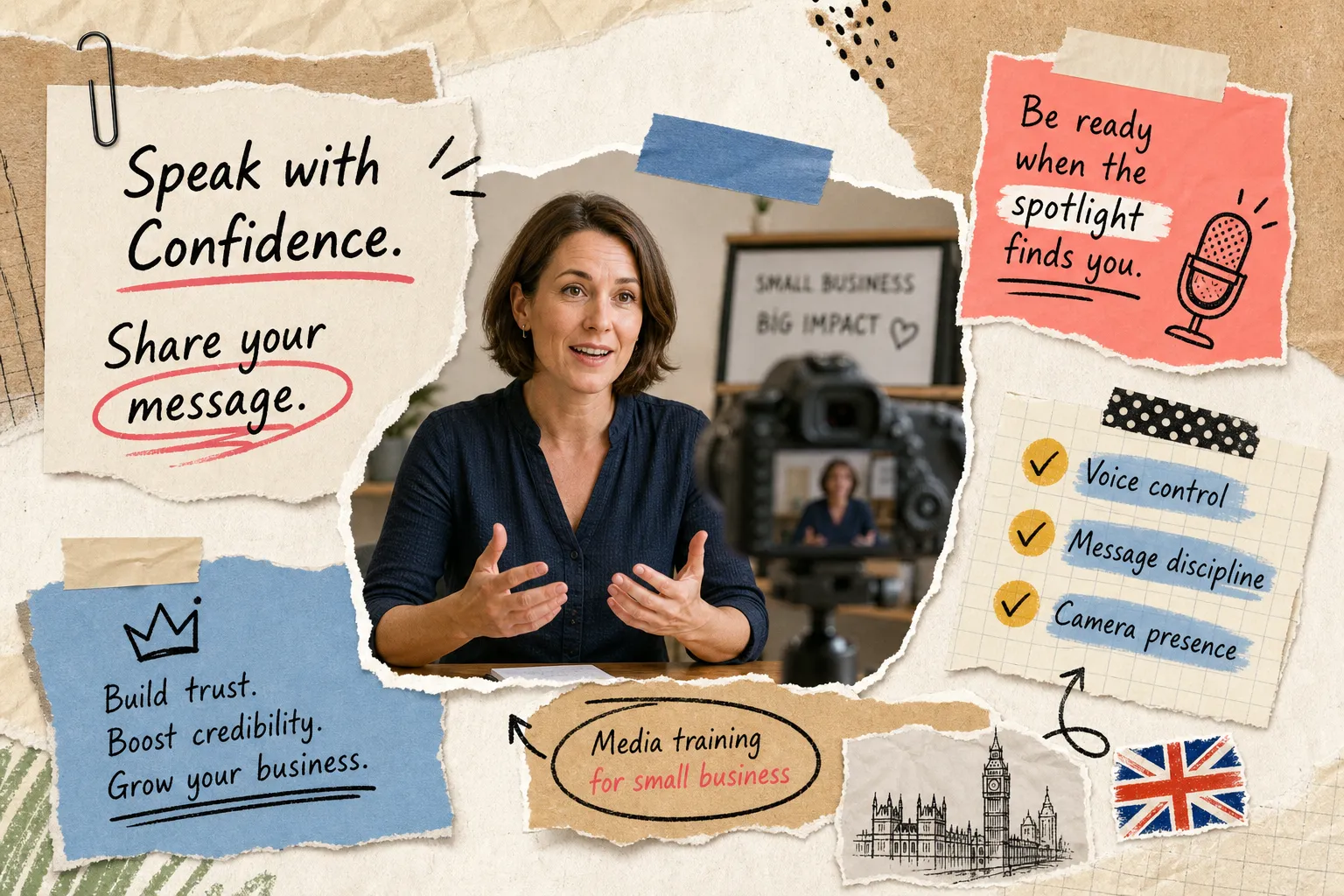
Message discipline
Message discipline is the foundation. You identify two or three key points you want the audience to take away, and you learn to return to them consistently regardless of where the conversation goes. Trainers teach bridging and flagging techniques, structured ways to redirect a question back to your core message without sounding evasive or robotic. It is a surprisingly learnable skill once someone shows you the mechanics.
Interview technique
Interview technique covers the practical side of being questioned. How do you answer something concisely without leaving gaps that get filled by a journalist’s interpretation? How do you handle a hostile line of questioning without becoming defensive? How do you manage silence, clarify a misquote, or stay composed when the interviewer is pushing hard? Most courses include simulated interviews, often filmed, so you can watch yourself back and identify the habits you did not know you had.
Camera presence
Camera presence deals with body language, eye contact, posture, voice pacing, and reducing the nervous habits that make people look uncertain on screen. This element is relevant to SME owners producing video content, though it is worth noting that the filming environment and direction you receive on the day can achieve similar results without a standalone training programme.
Crisis response
Crisis response prepares you for situations where the media contact is driven by something going wrong: a complaint, a product issue, a data breach. Media training is not about looking slick or corporate. It is about protecting your message, your credibility, and your composure when the conversation gets edited, repeated, or broadcast live.
Why on-camera moments matter more than ever for SME owners
Brand videos, video testimonials, podcast appearances, local press interviews, investor meetings, trade publication features, and social media content all require some version of the same skill: performing credibly when someone is watching, recording, or asking questions you have not scripted. These situations are far less common among small businesses than they were a decade ago, the shift in how SMEs communicate publicly has accelerated significantly, driven by low-cost video technology and the rise of content-led marketing.
That kind of performance does not just fail to impress when it goes wrong, it actively loses trust. When a viewer watches a business owner stumble through their value proposition on a website video, they do not think “they’re just nervous.” They think “do they actually know what they’re doing?” That is an understandable inference based on how credibility is read on screen, and it is one that marketing researchers have consistently observed in studies on video trust signals.
The stakes are higher because video is often the first impression. Before any human contact, a potential client, investor, or journalist has already watched something with your face on it. One rambling answer in an investor video, one hesitant response to a local reporter’s question, one awkward talking-head clip on a services page, and the business looks less credible than a competitor who simply appears calm and clear. This applies equally to established businesses with existing authority and startups trying to build trust quickly from nothing.
Do UK small business owners need media training?
Be clear on this: professional media training is worth the cost in specific situations, not across the board. If you are running a small business and your main media challenge is a website video and the occasional LinkedIn post, a formal training course is probably more than you need.
The situations that justify the spend are more specific. If your business has multiple spokespeople who need to deliver consistent messaging across different locations or departments, formal training creates that consistency. If you are facing regulatory scrutiny, a public controversy, or potential crisis coverage, trained spokespeople tend to cause significantly less damage in a live interview. If you are preparing for broadcast media or national press, the consequences of a poor performance are large enough that the investment is obvious. And if your business is in a sector where personal credibility is central to winning clients, financial services, legal work, or consultancy, for example, the compound benefit of strong media performance over time can be substantial.
The ROI case is real in these higher-stakes contexts. Businesses with trained spokespeople often report more press placements, higher website traffic following media coverage, and lower reputational damage when things go wrong. In one case reported by a UK media training provider, a business saw a 150% increase in website traffic and a 20% reduction in cost per lead following a focused media training programme. Those are not universal outcomes, they depend on the quality of the training and the frequency of real media interactions the business actually has. But the underlying principle holds: if a poor performance would cost you more than the training, the training is worth buying.
If the business mainly needs to align internal talking points, practise message delivery in low-stakes settings, or build basic familiarity with interview structure, free resources and role-play sessions inside the team can get the job done. The decision rule is straightforward: if the consequences of a poor performance are serious, financially, reputationally, or legally, invest in professional media training. If the stakes are lower, start with practice and build from there.
What media training costs in the UK
UK media training costs vary depending on format, provider, and how bespoke the session is. Here are the practical benchmarks for 2026, based on current provider pricing across the market:
- Half-day group sessions: approximately £650 to £1,200 plus VAT
- Full-day private or small-group sessions: approximately £1,500 to £1,800 plus VAT
- One-to-one coaching (half or full day): approximately £1,200 to £1,800 plus VAT
- Per-person group rates for teams of up to six: roughly £200 to £300 per head
Bespoke or senior-level training from established UK providers will sit at the higher end of those ranges. Corporate media training from specialist firms can reach £2,000 to £5,000 plus VAT per day when tailored for executive spokespeople or crisis scenarios, a figure worth bearing in mind when comparing options. Most standard courses run half a day or a full day.
The framing that matters here is this: the question is not whether £1,500 is a significant number. It is whether a botched investor presentation, a fumbled response to a journalist, or a viral clip of an unprepared spokesperson would cost the business more. In most cases where a business genuinely needs media training, the cost of not having it is higher. That said, the caveat is worth stating plainly: these outcomes depend on the quality of the training provider and the frequency of real media interactions the business actually has.
Our more practical, and much cheaper, option for SME owners
Many UK small business owners producing video content do not need a half-day PR course. What they need is someone to help them perform naturally and confidently in front of a camera for their specific content. That is a different skill set from crisis communications or broadcast interview technique, and it requires a different kind of support.
Press interview training and message discipline for hostile journalists are genuinely valuable skills in the right context. But if your actual challenge is a website video, a testimonial, a case study interview, or a series of social media clips, the relevant problem is on-camera delivery and authentic performance, not media relations strategy.
This is the specific problem This Video Works is built to address. Our filming approach is prompt-led and conversational, designed for business owners who feel uncomfortable in front of a camera. There are no scripts and no teleprompters. Our director Nick draws out authentic, credible responses through structured questions and real-time direction during the shoot, producing confident, usable content built directly into the production process. The material you walk away with is immediately usable: finished video content that reflects how you actually think and communicate, without the stiffness that comes from trying to read from a screen or remember a script.
For SME owners whose primary goal is stronger video content rather than broadcast media preparation, this integrated approach can be more relevant and more cost-effective in many common scenarios, and it produces something tangible rather than skills you may or may not use again.
Three questions to help you decide what you actually need
Before booking anything, answer these three questions honestly.
First: are you facing high-pressure media interactions, broadcast interviews, national press coverage, or investor panels where a mistake has serious financial or reputational consequences? If yes, formal media training is the right investment. The stakes justify the cost, and the structured preparation will make a measurable difference.
Second: are you producing video content to build trust, attract clients, or establish authority in your market? Here the answer shifts. You likely need on-camera coaching and a production process that supports natural performance. A PR training course will not solve the problem of feeling stiff on camera. The filming environment, the questions you are asked, and the direction you receive during the shoot are what determine the quality of the output.
Third: are you nervous on camera but clear on your message? That is a delivery problem, not a knowledge problem. It is solved through practice, repetition, and the right filming environment, not through learning how to handle a hostile journalist. Many business owners conflate the two and book training they do not need, or avoid both entirely and end up with video content that does not work.
Media training for small business owners in the UK is valuable, but only when it matches the actual challenge the business faces. For many SME owners, the goal is not to handle a hostile BBC interview. It is to come across as credible, confident, and trustworthy in the video content, pitches, and interviews that are already part of running their business day to day. Understanding which specific problem you are solving before committing to a format or spend will save you time, money, and a fair amount of frustration.
What to do next
To recap: media training covers message discipline, interview technique, camera presence, and crisis response. It is worth the investment in specific high-stakes situations, particularly broadcast media, national press, investor events, and crisis management. UK costs range from approximately £650 to £1,800 plus VAT for standard formats, rising to £2,000 to £5,000-plus for bespoke corporate or executive-level work. And for many SME owners, an integrated video production approach delivers the same confidence and credibility outcomes more directly, with a finished product to show for it.
If your challenge is on-camera confidence for video content rather than broadcast interview preparation, get in touch with This Video Works. We help business owners perform authentically on camera without a script, and the result is video content that actually builds trust with the people you are trying to reach.