
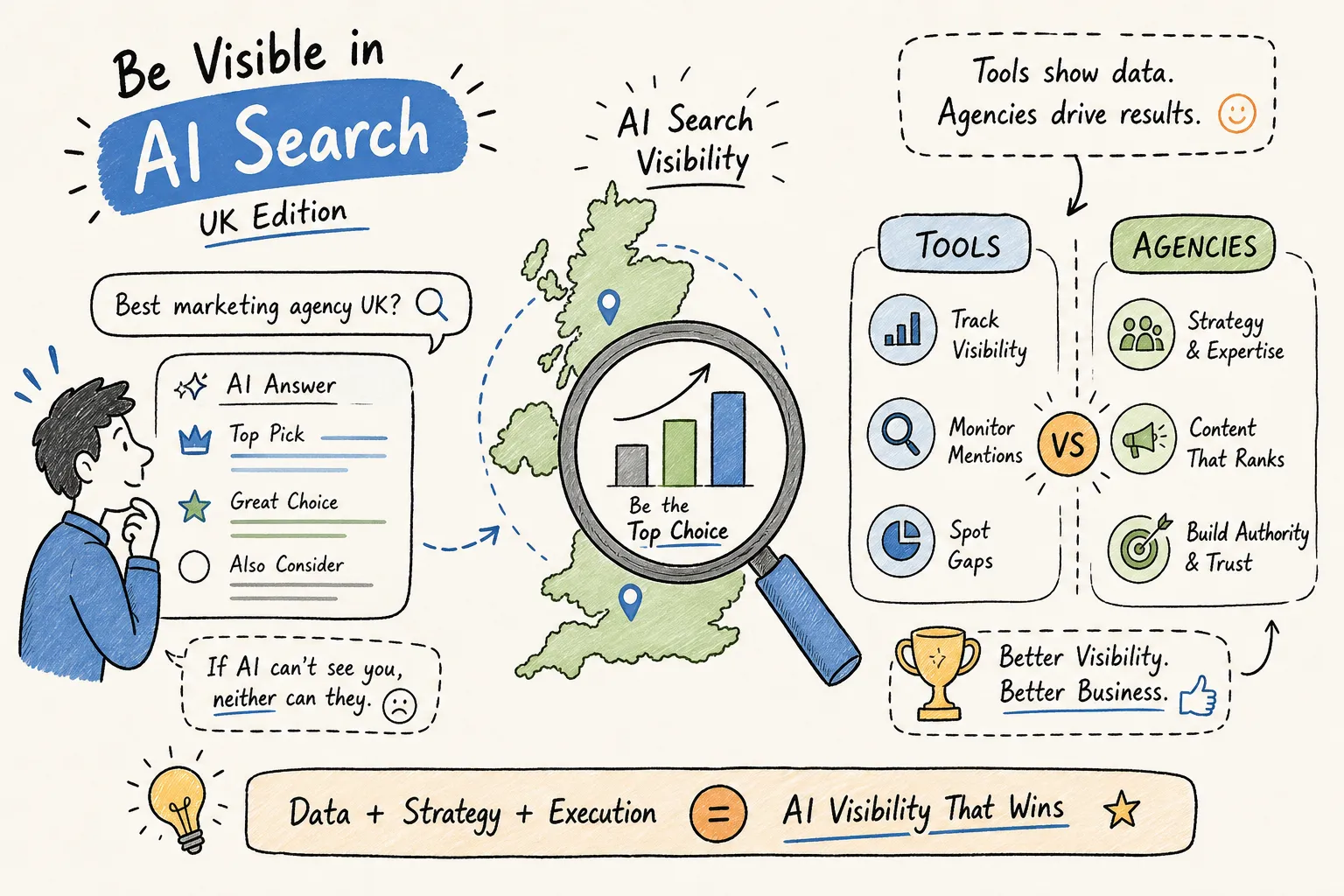
UK businesses are actively losing enquiries to competitors who appear in ChatGPT responses, Google AI Overviews, and Perplexity answers, and closing that gap is precisely what AI search visibility in the UK is now about. Many firms don’t yet track where they stand in AI-generated results, which means the gap between “we have a website” and “we appear when AI is asked about our category” is growing quietly in the background. At This Video Works, auditing a client’s current position in AI search is the first step in every content project we take on, because what you can’t measure, you can’t improve.
This article cuts through the vendor noise to give you a practical picture of the tools and agencies available to UK businesses in 2026, explains how AI search visibility is actually measured, and helps you choose a sensible next step based on what your business genuinely needs.
How AI Engines Decide Which Brands to Surface
The difference between a mention, a citation, and a recommendation
Most marketers assume that “appearing in AI search” is a single, binary event. It isn’t. When ChatGPT, Perplexity, or Google AI Overviews responds to a query, your brand can appear in three distinct ways, and they are not commercially equivalent. A mention means your brand name appears somewhere in the answer text, often without a link or explicit endorsement. A citation means your domain is referenced as a source, which carries significantly more weight because the AI is signalling that your content was used to construct the answer. A recommendation means the AI explicitly positions your brand as the answer or a top option, the outcome that actually drives enquiries.
Understanding this hierarchy matters because a tool that only tracks “brand mentions” will overstate your actual commercial visibility. Measuring citation rate and recommendation frequency separately is what tells you whether AI search is working for your business or merely acknowledging your existence.
How ChatGPT, Google AI Overviews, and Perplexity each work differently
Each engine surfaces brands through a different mechanism, and a single strategy won’t produce equal results across all three. Google AI Overviews pull citations from indexable pages, which means your own domain can appear directly as a source, provided your content is well-structured and technically readable. ChatGPT blends training data with live retrieval when search is enabled, so brand presence in credible third-party sources, directories, and publisher content matters at least as much as your own website. Perplexity is the most citation-forward of the three by design; it surfaces source links prominently, making domain citation a core part of how it responds rather than an occasional feature.
The practical implication is that building generative AI search visibility requires a multi-layer strategy: your own content needs to be technically readable, your brand needs to appear in credible external sources, and the language you use to describe what you do needs to match the prompts real customers are typing. This is the foundation of effective AI SEO, and it’s distinct from traditional search optimisation in ways that matter.
The Metrics That Actually Tell You Whether You’re Visible
Share of voice, mention rate, and citation rate explained
Four KPIs form the core of any credible AI visibility measurement framework. Mention rate is the simplest: divide the number of tracked prompts where your brand appears by the total number of prompts tested, then multiply by 100. If your brand appears in 6 out of 20 prompts, your mention rate is 30%. AI share of voice measures your proportion of all brand mentions within the same prompt set, your brand mentions divided by total brand mentions across all competitors, multiplied by 100. This tells you whether you’re gaining or losing ground relative to rivals, not just whether you appear in isolation.
Citation rate is calculated by dividing the number of prompts where your domain is cited as a source by the total prompts tested. This is the metric most closely tied to commercial outcomes. Finally, citation accuracy scores whether the AI describes your business correctly when it does appear; divide accurate brand representations by total brand appearances. A high mention rate with low citation accuracy is a problem worth diagnosing, because it often signals that training data or third-party content is describing you incorrectly. Together, these four metrics form the basis of any serious approach to LLM search ranking for UK businesses.
Building a repeatable prompt-tracking routine
Tools automate this at scale, but the underlying logic is the same whether you use software or a spreadsheet. Build a fixed set of 10 to 20 prompts covering “best [your category] for [your audience],” problem-and-solution questions your customers actually ask, and direct brand-name queries. Run them across at least two engines on a consistent weekly schedule and log the results. A single check is genuinely misleading because AI outputs vary by session, location, and whether live retrieval is enabled. Repeated runs over time produce reliable data, and that reliability is what makes any tool or agency’s dashboard worth paying for.
AI Search Visibility UK: Tools Worth Considering in 2026
Dedicated AI visibility platforms
The purpose-built options most relevant to UK businesses are OtterlyAI, Gauge, AIclicks, Peec AI, and TendorAI. This category handles prompt-level tracking, citation monitoring, AI answer share of voice dashboards, and sentiment analysis well. TendorAI is worth specific attention for UK regulated industries: it’s built from UK authority data including the SRA Solicitors Register, FCA Financial Services Register, and Companies House, and runs weekly scans across ChatGPT, Claude, Gemini, Perplexity, Grok, and Google AI Overviews at £299 per month with no contract. OtterlyAI starts at roughly £23 per month for its entry tier, rising to around £147 per month for its mid-range plan, based on current USD pricing converted to sterling at mid-2026 rates; check the OtterlyAI website for the latest GBP figures.
The honest limitation of this entire category is that these tools measure visibility; they don’t create it. A strong score requires underlying content and technical infrastructure to exist before tracking becomes meaningful. Buying a monitoring tool before sorting your content and schema is measuring a problem without addressing the cause.
SEO suites with AI visibility modules
Semrush’s GEO add-on, SE Ranking’s AI Results Tracker, and Ahrefs Brand Radar each bolt AI visibility monitoring onto a broader SEO workflow. This category suits businesses already invested in traditional SEO who want to add AI monitoring without switching platforms. SE Ranking tracks Google AI Overviews, AI Mode, ChatGPT, Perplexity, and Gemini, and includes gap detection for queries where competitors are cited but you aren’t. At enterprise level, BrightEdge is worth considering specifically because it correlates AI visibility with actual traffic impact, something most tools don’t attempt.
Pricing guide for UK SMEs and enterprise
Pricing varies considerably by use case, though broad bands are emerging. Self-serve monitoring tools run from roughly £49 to £399 per month. SME managed packages or light agency support sit at around £450 to £1,250 per month. Growth-stage retained support ranges from £1,500 to £5,000 per month. Enterprise platform subscriptions generally start above £2,000 per month, with full agency programmes reaching £5,000 to £10,000 or more. These figures reflect published rates and sample proposals from UK-facing providers as of mid-2026; confirm current pricing directly with any vendor before committing. The biggest cost drivers are prompt volume, number of engines tracked, reporting depth, and whether the provider also handles content and schema or only monitors what already exists.
UK Agencies Specialising in AI Search Visibility
What the leading agencies offer
Several UK agencies now position AI search visibility as a core service. Rank4AI focuses exclusively on AI search, with a proprietary methodology and research drawn from more than 1,400 UK website audits. Found positions itself around an “Everysearch” model and has a dedicated AI visibility platform called Luminr; the agency publishes case studies citing significant visibility improvements and ROAS gains, though readers should review the methodology in those case studies directly before drawing conclusions. ClickSlice frames AI search optimisation and Answer Engine Optimisation (AEO) as primary services for UK clients.
First Motion has published a B2B case study showing a 200% AI visibility improvement alongside a 40% shift of inbound enquiries to organic and AI search combined. Kaizen operates from London and Manchester with a content-led approach to AI visibility. Each of these agencies brings a different emphasis, tool-first, content-first, or technically-led, so the fit depends on what your business actually lacks.
How to evaluate agency claims before signing anything
Agency positioning in this space is, in many cases, running ahead of agency evidence. Before committing to any retainer, ask for prompt-level before-and-after data, not just organic traffic charts. Ask whether they track citation rate separately from mention rate, because agencies that conflate the two are measuring the wrong thing. Most importantly, ask whether they handle the content and technical infrastructure, including schema markup, query research, and on-page structure, or whether they only monitor and report. An agency that can’t answer those questions confidently is selling measurement, not outcomes.
Why Content and Technical Structure Determine Whether Any of This Works
Audience-focused query research as the starting point
Every tool and every agency depends on the same upstream variable: whether your content actually answers the questions real customers are asking. This requires research that goes beyond keyword volumes. It means identifying the specific prompts people use across Google, ChatGPT, and social search, then building content that directly addresses each one. Most businesses skip this step because it’s less visible than publishing content or buying a monitoring tool, but skipping it means everything downstream produces weaker results. At This Video Works, pre-production query research is built into every client project for exactly this reason: content can only earn AI search visibility if it’s answering questions the audience is genuinely asking.
Schema markup: the layer that makes content readable to AI
Structured data is one of the least understood competitive advantages available to UK businesses right now. Schema markup is code that describes your content to search engines and AI systems in the language they natively read. Internal tracking across This Video Works client projects in 2026 indicates that schema-marked pages are cited approximately three times more often in AI Overviews than unmarked equivalents, a pattern consistent with wider industry observations about the impact of AI search optimisation on citation rates.
The schema types that matter most for citation rates are Organisation (establishing your brand as a recognised entity), Article or BlogPosting (making authorship and freshness machine-readable), FAQPage (giving AI a clean question-and-answer structure to extract directly), and VideoObject for any video content you publish.
Schema markup is more commonly used in the United States than in the UK, and it remains underused by many UK business websites. That gap represents a genuine competitive advantage for businesses that act on it now. This Video Works codes schema into every piece of content it produces, covering video transcripts, written copy, and business details, so that content is immediately readable and citable by AI systems from the moment it’s published. Video production companies that stop at filming and editing, and SEO agencies that don’t incorporate video into their workflow, are each leaving part of the puzzle unsolved. The combination of authentic interview-led video, pre-production query research, and technical schema applied across every output is what creates the conditions for consistent AI visibility, not any one element in isolation.
Running a Basic AI Visibility Audit Before You Spend Anything
A simple self-audit in under an hour
Start by building 10 prompts that a potential customer would genuinely type into ChatGPT or Google: “best [your category] in [your city],” “[your service] for [your audience],” and a direct query using your brand name. Run them across at least two engines and note whether your brand appears, whether it’s cited as a source, and whether the description of your business is accurate. Then check your own website for schema markup using Google’s Rich Results Test, which is free and takes about five minutes per page. Many UK business websites lack schema entirely or don’t use it comprehensively, and that absence is a measurable, fixable disadvantage. Treat this exercise as diagnostic, not definitive: it tells you where you stand, not everything about why.
Choosing the right next step
Three decision paths make sense depending on what your business actually needs. If the primary need is monitoring and benchmarking, a dedicated AI visibility tool at the right price tier is the logical starting point. If the need is broader strategy and campaign execution, an agency with documented prompt-level outcomes is worth the investment, but ask the hard questions before signing.
If the need is the full pipeline, research into what your audience is searching for, authentic video and written content that answers those questions directly, and technical schema that makes all of it discoverable by AI from day one, that is precisely what This Video Works is built to deliver.
Research and case studies consistently indicate that content quality and schema implementation are the primary drivers of AI citation; monitoring tools measure progress but don’t substitute for that foundation. If you want to improve your AI search visibility in the UK and start that conversation, get in touch with This Video Works and we’ll begin with a query research review of your current position.