If you have ever wondered how a talent producer helps non-media professionals perform on camera, you are not alone. Many business owners dread the prospect, not because they lack knowledge, personality, or something genuine to say, but because they have never been shown how to translate what they know into something that reads naturally on screen. The camera picks up everything: the slight pause before a word you are not sure about, the stiffness that creeps in when you are trying to remember a line, the subtle disconnect between what you know and how it comes across. None of that reflects personal ability. It reflects a gap in the process.
A talent producer is the specialist who closes that gap, not through media training jargon or rigid scripting, but through practical preparation, honest conversation, and real-time support on the day. Some production companies treat this role as an afterthought: a tick-box function to wrangle contributors onto set and hand them a script. Others, like This Video Works, embed it into every shoot as a core part of the process, because the quality of what ends up on screen depends heavily on how supported the person performing to camera feels.
How a talent producer helps non-media professionals perform on camera
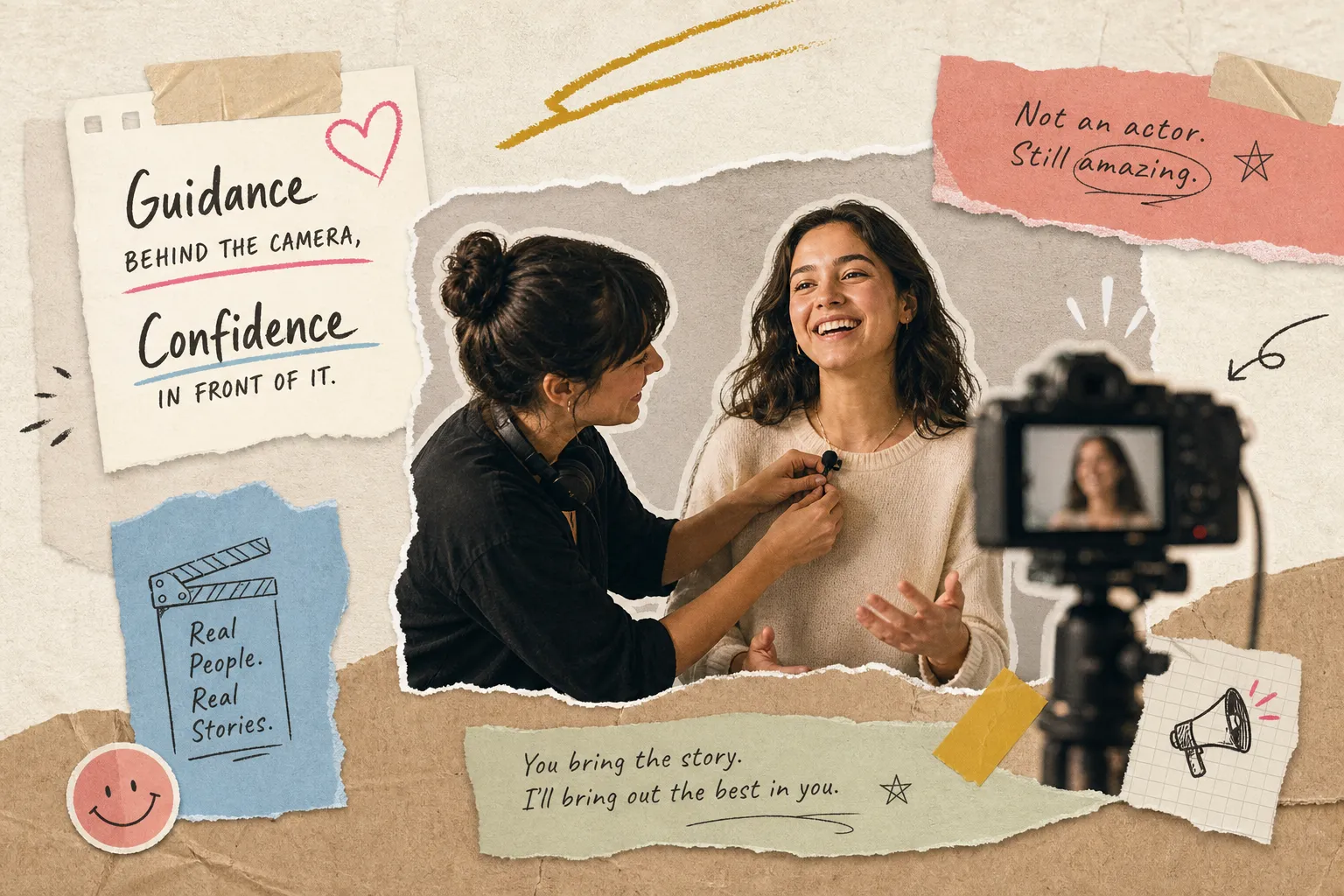
The title “talent producer” is often misunderstood as a logistics role: someone who confirms call times, collects release forms, and keeps things moving. That is part of it. But the actual work sits at the intersection of preparation, people management, and performance support. A talent producer makes sure every contributor arrives ready, informed, and at ease before the camera rolls.
The distinction from a director or camera operator matters here. A director is focused on what the footage looks like. A camera operator is focused on capturing it. The talent producer is focused entirely on the person performing to camera, their expectations, their nerves, their energy, and the quality of what they deliver. Without that separation of responsibilities, the human side of a shoot gets deprioritised under time pressure. It almost always does.
When someone with no media experience is asked to speak to camera, their instinct is to perform rather than communicate. They stiffen. They try to remember phrases. They monitor themselves instead of responding naturally. A talent producer’s job is to reverse that. They strip away the formality, manage the environment, and create the conditions where genuine responses happen without being forced.
Pre-shoot preparation: helping non-media professionals perform on camera
Most on-camera nerves come from uncertainty, not knowing the format, the questions, the tone, or what “good” looks like on this particular shoot. A thorough pre-shoot briefing removes that uncertainty. A proper briefing covers the shoot goal, the intended audience, the format of the day, likely question areas, and reference examples of tone and style. Importantly, it should be a written document, not just a five-minute phone call the morning of the shoot.
Scripts create problems for non-professionals. They shift a person’s attention from communicating to recalling, and the camera picks that up immediately. A concise list of talking points, key messages, and must-cover beats gives structure without rigidity. The talent producer helps the contributor internalise those points so they can speak naturally rather than recite. A practical pre-shoot checklist should include:
- a written briefing document
- agreed talking points
- wardrobe guidance
- location and access confirmation
- mic and eyeline cues
- release forms
- a reminder sent the day before
The practical details matter more than most people expect. Wardrobe direction matters on its own terms. Knowing which colours work on camera, which patterns cause problems, and whether branded clothing is appropriate affects both comfort and how someone reads on screen. Environment checks, covering sound bleed, lighting conditions, and the availability of a quiet holding space, allow contributors to decompress before stepping in front of the camera. These are not minor niceties. Comfort directly affects delivery.
Coaching techniques that make non-professionals look natural
Before the camera rolls, a good talent producer uses informal conversation to get the contributor out of their own head. This might mean a casual warm-up chat about their work, a few tongue twisters to loosen up the voice, or simply talking through what the session will feel like so nothing comes as a surprise. Framing a question as “tell me about that as if we’re just chatting” consistently produces more usable footage than any formal instruction. The goal is to shift the person’s focus from the camera to the conversation.
Eyeline is one of the most common stumbling blocks when helping non-media professionals perform on camera. Most people either stare into the lens or avoid it entirely, and both read as unnatural on screen. A talent producer addresses this by positioning themselves close to the lens, using a marker near the camera, or conducting an off-camera interview that keeps the contributor’s gaze directed naturally. On pacing, they let contributors speak at their own rhythm, break longer segments into shorter answer blocks, and avoid forcing repeated resets. Explicit permission to be imperfect during a take is part of the coaching, reassurance in the moment produces better results than correction afterwards.
Real-time direction during a take is what separates coached performance from uncoached footage. Unlike a director who calls cut and gives feedback between takes, a talent producer often guides the conversation mid-flow: introducing a follow-up prompt, signalling a pause, or using a conversational cue to draw out a more specific or genuine response. This is subtle work, but it is where the footage that actually works gets made.
What to expect on the day of your shoot
Realistic expectations help. For a well-briefed business owner with a clear set of talking points, usable performance is typically achievable within one to two hours of on-set coaching. A half-day intensive is usually enough for a well-prepared contributor to deliver confident, repeatable answers. Higher-stakes or longer-form work may need multiple sessions. The single biggest variable is preparation: contributors who arrive having read their briefing and thought through their key points consistently reach usable takes faster and with less effort on the day.
On the day itself, the talent producer controls pace and energy across the set. They manage call times so contributors are not kept waiting, keep the set calm and free of unnecessary people, run a test shot before any important take, and monitor performance throughout to catch fatigue or drift before it affects the footage. Their presence allows the director and camera operator to focus on craft, while the contributor gets the human support that makes the difference between adequate footage and content that actually connects.
The measurable difference good talent coaching makes
The case for structured on-camera coaching is well established within the industry. Coaching providers report meaningful reductions in off-message responses after focused media coaching sessions, alongside improvements in how audiences receive and trust the contributor, gains that are consistent with broader research into professional communication training, which suggests that the majority of participants report measurable improvement in their on-camera confidence and clarity. For business owners, those gains translate directly into video content that earns trust rather than undermining it.
Without talent support, the risk to the footage is real. Stiff delivery, visible discomfort, and content that feels rehearsed rather than genuine are not minor aesthetic problems. For professional services businesses especially, where personal credibility is central to winning clients, video that reads as inauthentic can actively damage the reputation it was meant to build. The investment in proper on-camera coaching for non-professionals pays back in content that works for the business long after the shoot day is over.
Why This Video Works includes a talent producer on every shoot
At This Video Works, a talent producer is built into every shoot as standard, not as an add-on for high-budget productions or a luxury for particularly nervous clients. The reason is straightforward: the prompt-led, conversational filming approach used on every shoot only works when the person performing to camera is genuinely at ease. Getting that result is not accidental. It is the product of proper preparation, on-set coaching, and real-time direction working together.
For SME owners and professional services businesses, this means arriving briefed rather than scripted, and coached rather than simply directed. The session feels more like a structured conversation than a performance. The footage that results does not look coached, it looks like you at your best: talking about what you know, with a confidence that comes across as genuine rather than performed. That is the intended outcome of every shoot, and it is what a properly embedded talent producer makes possible.
Bringing it together
Understanding how a talent producer helps non-media professionals perform on camera makes clear why this role matters. The key steps are consistent: a thorough written briefing before the shoot, practical preparation covering wardrobe, environment, and logistics, conversational coaching techniques on the day, and real-time support throughout the session. Screen presence for beginners is not something that just happens, it is built, systematically, through presenter coaching and careful talent direction.
The anxiety many business owners bring to a shoot is understandable, but it is not a personal weakness. It is a gap in the process. When that gap is properly filled by a skilled talent producer, the result is content that connects, honest, credible, and genuinely representative of the person behind the business.
If you are an SME owner or lead a professional services firm and want to see what properly supported, talent-coached video looks like in practice, get in touch with the team at This Video Works. A short initial conversation is all it takes to understand what the process involves and what it could do for your content.