
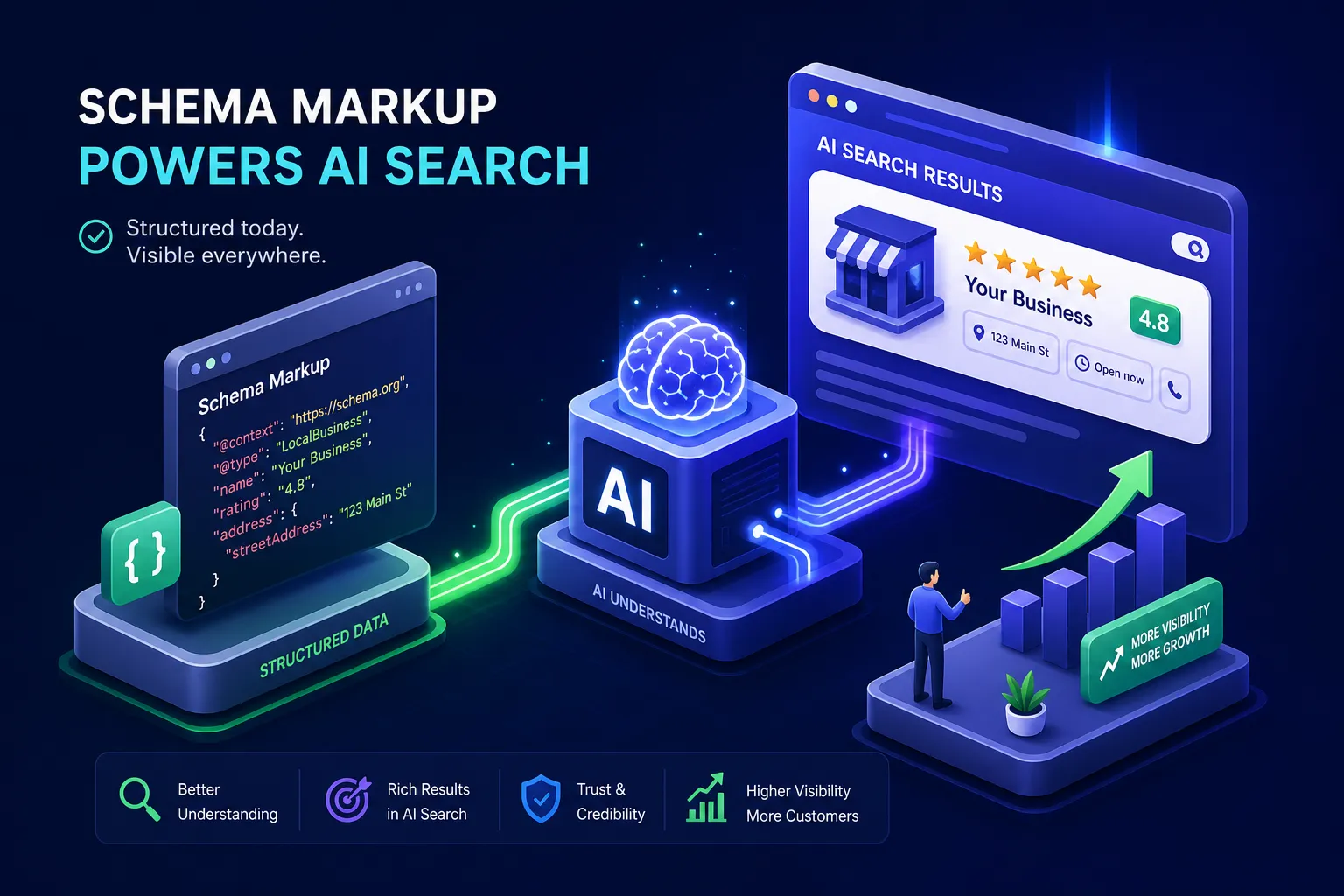
If you’ve ever wondered how does schema markup help a business appear in AI search results, the answer comes down to one word: clarity. You might have a well-maintained website, solid content, and genuine expertise in your field. Customers who find you rate you highly. But when someone asks Google, Bing Copilot, or Perplexity a question you should be answering, your competitors get the citation. Your content exists. AI just cannot read it properly. That gap has a name, and it has a fix.
Schema markup is structured code, invisible to your website visitors, that sits inside a script block on your page and speaks directly to AI systems and search engines in the language they natively understand. Rather than forcing a machine to infer what your page is about from raw HTML, schema tells it explicitly: this is a business, this is what it does, these are the questions it answers, and this is who wrote it. Explicit structured data increases the likelihood of being cited, though it is neither sufficient nor the only factor in play.
Schema adoption appears higher in the US, where it has become a common part of digital marketing practice. In the UK, it remains significantly underused, which means there is a meaningful window right now for businesses that move early. Some UK specialists are already applying schema to every piece of content they produce. At This Video Works, structured data is applied to written pages, video transcripts, and VideoObject markup alike, so that every format is readable by AI systems from the moment it goes live. By the end of this article, you will understand the mechanics, the schema types worth prioritising, and the exact steps to get your content into AI-generated answers.
How does schema markup help a business appear in AI search results?
Schema markup is not a ranking shortcut. It is machine-readable metadata, written in JSON-LD format and placed in a script block on your page, that defines what your content is, who produced it, and what questions it answers. Without it, AI systems have to infer all of this from raw HTML, which is an imprecise process. With it, they receive a clean, structured object graph they can parse reliably and confidently cite.
How JSON-LD differs from plain HTML
HTML tells a browser how to display a page. JSON-LD tells an AI system what the page means. The key distinction is that JSON-LD lives in a separate code-block, independent of the visible content. Google recommends JSON-LD over the older microdata approach for good reason: it is less fragile when page templates change, easier to maintain, and it presents structured relationships between entities that AI systems can parse without reconstructing data from scattered HTML attributes. For any new schema work, JSON-LD is the default.
The pipeline from structured data to AI citation
The sequence works like this: you publish content with valid schema markup, Google’s crawlers index the structured data alongside the page content, and when a user asks a question, the AI system draws on pages where the answer is explicitly signalled rather than implied.
Structured data can improve a page’s eligibility and interpretability across Google’s AI Overviews and Bing Copilot, though each engine weighs signals differently. Perplexity relies heavily on visible, extractable content; Schema helps it identify entities, verify metadata, and attribute facts correctly when the page is already relevant, though Perplexity has not publicly detailed a schema-centric citation algorithm.
The schema types that give you the best shot at AI citations
Not all schema carries equal weight when it comes to AI-generated answers. Some types mirror the exact format AI systems use to construct responses. Others build entity credibility that helps AI systems decide whether your source is trustworthy. Here is the priority stack.
FAQPage and HowTo: the formats AI systems quote most readily
FAQPage and HowTo schema are particularly powerful because they match the structure of AI responses almost exactly. FAQPage marks up explicit question-and-answer pairs using mainEntity, Question, and acceptedAnswer properties. AI systems can extract these cleanly and reuse or paraphrase them in generated answers. HowTo schema presents step-by-step procedures using step, name, and url properties, which AI Overviews can reconstruct as ordered answers to instructional queries. Both types have a firm rule attached: the marked-up content must match what is visibly on the page. Where schema and visible content diverge, Google may ignore the markup entirely and reduce the page’s eligibility for rich results.
A minimal FAQPage JSON-LD block looks like this:
{ "@context": "https://schema.org", "@type": "FAQPage", "mainEntity": [{ "@type": "Question", "name": "How does schema markup help a business appear in AI search results?", "acceptedAnswer": { "@type": "Answer", "text": "Schema markup provides AI systems with explicit, structured signals about your content, making it easier for them to identify, interpret, and cite your pages in generated answers." } }] }Organisation, Article, and LocalBusiness: signalling who you are
Entity schema establishes credibility and authorship. Organisation and Person schema, particularly when they include sameAs properties linking to verified profiles, help AI systems confirm who is speaking and whether the source is worth citing. Article and BlogPosting schema signal recency through datePublished and dateModified properties, which matters for AI systems that favour fresh, attributed content. LocalBusiness schema is essential for any business with a physical presence or regional service area: it surfaces in location-aware AI queries and covers the business name, address, phone number, and opening hours that AI systems need to recommend you confidently.
A minimal LocalBusiness block looks like this:
{ "@context": "https://schema.org", "@type": "LocalBusiness", "name": "This Video Works", "url": "https://www.thisvideoworks.com", "telephone": "+44-XXXX-XXXXXX", "address": { "@type": "PostalAddress", "addressLocality": "Your Town", "addressCountry": "GB" }, "sameAs": [ "https://www.linkedin.com/company/this-video-works" ] }Product and Review schema for commercial queries
For businesses in e-commerce or professional services, Product schema plays a direct role in comparison and commercial AI answers. The aggregateRating and offers properties are particularly influential when AI systems construct responses to “best of” or “which should I choose” queries. Review schema, when it reflects genuine, sourced customer feedback, adds a trust dimension that AI systems draw on when recommending products or services. The rule is the same throughout: only mark up what is accurate and visible on the page.
What the evidence actually shows
The data here is mostly correlational and vendor-reported rather than independently controlled, and being honest about that matters. What the benchmarks show is directional: pages with valid structured data, particularly FAQPage and HowTo markup, appear more frequently in AI-generated summaries than unstructured pages. 2025 benchmarks from Semrush and Measured.com indicated that pages with valid schema appeared 20 to 30 per cent more often in AI-generated summaries. BrightEdge analysis found improved citation rates and stronger brand presence in AI Overviews for pages with robust schema implementation, compared with equivalent pages without structured data. Some published datasets suggest pages with FAQPage markup achieve substantially higher AI citation rates than those without, though the precise figures vary across studies and should be treated as indicative rather than definitive.
Treat those figures as directional signals, not guarantees. Google itself states there is no special schema required to appear in AI Overviews; structured data improves eligibility and interpretability, not certainty. A controlled Ahrefs study from 2026 found no significant positive lift from adding JSON-LD alone, which underlines the point that schema works alongside quality content, not instead of it. The honest summary is that structured data makes it easier for AI systems to understand and cite your content, and that consistently produces better outcomes than leaving AI to guess.
How This Video Works applies this across video content
Most businesses only think about schema for written pages. This Video Works takes a different approach: applying structured data to video transcripts, VideoObject schema, and business data simultaneously, so that every piece of content is readable by AI systems from the moment it is published. This matters because video content is one of the most underutilised formats in structured data terms. Many video production companies stop at filming and editing, leaving the technical layer that makes video content citable by AI systems completely unaddressed. For businesses whose content strategy includes video, that is a significant gap, and it is more pronounced in the UK, where schema adoption still lags behind US practice.
A practical implementation guide for your pages
Implementation is less complicated than most people expect once you know the sequence. Start by auditing what you have and matching each page type to its schema. Product detail pages use Product schema. Location or contact pages use LocalBusiness. FAQ sections use FAQPage. Blog posts and articles use Article or BlogPosting. The cardinal rule throughout: only mark up content that is visibly present on the page.
Once you have mapped your pages, build your JSON-LD code block. Place it in the rendered HTML of your page; Google accepts this in either the or the , provided it is present in the final rendered output. For each schema type, document the fields your content management system already holds and the fields you need to add manually. Fill only accurate, verifiable properties. Hidden, inflated, or speculative data causes Google to ignore the markup entirely.
Before deployment, run every page through two tools. The Google Rich Results Test confirms whether Google can process the markup and whether the page is eligible for rich results in Search. The Schema Markup Validator confirms whether your schema.org vocabulary and syntax are correct, including for types Google may not yet surface as rich results. Both serve different purposes; you need both to cover the full picture. After deployment, use Search Console’s URL Inspection to verify Google has rendered the page correctly, and watch the Enhancement reports for errors and warnings on an ongoing basis.
How schema markup helps you measure AI search visibility
Schema is not a one-and-done technical fix. After launch, there are specific signals worth monitoring. The Enhancement reports in Search Console flag structured data errors and warnings across the site. URL Inspection shows how Google renders individual pages, including whether the structured data is being read correctly. The Performance report, filtered by query, reveals shifts in impressions and click-through rate on pages where you have newly added schema. These are indirect signals: the console does not have a dedicated AI Overview report, so you are looking for rising impressions on informational queries and improved CTR where rich results appear.
Schema also needs to stay accurate over time. Every time prices change, opening hours update, FAQs are revised, or new content is published, the schema needs updating to match. A straightforward habit is to review structured data whenever a page is substantially edited and re-test with the Rich Results Test before republishing. For businesses publishing regular video content, VideoObject schema and transcript markup should be treated as part of the standard post-production workflow, not something addressed months later when the content is already indexed without it.
Acting early while adoption lags
AI systems are not reading between the lines of your content. They are reading structured signals. Businesses that add schema markup to their pages, using the right types with accurate properties, give AI systems exactly what they need to cite them with confidence. The gap between structured and unstructured content is widening as AI-generated answers become the default response to more queries.
Schema is among the lower-cost, higher-leverage technical changes a UK business can make right now, in part because adoption here still lags behind US practice. Start with FAQPage or Organisation schema on your most important pages, validate with the Rich Results Test (free to use), and build from there. The mechanics are learnable and the core tools, the Rich Results Test, Schema Markup Validator, and Search Console, are all free.
For businesses that want structured data applied across both written content and video from the outset, including transcripts, VideoObject markup, and business entity data, working with a specialist who understands both disciplines removes the guesswork entirely. That is exactly what This Video Works builds into every project: content that is well-produced, immediately readable, and citable by the AI systems your customers are already using.
