
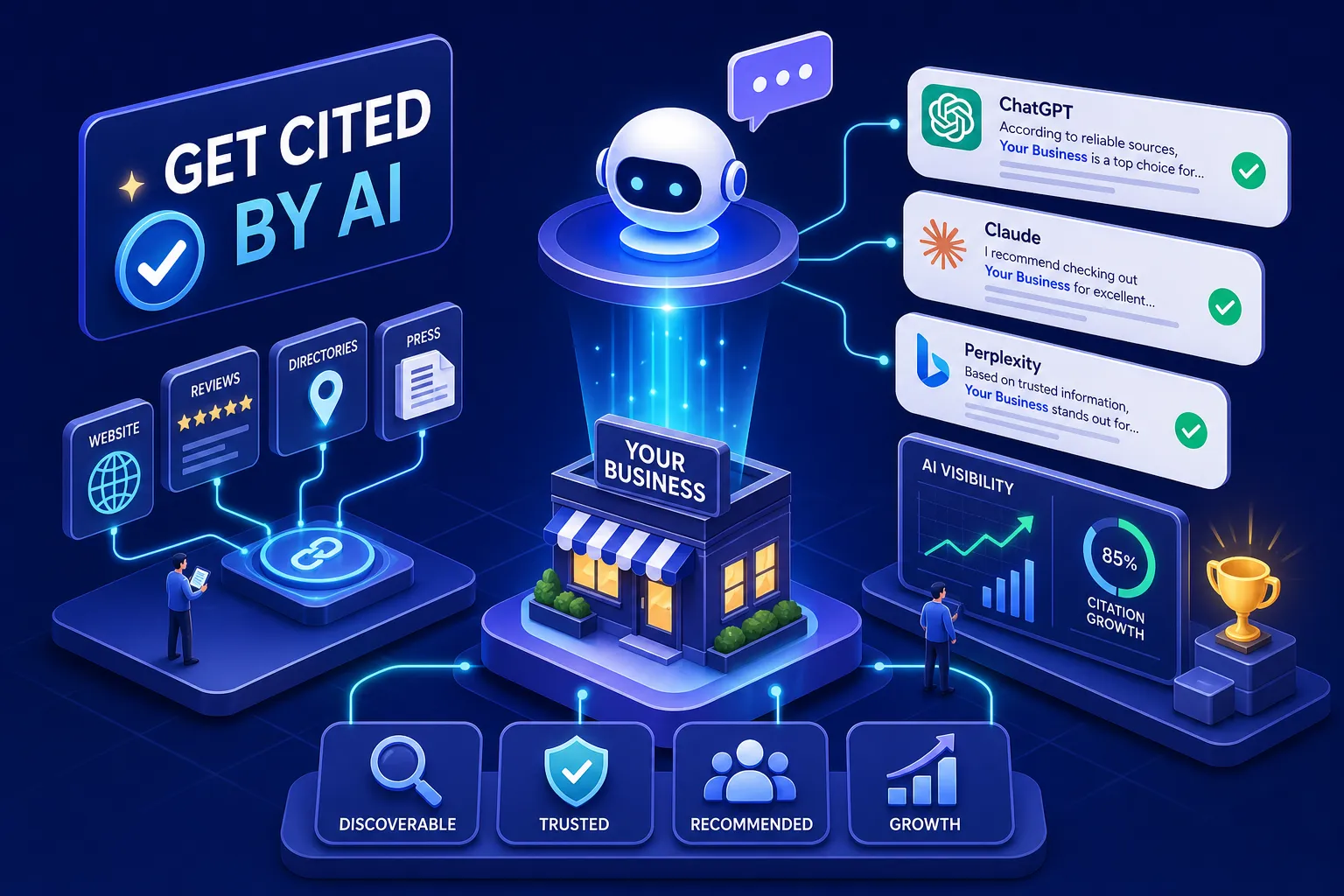
AI chatbots are now answering buying decisions, service queries, and local recommendations in real time. If your business isn’t being cited as a source in those answers, you’re invisible at the most valuable moment in a customer’s research. This isn’t about ranking on page one any more. It’s about being the trusted source an AI system chooses to quote, and if you’ve been asking yourself how do I get my business cited as a source in AI chatbot answers, this guide gives you a concrete, step-by-step answer.
When someone asks Perplexity “which accountant in Manchester handles freelancers?” or asks ChatGPT “what’s the best way to structure a shareholder agreement?”, the chatbot pulls from a set of web sources, generates an answer, and attaches citations. The businesses that appear in those citations are the ones that made it structurally easy for AI systems to find, read, and trust their content. At This Video Works, we’ve worked with businesses at various stages of their digital journey and observed that content structure and schema markup can establish AI source attribution surprisingly quickly, even for newer sites. That approach is what this guide unpacks.
What follows is a concrete action plan: content formats that get cited, the schema types that matter most, how to set up an llms.txt file for AI crawlers, third-party credibility signals you can build quickly, and how to test and track your AI search citation status across the major platforms.
What actually determines whether an AI chatbot cites your business
Most AI chatbots that provide citations use a mechanism called retrieval-augmented generation, or RAG. The system searches an approved or indexed set of web pages, retrieves the most relevant passages, generates an answer from those passages, and attaches the source URLs to the response. Perplexity shows citations by default on every response, based on consistent user and industry testing. Google AI Overviews, Microsoft Copilot, and YouChat all operate on similar principles. ChatGPT with web search enabled also retrieves external sources, though its citation behaviour is less predictable because the model decides how to reference them.
The three factors behind AI source attribution
Before selecting any source, AI systems evaluate three things: relevance (does the content directly answer the query?), authority (does the page carry credibility signals, including author attribution, organisation data, and third-party mentions?), and extractability (is the content structured in a way the AI can parse and quote?). Many UK small business sites struggle with the third point. The content might be relevant and the business might be credible, but if the page is a wall of prose with no structured data and no clear Q&A format, the AI simply can’t extract a clean, citable passage from it.
Schema markup, which is widely adopted in the US, remains significantly underused across UK business websites. One UK-focused audit found that most small business sites either have no schema at all or have partial, incorrectly implemented markup. That gap is an opportunity. Businesses that implement it now gain a meaningful head start before the rest of the market catches up.
The content formats AI chatbots are most likely to quote
Content written in a direct question-and-answer format is structurally aligned with how AI retrieval works. When an AI system receives a query, it searches for passages that match the question. A dedicated FAQ page that asks “How long does it take to register a UK trademark?” and answers it fully in two to three sentences is far more likely to be cited than a paragraph buried in a services page that mentions trademarks in passing. Every service page you publish should open with the question a prospective customer would actually type, then answer it clearly before expanding into detail.
How-to guides and structured long-form articles are among the most frequently cited content types across Perplexity, Google AI Overviews, and ChatGPT. The content must answer a specific query completely, use a clear heading hierarchy so the AI can navigate sections, and be attributed to a named author or verifiable organisation. Generic “About Us” copy doesn’t get cited. Specific, structured, query-matched content does.
How to be cited in AI chatbot answers using video content
Video content is an avenue to AI citation that most businesses overlook. The mechanism is straightforward: a video transcript published on the page, tagged with VideoObject schema, and written to directly answer a specific search query gives AI systems a clean, quotable text source attached to a credible, authoritative format. Whether this consistently outpaces other content types in citation speed is still an evolving picture, but the combination of transcript text and structured markup does give AI crawlers more to work with. At This Video Works, this thinking is central to how we approach every production. Before filming starts, we research the exact queries a target audience is using across Google, AI assistants, and social search. Every piece of video and written content is then built to answer those queries directly, and schema markup is applied as soon as content goes live.
Schema markup: the technical layer most businesses skip
FAQPage schema is the strongest performer for AI citation because it packages your content into question-and-answer pairs that AI retrieval systems can extract directly. If you implement one schema type first, make it FAQPage. QAPage schema is close behind for pages that genuinely function as a community or forum-style Q&A. Organisation schema tells AI systems who you are as an entity, establishing the credibility layer that supports your content. Author and Person markup strengthens authorship signals, particularly when paired with Article or BlogPosting schema. Dataset schema is useful for research-heavy or data-driven pages but is too specialised to prioritise for most business sites.
AI chatbot citation checklist: implementing schema correctly
JSON-LD is the recommended format for implementation. You drop it into the page’s head section or add it via Google Tag Manager; it doesn’t require changes to your visible HTML. For Organisation schema, the key fields are:
- name, your business name as it appears on official listings
- url, your canonical homepage URL
- logo, a direct URL to your logo image
- address, your full postal address
- telephone, in a consistent format across all platforms
- sameAs, links to your social profiles and directory listings
For FAQPage schema, each question needs a Question type with an acceptedAnswer containing the full answer text. Before publishing, validate everything using Google’s Rich Results Test and Schema.org’s validator. Poorly implemented schema can reduce the benefits and may confuse crawlers, so validation is not optional.
llms.txt for AI crawlers
The llms.txt file is an emerging signal worth implementing now given its low cost. It’s a plain Markdown file served at /llms.txt that lists your most important pages for AI crawlers in a structured format. The syntax follows a specific pattern:
- One H1 containing your site or company name
- A blockquote immediately below it summarising what the site covers
- H2 sections containing link lists in the format:
- [Page Name](URL): brief description
Include your homepage, service pages, FAQ pages, key articles, and contact page. Adoption of llms.txt sits at roughly 8 to 10 per cent across business websites in 2026, with developer tools and SaaS companies leading uptake. General business websites are behind, which again means early movers benefit.
Building the third-party credibility AI systems rely on
NAP consistency, meaning your business name, address, and phone number appearing identically across every directory and platform, is a foundational trust signal for AI citation. Inconsistencies create ambiguity that reduces how confidently an AI system will identify and cite your business. Examples include:
- “Ltd” on some listings but absent from others
- “Road” versus “Rd” in your address
- “+44” versus “0” phone number formats
- Old addresses still live on directory profiles
Audit your listings on Google Business Profile, Yell, Bing Places, LinkedIn, Checkatrade, and any sector-specific directories. True contradictions, a different phone number or an old address, carry the biggest credibility impact and should be corrected first.
Third-party mentions act as the off-site credibility layer that supports your on-site content and schema. AI chatbots weight external sources: review platforms, trade directories, industry publications, local news outlets, and professional body listings all tell the AI that your business is legitimate and worth citing. To build that layer, contribute expert commentary to industry publications in your sector, ensure you’re listed on the directories most relevant to your field, and encourage detailed customer reviews on credible platforms. Research indicates that a mention in a relevant trade publication carries considerably more weight than several generic directory listings, though the exact ratio will vary by sector and AI system.
For businesses launching from scratch, the common objection is “I have nothing online yet.” Structured content and schema markup can establish AI citability much faster than traditional SEO link-building. A new business that publishes a set of well-structured service pages with FAQPage schema, Organisation schema, clear author attribution, and consistent NAP data across a handful of core directories is already ahead of established competitors whose sites are technically invisible to AI systems. Treat this as a practical starting heuristic rather than a guaranteed outcome, the businesses achieving AI citations right now aren’t always the biggest ones. They’re the ones whose content is easiest for AI systems to read and trust.
How to test and monitor your AI citation status
Build a library of prompts, a practical starting point is somewhere between 10 and 20, representing the queries your customers would actually ask: service queries, location-based searches, comparison questions, how-to queries in your sector. Run those prompts across Perplexity, ChatGPT with web search enabled, Google AI Overviews, and Copilot. Record which sources are cited, whether your business appears, and what competitor content is being referenced instead. This gives you a baseline to measure against and tells you exactly which queries you need to target with new or improved content.
For ongoing monitoring, dedicated AI citation-tracking platforms run fixed prompt libraries against multiple AI systems on a schedule and report brand mention rates, cited URLs, citation position, and competitor comparisons. The main options worth considering:
- Profound, the most comprehensive multi-engine coverage, tracking over ten AI systems
- Peec AI, URL-level citation analysis with a clear distinction between being mentioned and being cited
- Semrush AI Visibility, citation tracking inside a broader SEO workflow you may already be using
- OtterlyAI, a lighter-weight option for budget-conscious monitoring
- Brand24, real-time mention alerts for notification-style tracking between scheduled audits
For teams with development resource, an API-based approach, running an automated prompt library against model endpoints on a schedule and parsing the citation outputs, offers the most control and flexibility.
If your testing shows you’re not being cited, work through the following checks in order. First, confirm your content actually answers the specific queries you tested in full: most business sites don’t. Second, check that your FAQPage and Organisation schema are correctly implemented and validated. Third, verify your NAP data is consistent across the directories most relevant to your sector. Fourth, identify which third-party sources are currently being cited for the queries you care about, then get your business listed or mentioned there. Treat citation tracking as an ongoing feedback loop. AI indices update regularly, and a quarterly prompt audit is the minimum to stay visible.
Your action sequence from here
The path to AI chatbot citation is a sequence, not a single fix. Produce content in Q&A and how-to formats that directly answers real customer queries. Implement FAQPage and Organisation schema as your first technical priority. Publish an llms.txt file at your site root. Audit and clean up your NAP data across Google Business Profile, industry directories, and social profiles. Earn third-party mentions through reviews, directories, and contributions to industry publications. Then test your citation status across the major AI platforms and monitor it on a schedule.
The timeline is shorter than most people expect. A newly published page with valid FAQPage schema and clear, query-matched content can begin appearing in Perplexity citations within two to four weeks, and in Google AI Overviews within a similar window, provided the page is crawled and indexed promptly. That’s a fast return compared to the months traditional SEO typically requires to show movement.
The question of how do I get my business cited as a source in AI chatbot answers turns out to have a practical, implementable answer, and it’s available to any business willing to approach content with the right technical and editorial discipline from the start. You don’t need a large content team or a long domain history. If you’d like support building that foundation, from pre-production query research through to schema implementation and AI citation monitoring, get in touch with our team at This Video Works. We can show you where your content currently stands and what it would take to start appearing in AI answers for the queries your customers are already asking.