Many business owners know their subject inside out. They’re articulate in meetings, persuasive on the phone, and confident face-to-face. Then someone points a camera at them and everything falls apart. The posture stiffens, the eyes drift, the sentences get faster and shorter, and the person who was so compelling five minutes ago suddenly looks like they’re giving evidence at a tribunal. Remote camera coaching UK specialists see this pattern constantly, and it is entirely fixable.
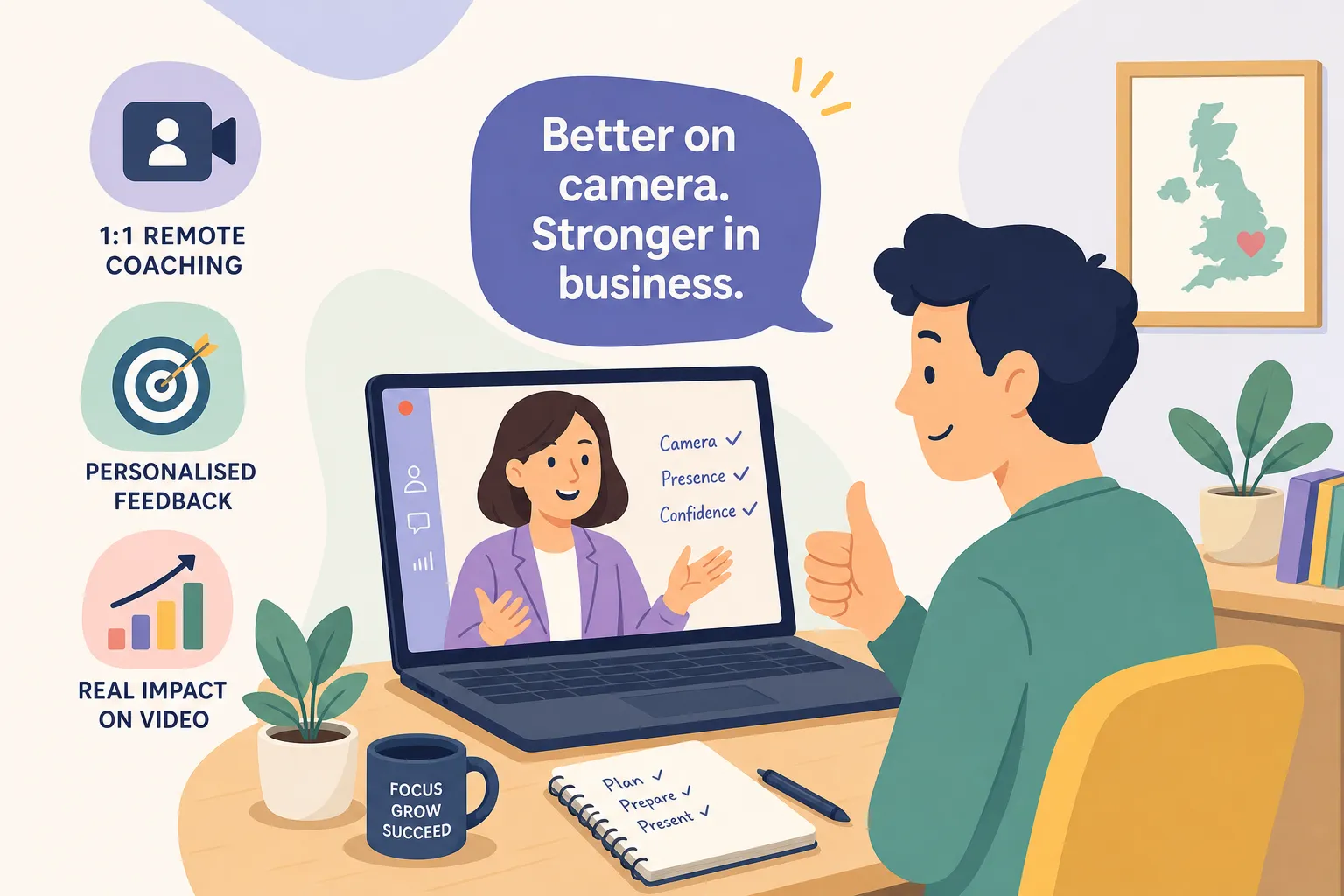
The camera is not a mirror. It amplifies everything, and without external feedback, most people reinforce their bad habits rather than fix them. They practise alone, watch themselves back, cringe, and try again, usually making different mistakes rather than correcting the original ones. One-to-one virtual camera coaching solves this problem directly: a coach watches you live via video call and corrects your posture, pacing, and delivery in real time, without you leaving your office.
At This Video Works, we coach non-media professionals before and during video interviews as part of our production process. We’ve seen first-hand how quickly people improve when someone experienced is watching them in real time and giving targeted feedback as it happens. By the end of this article, you’ll know exactly what to expect from a coaching session, how many you’ll need, what to look for in a provider, and what a session in the UK typically costs.
Why being on camera feels unnatural, even for confident people
This is not a confidence problem. It is a skill gap. Most people have spent their entire working lives practising face-to-face communication, where eye contact is natural, body language is calibrated to a room, and small imperfections disappear in the flow of conversation. The camera changes every variable simultaneously. Your eye line shifts, your gestures look bigger, and pauses that feel completely normal suddenly seem to stretch for an uncomfortable eternity. Telling yourself to “just relax” rarely addresses the underlying technical and behavioural skills involved, structured coaching is what closes the gap.
The difference between knowing your subject and looking credible on screen
Subject-matter expertise and on-screen credibility are completely separate skills, and conflating the two is where most people go wrong. To illustrate: a solicitor with 20 years of experience can look uncertain or untrustworthy on camera not because they lack knowledge, but because their posture is closed, their eyes are drifting, and their pacing is too fast. The camera judges you on how you deliver, not just what you say. This is why people who are genuinely brilliant in person sometimes look unconvincing in a video interview, and why coaching focuses on performance rather than content.
Why practising alone usually makes things worse
Without external feedback, self-practice tends to reinforce bad habits. Most people watch themselves back and focus on how they look rather than what they’re doing with their eyes, hands, and breathing. They over-correct by speaking more slowly, then sound monotone. They stare directly into the lens so hard it looks unnatural. A skilled coach watching in real time catches these patterns within seconds and redirects the performance with one or two specific notes. That is the core value of remote camera coaching UK sessions: the feedback loop is immediate, precise, and tied directly to what the coach is observing as it happens.
Getting your setup right for remote camera coaching UK sessions
A coaching session is only as useful as the quality of what the coach can see and hear. If your webcam is blurry, your microphone is echoing, and your background is a distraction, the coach spends valuable session time troubleshooting tech rather than improving your delivery. Sorting the setup beforehand is not optional; it is the foundation on which everything else depends.
Camera, microphone, and lighting: the practical minimum
You need a webcam capable of 1080p at eye level. 720p is acceptable, but the coach needs to see your expression clearly to give useful feedback on your performance. Replace your built-in laptop microphone with a USB microphone or noise-cancelling headset, the quality difference is significant, and clear audio is non-negotiable for a productive session.
For lighting, position a soft light in front of you and slightly above eye level, and avoid backlighting from a window behind you. Inexpensive ring lights and desk softboxes are widely available and solve most lighting problems without a large outlay. On connection, aim for at least 10 Mbps upload and download as a workable minimum, though 15 Mbps or above is recommended for a reliably smooth session. Use Ethernet where possible rather than relying on Wi-Fi.
Framing, background, and your space
Get the lens at eye level. Not tilted up from a laptop sitting flat on a desk, not mounted so high you’re looking up at it, at eye level. Your head and upper torso should be visible with a small amount of headroom above you. The background should be clean, uncluttered, and neutral enough that the viewer’s focus stays on your face rather than wandering around the room. Run a test recording in the same room and the same software you’ll use for the session before it begins. Coaches assess posture and camera angle together, because slouching looks noticeably worse on screen than it does in person, and a good coach will check all of this within the first few seconds of the call.
What a real-time remote camera coaching UK session actually covers
A good session is not a lecture. It is live practice with immediate feedback, repeated until the correction becomes natural. Most sessions follow a consistent structure: assess, record a short segment, review it together, adjust, and record again. The coach watches your performance as it happens and directs you in real time, exactly as a director would on a film set. The feedback loop is tight and deliberate.
Body language, posture, and how the camera reads your physicality
The coach focuses on seated or standing alignment, shoulder tension, hand placement, facial expression, and where your eyes go. On camera, looking even slightly off-lens can read as evasive or distracted, even when that is not your intention at all. The coach corrects your eye line so you appear to be speaking directly to the viewer. They also watch for closed body language: arms crossed, chin down, hunched shoulders. These physical signals project uncertainty even when your words say the opposite.
In our experience, participants who complete four to five recorded takes within a single session show measurable improvement by the final take, before they have addressed delivery or content at all.
Pacing, delivery, and answering questions without sounding rehearsed
This is where the session shifts from the physical to the verbal. Most non-media professionals speak too fast on camera because adrenaline is running. The coach slows your delivery, introduces deliberate pauses, and helps you structure answers without a script. The goal is not to memorise responses but to organise your thinking so answers flow logically under pressure. Coaches typically use a simple hook-point-close structure: one clear opening sentence, the core point, and a definite finish. At This Video Works, this is the method we use when coaching business owners before a video interview, helping them sound considered rather than rehearsed, and genuine rather than scripted.
How many sessions do you actually need?
The honest answer: one session will produce visible improvement, but it will not stick without practice. The number of sessions you need depends on what you are preparing for and how large the gap is between where you are now and where you need to be.
What one focused session realistically achieves
A single 60 to 90-minute session with recorded takes and live feedback is enough to identify your main problems and demonstrate what improvement looks like. For someone preparing for a specific interview or video shoot in the next week, one session combined with deliberate practice in the days after is often sufficient to perform credibly on the day.
When a short coaching package makes more sense
For lasting improvement in confidence, pacing, eye contact, and handling unexpected questions, three sessions spaced over a few weeks produce reliably better results than one intensive block. By the third session, the corrections from the first have been practised and internalised, and the coach can work on finer details rather than fundamentals. Six sessions produces the most durable change, particularly for people who speak on camera regularly or who find the format genuinely stressful. Beyond six sessions, coaching becomes useful for high-stakes presenting or deeply ingrained habits that require longer to shift.
What to practise between sessions
Keep practice recordings short: two to three minutes maximum. Watch them back immediately and focus on no more than two or three specific corrections from your previous session. Do not over-review, record the take again. The goal between sessions is to build muscle memory for the corrections, not to perfect every nuance of your performance. Many providers supply a short setup checklist and a practice brief after each session to guide this kind of focused repetition, so you’re not guessing at what to work on. At This Video Works, this is part of our standard coaching process.
Choosing a remote camera coaching UK provider
The UK market for one-to-one online presentation coaching, sometimes called remote media training or webcam presentation coaching, ranges from general communication coaches who include camera technique as part of their offering, to specialist video and media training providers who focus exclusively on how you perform on screen. Many business owners preparing for video interviews find that a specialist provider is better suited to interview preparation than a broader communications trainer, because the skills involved are quite different from those required for keynote speaking or sales team training.
Session formats, inclusions, and what to ask before booking
Before committing to a provider, ask whether sessions include live recorded takes with immediate playback, whether the coach has experience with non-media professionals, and whether you receive written notes or a practice plan after each session. The difference between a provider who talks you through theory and one who records and reviews your performance in real time is significant. Also check whether the session covers technical setup, specifically lighting, framing, and audio, or whether that is assumed knowledge. For most business owners, the technical and performance elements need to be addressed together, not separately.
Typical UK pricing for remote camera coaching
Pricing for one-to-one virtual on-camera training in the UK varies considerably depending on the provider’s specialism and what is included. As a practical guide:
- A single 60-minute remote session typically costs between £80 and £250
- Short packages of three to ten sessions range from approximately £240 to £700
- Executive-level or highly specialised coaching runs from £150 to £500 per hour, with monthly retainers from around £800 to £2,400
When comparing providers, look beyond the headline hourly rate. Check whether recorded-session review, written feedback, and between-session support are included. These inclusions can significantly affect the value you receive, even when the hourly price looks similar on paper. A cheaper session that covers only theory is worth considerably less than a slightly more expensive one that includes recorded takes, immediate review, and a follow-up practice brief.
How This Video Works coaches non-media professionals
This Video Works takes a different approach to most media trainers. Rather than teaching presentation technique in the abstract, the coaching is built around the actual business video interview process: preparing the participant for the specific questions they will face, guiding their delivery in real time during the recording, and drawing out authentic responses that a scripted approach would flatten. Our prompting-led filming style reduces the need for a teleprompter in most interview situations. Instead, you’re coached to think on your feet in a structured way, so what ends up on screen is genuine rather than performed.
The gap is smaller than you think
Remote camera coaching is not about becoming a different person on screen. It is about closing the gap between how you come across in person and how you appear on video. That gap exists because the camera is a completely different medium, and it rewards a completely different set of habits. Those habits are learnable, and they are learnable quickly when someone experienced is watching you in real time and giving you precise, real-time correction.
If you have a business video coming up, a regular requirement to appear on screen, or simply want to stop dreading the record button, a single one-to-one coaching session is the most efficient way to start. This Video Works offers remote camera coaching UK businesses can rely on, designed specifically for business owners and professionals who want to look and sound like themselves on video, not like someone performing for a camera. Contact us to book a session. The difference shows.